Wednesday, May 30, 2007

I was reading Harper's Magazine (June 2007) in the airport on my way back from Pittsburgh. As I write, it is only available online to their subscribers and our subscription at Rollins only makes the May 2007 issue available. If you have read the magazine then I am sure you know about Harper's Index, a mind bending list of weird stats, ratios, and numbers about life that generally amaze and appal. (e.g. "Number of the sixteen states of the South where more than 25 percent of adults are clinically obese: 12. Number of all other states where this is true: 5." Yikes!)

The ones that caught my librarian's eye this month were the following:

  • Minimum number of different books sold in the U.S. last year, as tracked by Nielsen BookScan: 1,446,000
  • Number of these that sold fewer than 99 copies: 1,123,000
  • Number that sold more than 100,000: 483.

I am not sure you can define 99, as published,as in "make generally known" and over 100,000 is a definite bestseller; that leaves 322,517 in the middle. Olin library buys about 1.25% of those. It is a tough task the librarians and faculty have to do: which one book out of eighty belongs in the collection now and for decades to come?

More importantly, about 1,000,000 books get written, but hardly read. Yet another factoid that lead me to the conclusion that we are writing more books, but reading fewer, which is another way of saying we are more interested in talking than listening. (Kinda like the bloggers amongst us.) A liberal education should attempt to rectify this situation.

Tuesday, May 15, 2007

Academic Library Success

This is a really interesting post from Steven Bell on ACRLog. So interesting that I intend sending it to everyone in our library to help inform our strategic planning process.

Steven's formula is "Greater Awareness + Usable Websites + Flawless Authentication = Better Results."

Here at Olin, we have made great strides with authentication, and some progress in terms of greater awareness, but need to do better on both of those and we still have a long way to go with a usable website.

Thursday, May 10, 2007

What is Mapstats?

If you look at the bottom on the right hand column you will see a link to Mapstats. This is a free way of keeping stats on the (depressingly low) readership of this, or any, blog. The cool think about this (apart from it being free) is that it also maps the usage so I can see where usage is coming from and which specific post is being read. As a visual person anyway, I am increasingly interested in the various spatial ways we can display data, interactively and in real time.

You can see my readers are all in the US, not even my mother reads it!

Tuesday, May 08, 2007

NITLE Liaisons' Summit

I am just finishing the NITLE (National Institute of Technology in Liberal Education, pronounced "nightly") Summit. My first since becoming NITLE Liaison at Rollins. Rollins is the first NITLE school I have worked at so this is also my introduction to this group of liberal arts colleges. NITLE is a child of the Mellon Foundation and is run out of Ithaka. You can learn more than you ever wanted to know at those three websites.

I have a few take homes from this summit:

  1. We still need to be involved in NITLE as it transitions from "2.o" (a fixed fee with effectively unlimited opportunities for participation) to "3.0" (a low membership fee and a pay as you go model of participation.)
  2. We need to make greater use of NITLE professional development opportunities particularly in relationship to curricula renewal/reform at Rollins and our in involvement in general needs to be more more planned and strategic. As liaison I need to plan who I will invite to participate and try and pair interested faculty members with IT staff and librarians so that participation is more productive when participants get back to campus.
  3. We have a lot more to do at the interface between IT and the Library in supporting the use of technology in teaching and learning if we are to match the activities at our peer and aspirational institutions.

Information Literacy

In a recent post on the AHA Blog Peter Townsend reviews Google Book Search and finds it wanting. His entry has been discussed elsewhere so I will not enter the fray. But I do want to say that his original post and the associated comments are a perfect example of an information literate discussion. Of course, this is to be expected from the Assistant Director of the American Historical Association and readers of the AHA Blog.

Townsend's original post was not perfect, he misunderstood a particular aspect of US copyright law concerning US govt. publications and the public domain and did not know all there was to know about serial cataloging rules (I can only sympathize with him!) But both of those issues were quickly dealt with in the comments and did not affect his basic argument.

I want students to graduate from Rollins with the kind of information literacy competencies exhibited by everyone involved in this discussion -- the ability to be able evaluate information resources and compare and relate them to similar resources, to be able to understand information in context, to appreciate the long term implications of aspects and context of information resources, and to be able to discuss these in a civilized manner. They are going to need them if they are to thrive in the information, and misinformation, rich world that we live in and become more than just consumers of ill digested corporate pap.

Saturday, May 05, 2007

An age of irrationality

I rarely read the Financial Times, but one of the peculiar things about living in Winter Park is that one finds papers like the FT abandoned on tables in my favorite coffee shop -- Palmano's. This says something I am not prepared to explore here about the particular mixture of acquisitive luxury that seems to be a feature of life in Winter Park.

Still I had left the Times at home, so I read the FT while enjoying my delicious cappuccino. This quote from an interview with Francois-Henri Pinault (owner of YSL, Gucci, et al.) caught my eye. "We are entering what I think is an age of irrationality." OK, I thought, this is going to be about fundamentalists, creationism, Al Qaeda, a retreat from science and the Enlightenment, or perhaps a comment upon a Presidential Debate in which someone can ask whether or not the candidates "believe" in evolution and be taken seriously! I expected Pinault to be against irrationality.

But I was wrong. Pinault continued, "and a return to luxury. We are at the beginning of a social trend, change in values that could go on for years -- the age of rationalisation, after all, lasted for more than a century. The question we all have to resolve is how big can these brands grow?"

So the previous century was the age of rationalization and is now over. We can now all return to the Gilded Age, or perhaps the Ancien Regime. How awful.

As someone who works in higher education, and libraries in particular, I am a big fan of reason.

Friday, April 27, 2007

OK, so what next?

So, the furniture is popular. It is getting used and changing the way the space outside the library is used. Jane Wright told us it would slow people down and make the space more social. She was right. The new hours and offerings of the Bookmark Cafe have had the same effect inside. Our experiment with 24 hour access during exams and the lead up to exams is also changing how students think about the library. This is all good, but it is not enough.

These are all good things and they change students' perception of Olin Library -- they are ready to give us another look. But now we have to make some more fundamental changes to the library and, of course, when I say library I don't just mean the building that houses the personnel, the print based collection, and lots of study space. I mean the library as a physical space, an online presence, a collection of information resources, services, and relationships -- both online and the physical world. OK. So what might those changes be?


  • Integrating the library's educational role more effectively into the curriculum so that we work in partnership with the faculty to help students become more information literate by the time they graduate, and doing that online (synchronously and asynchronously) and in the physical world.
  • Continuing the hard work of making sure our customer services are consistently excellent and that our personnel are not undermined by poor planning, space, or procedures.
  • Linking all our digital resources so a document in one database is accessible from any other.
  • Linking our digital resources and services out from the library to digital places where the users are: Blackboard, the College website, Google, Facebook, their cell phone, campus plasma screens, etc.
  • Building alliances with other academic support organizations (IT, the Writing Center, TJ's, etc.) so that the truly integrated nature of research, writing, and dissemination is supported by our services, not hindered by them, and making sure such alliances are happening both online and in the physical world.
  • Creating extra-curricula reasons for students and faculty to spend time in the library, or online at the library: poetry slams, reading groups, exhibits, workshops, seminars, events of all kinds. At the same time, when it is useful, integrating the library's resources into other events happening around campus.

All of these are more difficult to do, are more expensive to implement, and in some cases mean a change in our mindsets. It is like a row boat. With the furniture, cafe, and hours we kicked off from the shore. Now we have to set the oars in place and bend our backs to rowing. It is hard work, but you get further.


Thursday, April 19, 2007

The new furniture has arrived


At least the outside rocking chairs and cafe style tables and chairs are here and were set out today. This picture really doesn't do them justice. They are an elegant green and the space is much sunnier. The inside furniture will be installed before the start of Fall term.


It all looks great and is getting used already. At least three students have complimented us on the furniture. One told me it was great to have when she brought her dog to campus, another said he had thought about this idea years ago, but never told anyone. I told him to let me know of any other great ideas he has. That goes for everyone, don't keep them to yourself.


We have put no smoking signs on the tables to try and set that as an expectation for the space. We shall see if it works. When I took this photo, it was.

The Cult of Barbara


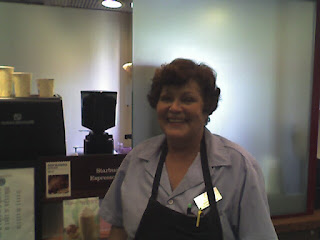
Some time ago I wrote about the Bookmark Cafe, amongst other things. We have been trying out some changes over the last semester with food offerings, extended hours, and new personnel. According to Dining Services these have so far been very successful. A big part of that success is due to Barbara a tireless source of energy, ideas, and good cheer who just makes the students want to come back, spend some time in the cafe, and buy another coffee. As Jim Collins says -- its all about the people. As Gerard Short of Dining Services said, "Barbara seems to have a cult following."

Monday, April 09, 2007

Library of Congress


The Madison Building has this magnificent relief of tumbling (or are they flying?) books above the main doors. I am happy to say that I managed to get all the way through all 64 boxes of unprocessed materials in the ARL collection. Now I just have to digest everything I learnt.

Tuesday, April 03, 2007

Research in the Library of Congress

I am lucky enough to have another week in the Manuscript Reading room of the Library of Congress buried in the ARL archive once again. I am still working my way through the 64 boxes of unprocessed materials, but it is going reasonably quickly this time, since most boxes don’t have anything about copyright in them or cover the period after the passage of the 1976 Act. It is only Tuesday and I have already passed the half way mark on the final collection: box 32 of 64. The thing about working in an unprocessed collection is that you have to open every box because no one has done so before.

Things are getting a bit clearer now. I am contemplating organizing my findings around a series of key documents in the revision process. Perhaps the following:

  • The early study of photocopying practice and the report of the Joint Committee in 1961
  • The Joint Committee’s acceptance of Fisher’s strategy.
  • Rutherford Roger’s testimony before the House Subcommittee in 1965.
  • The joint ALA/ARL proposed amendment to S597 in 1969
  • Joint ALA/ARL proposed amendment to §108 (d) in S1361 and Philip Brown and Stephen McCarthy’s testimony on 7/31/73.
  • The ARL response to §108 (g) (2) in 1974.

At each case I will show how the association developed these documents and the positions they represented and what actions flowed from these positions.

You come across the most wonderful things while doing archival research. It is fun to see that Robert Bork, as Solicitor General, was involved with the government’s case in Williams & Wilkins, to see letters form Fred Kilgour (founder of OCLC) agreeing to talk to the ARL librarians about library networks in the early 1970’s, and to see letters signed by Robert Maxwell. On a more post-modern self referential level, I have come across files concerning the funding for the building in which I am now doing my research, the letter in which L. Quincy Mumford invited the ARL to deposit its papers at the Library of Congress, and the minutes of the ARL Board’s decision not to publish Frank McGowan’s dissertation on the history of the ARL from 1932 to 1962, a dissertation that I read before coming here.

Sunday, April 01, 2007

Rollins Colloquy

I live in the vain hope that someone may be paying enough attention to this blog to notice the large gap between my March 7th and March 31st posts. My aim is to post two or three times a week (ha!) So what happened?

Well a number of things. Spring break was crazy busy with the librarians' workshop on March 12th when we worked on the Olin Library's strategic directions, then the 13th was spent at St. Leo University with Brent Short , Director of the Library, who I am working with as part of the ACRL College Library Directors Mentor Program, and then I also participated in an online SOLINET workshop on Web 2.0: Social Software Applications for Libraries. More on that later.

Then a couple of weeks after Spring break, Les Lloyd, George Herbst and I went to Tacoma, WA for a NITLE workshop on Learning Spaces and Technology. More on that later as well.

But what really had my attention was the Rollins College Colloquy. I was asked to facilitate a panel with Duane Ackerman, Sally Ride and Anna Deavere Smith and the follow up Q&A. You can imagine this was a little nerve wracking. But it seemed to go off quite well because these three people are consummate professionals with some fascinating experiences and plenty of well articulated thoughts about the future of liberal education in the 21st century. Some of the things that came from them and from other panelists and speakers that most struck me include:

  • American parochialism in terms of language, geography, and cultural literacy is unacceptable.
  • In an age of fluid cultural production and ubiquitous access to (mis)information, some body of shared knowledge, a core curriculum, is necessary.
  • The ability of people to critically engage with information, data, and the media, to find, evaluate, and use information in their own work is only going to become more important in an age of disintermediation, and information overload, and technology is not going to solve this problem. Our students need to learn the skills of critical thinking and information literacy.
  • At least two speakers mentioned the importance of memorization. Particularly in an age that actively works to enable us to stop using our memories.
  • Predictably, C.P. Snow's Two Cultures got a good workout.
  • Many of the faculty were very concerned with how to create the conditions in which our students can take risks and learn from failure.

ACRL 3 Usability testing

Perhaps the most interesting session was on usability testing with Nora Dimmock from the University of Rochester. They have a usability program that works with programmers and designers on digital projects. The usability group deals with 5-6 projects each year; new homegrown digital products, evaluating and suggesting changes to vendor products, and revising existing systems. The workshop went through a number of usability techniques including card sorting in which you give 21 users cards with one element from your website in each card (for instance a library website might have journals, books, articles, hours, staff, news, events, ask-a-librarian, departments, and policies) and ask the user to group them in a way that makes sense to them. Also the reverse, when you put flip charts on the wall with headings and ask users to put postit notes with when they would expect to find under each heading on your website for instance. Both these tests reveal the users’ mental model of the service. Heuristics, when you ask expert users, like librarians, to critique a digital product based on specific criteria. This latter one has the added advantage of enabling librarians to have input into web design etc. something that is politically useful since librarians have very strong, but usually conflicting, ideas about website design and like to be consulted. Finally, she took us through assessment, when you have a user complete 5-6 tasks on a website (e.g. "Find a book on fish farming.”) and see where they click and how long it takes them. This can be combined with the Talking Out Loud Protocol in which the subject articulates their thinking while they are working on the task.

Rochester used to then write copious reports on the results of the tests. Now they just record them using Morae and send the file to the designers and programmers.

Oh, one final point. They often save expensive programming and designer time by creating paper mock-ups of the website and having users work through those. This means that big problems can be fixed before it ever gets to the programming stage.

OK, I lied: one more point. In a few years Rochester may not even have a stand alone website. They are considering moving to widgets to be inserted in appropriate places, often at the users discretion, through the users’ personal “infosphere.”

Saturday, March 31, 2007

ACRL 2 -- librarians and technology

A recent theme in librarianship (recent as in 3 maybe 4 years) is this idea that everything is now different. A combination of digital technology and the so called Net Generation has changed our tradition role. At this point one is usually subjected to a hectoring tirade about how we have to keep up or die. It gets a bit exhausting after a while.

I was subjected to it today at a session called "Keeping Libraries in the Flow: Being Relevant in the World of Amazoogle." The trouble with this is that, like every other generation, this on is not monolithic. Rather than being all digital all the time I find that they are very selective about what technology they use and when. The other problem is the idea that librarians are not adapting to change and seeking new ways of doing things. Obviously this is not true. There are certainly Luddites and curmudgeons in the field but there are also quite forward thinking people and most -- of course -- are like the Net Generation: selective about what technology they use and when.

There were some interesting things that also seemed to be consensus positions:

  • The current model of the "just in case" reference desk is doomed.
  • As is the locally maintained catalog
  • Librarians must integrate themselves and their services and resources into the educational process.
  • Planning needs to speed up and improve.
It will be interesting to see if these come to pass.

ACRL

I am at the ACRL Conference. Strange to say this is the first time I have attended so I thought I would record some things. I am going to do this in bits, so expect more of these.

First, at 3000 people it is 10 times smaller than ALA and all academic librarians so I have met lots of friends, far more than I would meet at ALA. I like that.

Sessions, as usual, are a mixed bag but there have been some useful things.

Luz Mangurian, had some helpful things to say from a brain biology perspective about improving learning: emotions matter, show your students you care, sleep is important to memory retention, group learning, interactivity, discussion, and getting them to do the work all really work. We know this, I just wish we practiced it more! The other thing she said that I think is very important is "exclude the irrelevant." I always tell librarian teachers to show a model of success (in using a database etc.) before you get into the possible problems etc. Since she emphasizes the importance of emotion in learning it is no surprise that she describes online education as "the McDonalds of education."

Wednesday, March 07, 2007

Off-campus access


We just made the jump from OneLog to EZproxy to provide off-campus access to our restricted databases for the Rollins community. Back in the fall Steve Kahana, a student and Mac user who was unhappy with OneLog's PC-only solution, promised to donate two books to the Library if we found a way for him to access the databases etc. form off-campus. Here he is making good on his promise.
Incidentally this was a good early experience for us of people from the Library and IT working in a cross-departmental team. It also feels like the first substantial change in library operations that I have been able to help happen since I arrived.
Other comments include, "This is excellent, thanks!" "A big thank you to you from all of us Mac users!!! Thanks so much!!" and "As far as I can tell, this is GREAT, because now I can actually GET ON THESE VARIOUS D-BASES from off campus, which I could not do before!"

Thursday, March 01, 2007

Power in the 21st Century Library


No, this is not some arcane discussion of Foucault, knowledge, and information services in the post-modern world. I really mean power. Regular readers (in the vain hope that there might be such people) will remember that I wrote some time ago about transforming the experience of entering the library. I am delighted to say that many of these ideas have been taken up by the administration. Facilities installed power outlets on the loggia in anticipation of the imminent arrival of furniture. The idea is that if you put rocking chairs and power in such a delightful location then students will begin to linger there, meet their friends, and use the wireless network. Well it seems two at least can't wait until the furniture arrives, simply adding power is enough.


Thus the issue of power. We used to think that what we needed to do when building a new library was put as many network jacks in as many places as we possibly could. We were wrong. Wireless has become ubiquitous, but battery power is still a precious resource. Have you noticed the cluster of salespeople around power outlets in airport waiting rooms, like zebra mussels around an warm water outlet? Well students exhibit the same behavior in libraries and other academic buildings. So my mantra (at least until someone develops a reasonable wireless power solution) is put power everywhere.

Tuesday, February 27, 2007

Rollins on YouTube

Like every other college, Rollins is on YouTube and our students show the College in a good (or this) and a bad light. This is just zany. Who knew compact shelving could provide so much pleasure? I am heartened to see that the various safety features on this shelving worked perfectly.

Sunday, February 25, 2007

We have a New Mission Statement!

Exceptional services, information resources, and a welcoming environment for the Rollins community.

It passes my tests. It is short, it sets a high standard that we must work hard to reach, and I can easily communicate it to people with just the fingers of one hand -- services, resources, environment, and Rollins. I am publishing in in this rather informal place because it still needs to go through a few more trials by fire. I spent some time Friday showing it to various people in the library to gauge their reaction (perhaps the best summary of their reaction would be "cautiously optimistic") and it needs to be presented to the Library Advisory Committee (probably at our April meeting.) We will see how it fairs over the next few weeks.

The staff are now invited to write vision statements based on this mission statement. The idea is that such statements will enable them to fill in some of the gaps in the mission. Because it is short, it doesn't explicitly state whether an environment is physical or online, how the Rollins community is defined, what might constitute exceptional services, what kind of information resources, or whether we own or access them.

In my own opinion our environment is both a physical place and online, the community is the students, faculty, and staff of the College, exceptional services are customer services like circulation and ILL, educational services like group and individualized information literacy teaching and learning, and library services, like collection, description, organization, and preservation, that make a user want to recommend us to their colleagues, and to come back, and we will own some, access others, and provide a portal to still other information resources -- in all formats -- that our users need to fulfil the College's mission to educate responsible leaders and global citizens.

Wednesday, February 21, 2007

What I like about the new British Library website

Take a look

  1. I like the clean white page with a single striking (and changing) graphic in the background that is clearly linked to what the library collects.
  2. I like that a federated search box is front and center.
  3. But that search function lets you know exactly what collections you are searching and provides easy access to advanced searching.
  4. I like the uncluttered news feature.
  5. I like that all the business links ("about us" "collections" "services" etc.) are right on the front page, but not the first thing you see
  6. Finally, those cute graphic boxes along the bottom for featured "stuff" are cool. I particularly like the support us box.

What do you think?