The Library of Congress's Copyright Office has released its latest round of DMCA exemptions and there is a big one in there for faculty who use DVD's in teaching.
First some background. This rulemaking process undertaken by the Library of Congress and the Copyright Office is designed to, "determine whether the prohibition on circumvention of technological measures that control access to copyrighted works [in the DMCA] is causing or is likely to cause adverse effects on the ability of users of any particular classes of copyrighted works to make noninfringing uses of those works." If so, then the Library of Congress can exempt that class of works from the Act's prohibition on circumvention.
Here are a couple of pieces that go into more detail, one from Inside Higher Ed and one from a Chronicle Blog (which is really good by the way, and will be followed put by a how-to guide to actually ripping DVD's.)
Bottomline: it always was legal to use clips of movies in the classroom to help teach particular concepts or content, but the DMCA stopped teachers getting clips of movies off DVD's. Now this exemption to the anti-circumvention provision of the DMCA means that that barrier to getting these clips has been removed.
IT departments and libraries will have to understand how to rip clips from DVD's so they can help faculty who want to make use of this exemption.
Wednesday, July 28, 2010


Sunday, July 18, 2010
Kindle Android App Review
I downloaded the droid Kindle app to my Verizon LG Ally so that I could read books (Jane Smiley's latest novel, Private Life, and OffBeat Guides' Sao Paulo Travel Guide) while on vacation in Brazil and to test the program since we at Olin are beginning to invest more in e-books and in mobile computing. Here are my initial thoughts.
The app is great in terms of portability. Instead of carrying a number of paper books with me I can fit a bunch of titles (I certainly haven't found the limit yet) on my phone. I downloaded the books quickly and very easily before leaving the states (why I can't -- or won't -- do this in Brazil is a different story and concerns Verizon's own brand of money grubbing idiocy not the droid Kindle app, but more on that in a later post.)
Readability is good as well. The screen is backlit so reading on the plane and in bed has been fine, even outside in cloudy Sao Paulo. The text size can be adjusted, and the font (a comfortable serif style, which cannot be changed) is comparable to a printed book as well. The pages turn instantaneously with a convenient tap on the appropriate side of the screen. About 70 words fit on the screen (though this depends on the text size one selects) which is fine, although it means one turns a page far more often than would be the case in even a mass market paperback. This contributes to a somewhat disjointed reading experience (exacerbated by Jane Smiley's character strewn narrative.) The app automatically takes you to the last page viewed when you open the book again, which a great. So for vacation novels the app works well. I will certainly use it again.
The experience of using a travel guide is less happy. Here search and navigation through the text is very important and the app falls down badly. The table of contents consists of clickable links which is good, but there is no index and the text is not searchable a major drawback for this kind of reference. There is a reference in the app to search coming soon, so maybe this will change. There is also no ability to see any context (smaller images of the pages before or after your text, or some information about the chapter of the book for instance.) The only information you can see is a vague indication of how far, in percentages, you are into the title. One possible solution to this would be to set ones own bookmarks and the app does allow you to do this. However, you cannot edit these bookmarks and they are identified with an incomprehensible position location and some text from the page, not even the closest subtitle. Not very helpful. Finally, the app taunts the user with a function called, but no ability to actually write a note! Also you cannot change the size of images, so the map of the excellent Sao Paulo Metro system is utterly useless.
All of this means that that app does not meet the needs of researchers (even very relaxed vacationers) and certainly not of scholars or students, but works well for pleasure reading, which is in line with the results of a recent survey from the Chronicle.
The app is great in terms of portability. Instead of carrying a number of paper books with me I can fit a bunch of titles (I certainly haven't found the limit yet) on my phone. I downloaded the books quickly and very easily before leaving the states (why I can't -- or won't -- do this in Brazil is a different story and concerns Verizon's own brand of money grubbing idiocy not the droid Kindle app, but more on that in a later post.)
Readability is good as well. The screen is backlit so reading on the plane and in bed has been fine, even outside in cloudy Sao Paulo. The text size can be adjusted, and the font (a comfortable serif style, which cannot be changed) is comparable to a printed book as well. The pages turn instantaneously with a convenient tap on the appropriate side of the screen. About 70 words fit on the screen (though this depends on the text size one selects) which is fine, although it means one turns a page far more often than would be the case in even a mass market paperback. This contributes to a somewhat disjointed reading experience (exacerbated by Jane Smiley's character strewn narrative.) The app automatically takes you to the last page viewed when you open the book again, which a great. So for vacation novels the app works well. I will certainly use it again.
The experience of using a travel guide is less happy. Here search and navigation through the text is very important and the app falls down badly. The table of contents consists of clickable links which is good, but there is no index and the text is not searchable a major drawback for this kind of reference. There is a reference in the app to search coming soon, so maybe this will change. There is also no ability to see any context (smaller images of the pages before or after your text, or some information about the chapter of the book for instance.) The only information you can see is a vague indication of how far, in percentages, you are into the title. One possible solution to this would be to set ones own bookmarks and the app does allow you to do this. However, you cannot edit these bookmarks and they are identified with an incomprehensible position location and some text from the page, not even the closest subtitle. Not very helpful. Finally, the app taunts the user with a function called
All of this means that that app does not meet the needs of researchers (even very relaxed vacationers) and certainly not of scholars or students, but works well for pleasure reading, which is in line with the results of a recent survey from the Chronicle.
Wednesday, July 14, 2010
Wikis in Higher Education
There was an interesting piece by Steve Kolowich in Inside Higher Ed today on wikis in higher ed. he concludes that unless wikis find a satisfactory way to attribute specific content to individual contributors they will not satisfy academic researchers, but they that have been more successful in teaching and administration.
I am not sure I agree that they have been more successful in teaching or administration. I have used them in the classroom (as a glorified annotated bibliography in a one credit information course) and in administration (as regular readers of this blog know the Olin Library's strategic plan is a wiki.) The major problem I have found it the lack of enthusiastic adoption by the group one wants to participate in building the wiki. I think this is because the barriers to entry -- logging in, and the WYSIWYG editing features -- are just a bit too high for casual users to manage, even those who have no problem with other web based technologies. That combined with a the lack of attractiveness of much of the content (I am shocked, shocked, to find that our library staff are not as excited about strategic planning as I am!) leads to a lack of uptake.
I am not sure I agree that they have been more successful in teaching or administration. I have used them in the classroom (as a glorified annotated bibliography in a one credit information course) and in administration (as regular readers of this blog know the Olin Library's strategic plan is a wiki.) The major problem I have found it the lack of enthusiastic adoption by the group one wants to participate in building the wiki. I think this is because the barriers to entry -- logging in, and the WYSIWYG editing features -- are just a bit too high for casual users to manage, even those who have no problem with other web based technologies. That combined with a the lack of attractiveness of much of the content (I am shocked, shocked, to find that our library staff are not as excited about strategic planning as I am!) leads to a lack of uptake.
Friday, July 09, 2010
Painting the Exterior of the Library
This summer we are having the exterior of the library painted. You can follow progress on the Olin Library's Facebook page. But I couldn't resist this photo of the sky blue ceiling of the atrium at our entrance. This is something of an American tradition. Don't worry, the rest of the exterior will be a variation on the Rollins' Mediterranean stucco style.

Friday, July 02, 2010
ALA Advocacy Day 2010

Tuesday was Library Advocacy Day, a sweaty but a fun, and I hope productive, time was had by all. Of particular concern to me was to assess the interest amongst Florida legislators on the Federal Research Public Access Act (H.R. 5037 and S. 1373) and to make sure they understood how important this bill is to college librarians and the people they serve.
There is a lot of cynicism around U.S. government but I always get a great feeling when I am on Capitol Hill. Groups of ordinary citizens are purposefully walking from office to office earnestly lobby for their particular issues. On the day we were there the flags were at half mast for Senator Byrd, and the Kagan hearings were in full swing. It just gives me that warm and fuzzy, democracy in action feeling.
Saturday, June 26, 2010
Creating Change in Scholarly Communication
I was a panelist at the SPARC-ACRL Forum on Saturday (and at the discussion group on Sunday.) Here are my notes.
Change from the ground up – Campus-based policies to ensure Open Access to institutional research outputs through proactive copyright management, with Jonathan Miller, Library Director at Rollins College.
First I must acknowledge the work of Cynthia Snyder, Bill Svitavsky, David Noe, all librarians at Rollins. They are doing the real work of building the repository.
Rollins is a good selective liberal arts college in central Florida. With 3200 FTE students and 203 faculty. We emphasize teaching excellence. Our mission is to educate students for global citizenship, and responsible leadership. Most of our faculty members are active researchers, creators, and writers, but their main job is to teach.
We have an endowment that is better than most, but not as big as we want it to be. We have survived the latest recession better than most, but the library has had a flat G&S budget for three years.
So, in the context of US higher education, a perfectly normal school.
So how have I, the director of a small college library, found myself in the august company of colleagues from Duke, and UC San Diego?
Since the Rollins Arts & Sciences faculty passed their Open Access Policy a number of my librarian colleagues from around the country have expressed surprise that Rollins should be one of the first liberal arts colleges to pass such a policy. In fact I think we were third, after Trinity University in San Antonio and Oberlin.
Well, I would argue that Open Access is not just for the big guys. It is not just the concern of research universities. In fact I think it might be more relevant for small colleges than for larger schools.
Rollins, as a small, largely undergraduate, teaching intensive, school with a liberal arts curriculum that, at least in one sense, means we need broad not deep access to information. We are net information consumers rather than net producers and our students and faculty make a little use of a lot of resources, rather than a lot of use of a few resources, or a lot of use of a lot of resources. The subscription model of collecting a relatively small number of periodical titles “just in case” students need articles in those titles, doesn’t make much business sense for us. What we really need is “just in time” access to a broad array of information resources, none of which will be used particularly heavily.
Our Open Access policy was simply one part of a larger strategy to change focus of the faculty and students of Rollins College from a local library collection to a larger world of information. There are four parts to this strategy that I will mention today:
1. Working politically to create the scholarly communication system we prefer and that meets the needs of the students and faculty at liberal arts colleges.
2. Building collaboration and cooperation with – amongst others -- the state universities of Florida.
3. Moving aggressively from print to digital periodicals.
4. Contributing to open access initiatives and exploiting open access resources.
First, working politically – I am the outgoing chair of the ACRL Government Relations Committee which plays a leading role in the advocacy efforts of ACRL . For the last few years, pre-dating my involvement, much of that advocacy has focused on open access and on finding a productive balance in terms of copyright law. I also serve on the SPARC Steering Committee. My research and writing also concerns copyright policy. On campus I have looked for opportunities to present that research to my colleagues and build a reputation as someone with whom they can discuss copyright issues.
At the state level I have worked with others to get libraries in the three Florida higher education silos – state universities, state colleges and community colleges, and the private schools to think about cooperation and collaboration. That has led to some interesting strategic planning, some cooperative licensing, and to Rollins and Miami participating in the Florida group involved in the Open Library Environment Project, putting significant money into the project.
I also led an effort amongst liberal arts college library directors nationally to protest the Nature Publishing Group’s recent exorbitant increase in the online subscription price for Scientific American. We also cancelled our subscription. This was not universally popular on campus, but it was an opportunity to explain why we thought we had to hold the line on periodical prices.
That is a good segue into the next point – aggressively moving from print to digital periodicals. Obviously, most if not all of us are doing this these days, we at Rollins are doing for the usual reasons – our users prefer digital articles to print, we are able to link these articles into our wider information systems, we save space, etc. But, in response to flat budgets, we also did a major periodical cancellation project in the last 18 months, focused on print subscriptions because the use was so low and the subscription prices were increasing so fast that the model was unsustainable. We worked closely with faculty on this project and this increased their awareness of just how expensive the annual subscriptions to scholarly periodicals have become. That project was definitely about cuts, but we described it as a necessary pruning. We made sure that faculty understood that when budgets came back, we would consider adding subscriptions to digital content. In the meantime we continued to make them aware of open access journals, open repositories and made sure to incorporate these open resources into our systems and services.
So: I have a reputation on campus as someone who thinks about copyright. The Library is acting in a concerted way to protest journal price hikes, to limit our exposure to periodical inflation, and to find ways to improve our users access to a broad array of resources, including open resources, and our faculty are primed to think about scholarly communication in general and journal pricing in particular.
Which leads us to my presence on this panel. If are going to encourage our faculty and students to use open access resources as information consumers, shouldn’t we also contribute to those resources as information producers?
We were given good advice by those who had traveling this road before us: the good people at SPARC, Peter Suber, Ray English, Diane Graves, Terri Fishel. So I pass this on to you:
What are the next steps?
Throughout the process I was in the background, frankly “loaded for bear” ready with facts, figures, and arguments. I worried we needed to hold all kinds of informational meetings with various constituencies. Thom said, “nah.”
I came to that final faculty meeting ready for any eventuality and just sat and watched Thom and Claire quickly and quietly move to the unanimous vote. At the end the meeting Thom came over and just said, “told you.”
Change from the ground up – Campus-based policies to ensure Open Access to institutional research outputs through proactive copyright management, with Jonathan Miller, Library Director at Rollins College.
First I must acknowledge the work of Cynthia Snyder, Bill Svitavsky, David Noe, all librarians at Rollins. They are doing the real work of building the repository.
Rollins is a good selective liberal arts college in central Florida. With 3200 FTE students and 203 faculty. We emphasize teaching excellence. Our mission is to educate students for global citizenship, and responsible leadership. Most of our faculty members are active researchers, creators, and writers, but their main job is to teach.
We have an endowment that is better than most, but not as big as we want it to be. We have survived the latest recession better than most, but the library has had a flat G&S budget for three years.
So, in the context of US higher education, a perfectly normal school.
So how have I, the director of a small college library, found myself in the august company of colleagues from Duke, and UC San Diego?
Since the Rollins Arts & Sciences faculty passed their Open Access Policy a number of my librarian colleagues from around the country have expressed surprise that Rollins should be one of the first liberal arts colleges to pass such a policy. In fact I think we were third, after Trinity University in San Antonio and Oberlin.
Well, I would argue that Open Access is not just for the big guys. It is not just the concern of research universities. In fact I think it might be more relevant for small colleges than for larger schools.
Rollins, as a small, largely undergraduate, teaching intensive, school with a liberal arts curriculum that, at least in one sense, means we need broad not deep access to information. We are net information consumers rather than net producers and our students and faculty make a little use of a lot of resources, rather than a lot of use of a few resources, or a lot of use of a lot of resources. The subscription model of collecting a relatively small number of periodical titles “just in case” students need articles in those titles, doesn’t make much business sense for us. What we really need is “just in time” access to a broad array of information resources, none of which will be used particularly heavily.
Our Open Access policy was simply one part of a larger strategy to change focus of the faculty and students of Rollins College from a local library collection to a larger world of information. There are four parts to this strategy that I will mention today:
1. Working politically to create the scholarly communication system we prefer and that meets the needs of the students and faculty at liberal arts colleges.
2. Building collaboration and cooperation with – amongst others -- the state universities of Florida.
3. Moving aggressively from print to digital periodicals.
4. Contributing to open access initiatives and exploiting open access resources.
First, working politically – I am the outgoing chair of the ACRL Government Relations Committee which plays a leading role in the advocacy efforts of ACRL . For the last few years, pre-dating my involvement, much of that advocacy has focused on open access and on finding a productive balance in terms of copyright law. I also serve on the SPARC Steering Committee. My research and writing also concerns copyright policy. On campus I have looked for opportunities to present that research to my colleagues and build a reputation as someone with whom they can discuss copyright issues.
At the state level I have worked with others to get libraries in the three Florida higher education silos – state universities, state colleges and community colleges, and the private schools to think about cooperation and collaboration. That has led to some interesting strategic planning, some cooperative licensing, and to Rollins and Miami participating in the Florida group involved in the Open Library Environment Project, putting significant money into the project.
I also led an effort amongst liberal arts college library directors nationally to protest the Nature Publishing Group’s recent exorbitant increase in the online subscription price for Scientific American. We also cancelled our subscription. This was not universally popular on campus, but it was an opportunity to explain why we thought we had to hold the line on periodical prices.
That is a good segue into the next point – aggressively moving from print to digital periodicals. Obviously, most if not all of us are doing this these days, we at Rollins are doing for the usual reasons – our users prefer digital articles to print, we are able to link these articles into our wider information systems, we save space, etc. But, in response to flat budgets, we also did a major periodical cancellation project in the last 18 months, focused on print subscriptions because the use was so low and the subscription prices were increasing so fast that the model was unsustainable. We worked closely with faculty on this project and this increased their awareness of just how expensive the annual subscriptions to scholarly periodicals have become. That project was definitely about cuts, but we described it as a necessary pruning. We made sure that faculty understood that when budgets came back, we would consider adding subscriptions to digital content. In the meantime we continued to make them aware of open access journals, open repositories and made sure to incorporate these open resources into our systems and services.
So: I have a reputation on campus as someone who thinks about copyright. The Library is acting in a concerted way to protest journal price hikes, to limit our exposure to periodical inflation, and to find ways to improve our users access to a broad array of resources, including open resources, and our faculty are primed to think about scholarly communication in general and journal pricing in particular.
Which leads us to my presence on this panel. If are going to encourage our faculty and students to use open access resources as information consumers, shouldn’t we also contribute to those resources as information producers?
We were given good advice by those who had traveling this road before us: the good people at SPARC, Peter Suber, Ray English, Diane Graves, Terri Fishel. So I pass this on to you:
- Find faculty champions to push the OA policy
- Build the institutional repository at the same time as you develop the policy.
- Find the message that resonates with particular audiences: on our campus the provost was interested in institutional reputation, the Dean of Faculty by the idea of a stable repository of faculty publications, IT and the librarians in a hosted solution from Bepress which did not involve much staff time and expertise in implementation, and – most importantly – the faculty were interested in more visibility for their own research and a policy that was flexible enough to enable them to get an automatic waiver when necessary, and that recognized the diversity of their output. Fully half of the output of Rollins faculty is something other than the classic peer-reviewed scholarly article.
What are the next steps?
- Continuing to populate the repository.
- Passing a similar policy in the other faculty on campus: the faculty of the business school.
- Reaching out to journal editors on campus – both faculty and students -- and offering to host their content. Preferably with open access, but toll access if necessary.
- Building other collections – theses for instance.
- Continue to work on other parts of the strategy – statewide collaboration and cooperation, rewriting our copyright use policy so that it offers more practical guidance to faculty, moving from print to digital, and working politically. I will be on the Hill on Tuesday, lobbying for FRPAA.
Throughout the process I was in the background, frankly “loaded for bear” ready with facts, figures, and arguments. I worried we needed to hold all kinds of informational meetings with various constituencies. Thom said, “nah.”
I came to that final faculty meeting ready for any eventuality and just sat and watched Thom and Claire quickly and quietly move to the unanimous vote. At the end the meeting Thom came over and just said, “told you.”
Demonstrating the Value of Libraries
This session from the University Libraries Section was formally titled "Demonstrating Excellence in Higher Education: What Universities are Doing. What Libraries are Doing." University libraries, particularly public ones, and libraries in Europe and Asia are very concerned with this, but we all need to be. Personally, I am increasingly interested in trying to find ways to accurately indicate what value we add to the mission of Rollins.
The speakers included Alexander C. McCormick, Director, National Survey of Student Engagement & Associate Professor, School of Education, Indiana University; J. Stephen Town, Director of Information, University Library and Archives, The University of York; Patricia Brennan, Director of Product Management for Evaluative Products, Thomson Reuters; and the moderator was Marilyn Myers, Associate Dean for Public Services, University of Houston Libraries.
McCormick talk on NSSE was interesting. He pointed out that ranking largely track the incoming SAT scores of students, research rankings ignore undergraduates entirely, and that the official measure of quality assurance in the US is the accreditation process. He did note that there is a direct relationship between students' reported library use and measures of institutional quality, but when one isolated library there is no independent impact on outcomes. He urged libraries to emphasize a “Discourse of improving, not proving.”
But the best speaker was Towns, the University of York in the UK. One measure I use to determine if I have been in a good session, is if I come out with a reading list. Towns gave me that:
ARL SPEC Kit 305
SCONUL’s “Performance portal”
Roxanne Missingham. 2005. Libraries and economic value: a review of recent studies. Performance Measurement and Metrics 6, no. 3, (September 1): 142-158. http://rollins.summon.serialssolutions.com (accessed June 28, 2010). [Rollins people can find the fulltext here.]
Petros A Kostagiola, and Stefanos Asonitis. 2009. Intangible assets for academic libraries. Library Management 30 (6/7): 419.
Town made the point that, “All of this [talk of value and impact] may damage the idea of libraries as ‘transcendent’ collective and connective services.”
He said we need comprehensive and holistic measurement --- true worth, transcendent valuation, in a narrative of worth.
The speakers included Alexander C. McCormick, Director, National Survey of Student Engagement & Associate Professor, School of Education, Indiana University; J. Stephen Town, Director of Information, University Library and Archives, The University of York; Patricia Brennan, Director of Product Management for Evaluative Products, Thomson Reuters; and the moderator was Marilyn Myers, Associate Dean for Public Services, University of Houston Libraries.
McCormick talk on NSSE was interesting. He pointed out that ranking largely track the incoming SAT scores of students, research rankings ignore undergraduates entirely, and that the official measure of quality assurance in the US is the accreditation process. He did note that there is a direct relationship between students' reported library use and measures of institutional quality, but when one isolated library there is no independent impact on outcomes. He urged libraries to emphasize a “Discourse of improving, not proving.”
But the best speaker was Towns, the University of York in the UK. One measure I use to determine if I have been in a good session, is if I come out with a reading list. Towns gave me that:
ARL SPEC Kit 305
SCONUL’s “Performance portal”
Roxanne Missingham. 2005. Libraries and economic value: a review of recent studies. Performance Measurement and Metrics 6, no. 3, (September 1): 142-158. http://rollins.summon.serialssolutions.com (accessed June 28, 2010). [Rollins people can find the fulltext here.]
Petros A Kostagiola, and Stefanos Asonitis. 2009. Intangible assets for academic libraries. Library Management 30 (6/7): 419.
Town made the point that, “All of this [talk of value and impact] may damage the idea of libraries as ‘transcendent’ collective and connective services.”
He said we need comprehensive and holistic measurement --- true worth, transcendent valuation, in a narrative of worth.
Google Book Search Settlement Discussion
This was a session organized by the ALA Washington Office. The session focused on the future rather than on describing the case. It included Jonathan Band, who provides legal advice for the Library Copyright Alliance, James Grimmelmann of NYU, Mark Sandler of the CIC, Mary Beth Peters (who will be retiring as Register of Copyrights at the end of this year) Johanna Shelton (previously a Congressional Committee staff member and now a lobbyist for Google.)
Peters described the proposed settlement as a "bridge too far." The Judge, Denny Chin, recently appointed to the 2nd Circuit Court of Appeals may provide a roadmap to a more reasonable settlement, the two parties are keen to find such a settlement.
Band laid out a series of scenarios and each of the panelists responded to those.
The first was if the settlement is rejected, litigation ensues, and Google is found to have infringed.
Shelton pointed out that the settlement addresses the legacy problem, not the future of books. Google’s future of books is their “Google Editions” in which consumers can buy and store online books in a personal account. This will be an open platform with opportunities for device developers and bookstores. Not proprietary like Kindle or iPad.
Peters described the proposed settlement as a "bridge too far." The Judge, Denny Chin, recently appointed to the 2nd Circuit Court of Appeals may provide a roadmap to a more reasonable settlement, the two parties are keen to find such a settlement.
Band laid out a series of scenarios and each of the panelists responded to those.
The first was if the settlement is rejected, litigation ensues, and Google is found to have infringed.
Shelton pointed out that the settlement addresses the legacy problem, not the future of books. Google’s future of books is their “Google Editions” in which consumers can buy and store online books in a personal account. This will be an open platform with opportunities for device developers and bookstores. Not proprietary like Kindle or iPad.
Sandler addressed what the libraries partners might do. He pointed out that we still have Hathi Trust with over 1,000,000 books in the public domain and 6,000,000 in copyright. He stated that, “It is inconceivable that anyone with a shred of a sense of social justice will suggest that those files [the 6 million in-copyright digitized books] be deleted.”
The second scenario was that we scale back to scan and snippet display.
Sandler pointed out that this would still be a substantial benefit to people, because they will use Google Books as a discovery service and come to libraries to find the print. Band pointed out that one can also just use of snippets for reference and Grimmelmann noted other fair uses like the ability to search and conduct research across the collection. Peters suggested that under these circumstances other companies could push for legislation.
Grimmelmann used that opportunity to argue for a radical revision of copyright law with shorter, fixed terms and clear notices. Peters, with long experience, pointed out the difficulty of achieving the correct balance in legislation and that Europe was proceeding with mass digitization and using licensing to manage compensation.
Sandler described the recent decision in Viacom v. YouTube as encouraging. Google’s ability to take down when notified was enough. We can do this in higher education; digitize and then take down if the owner comes forward.
My take away from this is that any definitive decision in the Google Book Search settlement is a long way off and when it does come the outcome will be more limited and lead to less radical change in library service than I had hoped. In the meantime we have to proceed to providing access to those Hathi Trust public domain titles, and pursue digital book access via licensing with individual packages and unify the search experience for users via services like Summon.
Here are a couple of unsubstantiated factoids from the presentation: the size of the existing digitized collection at GBS is around 12 million titles -- 2 million in the public domain, 2 million commercially available and under copyright in the Google partners program, and 8 million potentially in copyright scanned from library collections, 20% of those 8 million are orphaned works. About 35% of the public domain works are viewed during any month.
Thursday, June 24, 2010
Summon Advisory Board
This was the second meeting of the advisory board and, as with the first, it was an meeting of a committed group of developers and of thoughtful librarians from all over the world. I think Summon is still ahead of the game in unified discovery but has some competition particularly from EBSCO's new discovery product.
New publishers and resources continue to be added, search and relevance continue to be refined, de-duplication is improving, next week we get better usage stats, and an autocomplete feature. As well as lots more stuff a bit further out.
I have lots to talk to Bill and the rest of Digital Services when I get back.
New publishers and resources continue to be added, search and relevance continue to be refined, de-duplication is improving, next week we get better usage stats, and an autocomplete feature. As well as lots more stuff a bit further out.
I have lots to talk to Bill and the rest of Digital Services when I get back.
Wednesday, June 23, 2010
Sustaining Copyright in Culture
I am in D.C. for the next week for a variety of meetings, the Center for Intellectual Property's 2010 Symposium, the Summon Advisory Board, then ALA, followed by a visit with Ms. Evangeline Moore about her father's papers, and then the ALA National Day of Advocacy on Capitol Hill.
Let's start with the symposium. This is the first one I have attended and I am not convinced it was money well spent. First that title. Hybrid C: Sustaining Copyright in Culture. I get the hybrid, we live in a hybrid world of analog and digital works and have for many decades, the phrase "sustaining copyright in culture" is as confusing, hazy, and empty as the Symposium turned out to be. I signed up because I thought I might learn something more about fair use, but the argument put forward by Jaszi and Jonathan Band, was pretty extreme. Here is the abstract to Band's 2007 paper for ARL.
“Three appellate decisions [Blanch v. Koons, Perfect 10 v. Amazon.com, and Bill Graham Archives v. Dorling Kindersley] concerning fair use should give educators and librarians greater confidence and guidance for asserting this important privilege. In all three decisions, the courts permitted extensive copying and display in the commercial context because the uses involved repurposing and recontextualization. The reasoning of these opinions could have far-reaching implication in the education context.”
Band thinks these decisions “should give educators and librarians greater confidence and guidance for asserting this important privilege.” Because, if I understand the argument, simply copying copyrighted works originally published for a non-educational market, in an educational context "re-contextualizes" the work and thus makes the use fair use. But he also notes, “many copyright owners will not agree.” (Band, December 2007.)
I did enjoy listening to Maria Pallante and David Balto on the Google Book Search settlement. They disagree on whether the judge will accept the settlement or not, but seem to agree it will be appealed. We could be in for a very long wait on this one.
I had hoped to get some good ideas on how to incorporate issues of copyright and information policy into information literacy, and some of the audience had some ideas (focus on carrots not sticks for undergraduates with contexts that interest them like textbook costs, fan fiction, and open access), but the panelists didn't.
I think that was the overall problem with the symposium. The format of theater style seating before talking heads on a raised panel, left little time for Q&A or interaction. I could have watched a webcast.
Let's start with the symposium. This is the first one I have attended and I am not convinced it was money well spent. First that title. Hybrid C: Sustaining Copyright in Culture. I get the hybrid, we live in a hybrid world of analog and digital works and have for many decades, the phrase "sustaining copyright in culture" is as confusing, hazy, and empty as the Symposium turned out to be. I signed up because I thought I might learn something more about fair use, but the argument put forward by Jaszi and Jonathan Band, was pretty extreme. Here is the abstract to Band's 2007 paper for ARL.
“Three appellate decisions [Blanch v. Koons, Perfect 10 v. Amazon.com, and Bill Graham Archives v. Dorling Kindersley] concerning fair use should give educators and librarians greater confidence and guidance for asserting this important privilege. In all three decisions, the courts permitted extensive copying and display in the commercial context because the uses involved repurposing and recontextualization. The reasoning of these opinions could have far-reaching implication in the education context.”
Band thinks these decisions “should give educators and librarians greater confidence and guidance for asserting this important privilege.” Because, if I understand the argument, simply copying copyrighted works originally published for a non-educational market, in an educational context "re-contextualizes" the work and thus makes the use fair use. But he also notes, “many copyright owners will not agree.” (Band, December 2007.)
I did enjoy listening to Maria Pallante and David Balto on the Google Book Search settlement. They disagree on whether the judge will accept the settlement or not, but seem to agree it will be appealed. We could be in for a very long wait on this one.
I had hoped to get some good ideas on how to incorporate issues of copyright and information policy into information literacy, and some of the audience had some ideas (focus on carrots not sticks for undergraduates with contexts that interest them like textbook costs, fan fiction, and open access), but the panelists didn't.
I think that was the overall problem with the symposium. The format of theater style seating before talking heads on a raised panel, left little time for Q&A or interaction. I could have watched a webcast.
Monday, June 14, 2010
Thinking About the Future of College Libraries
It is planning time at Olin (when isn't it planning time? Planning should be continuous!) I am gathering readings to be shared with the librarians. So on top of my hastily put together presentation to some Balinese librarians, I also have the following:
Horizons 2010
A collection of 21 pieces gathered by Alire and Evans.
C&RLN's 2010 top ten trends in academic libraries: A review of the current literature.
I haven't had a chance to look at the IMLS wiki yet, but it looks vaguely promising.
Do you have any others I should take a look at?
Horizons 2010
A collection of 21 pieces gathered by Alire and Evans.
C&RLN's 2010 top ten trends in academic libraries: A review of the current literature.
I haven't had a chance to look at the IMLS wiki yet, but it looks vaguely promising.
Do you have any others I should take a look at?
Saturday, June 12, 2010
Indonesian Food
 |
| From Bali Photos |
Trust me. I did more food prep than these videos show. We made about five different dishes. All were delicious.
Thursday, June 10, 2010

Monday, June 07, 2010
Nature news article on open access and government mandates.
As I try to catch up with at least a semester's worth of e-mails, this article from Nature (April 7, 2010) caught my eye.
Blogging from Bali

Phil Deaver just sent me this. We would go to this local restaurant (Marni's? Mauni's?) and use their wifi while drinking Bintang's, the local beer. Many of my posts came from here. I am surpised I got any blogging doen at all!
Sunday, June 06, 2010
Wednesday, June 02, 2010
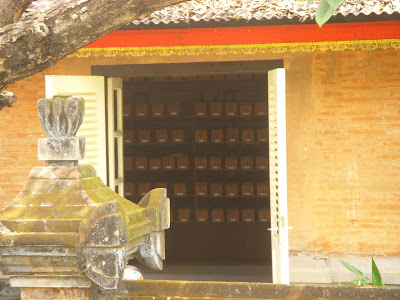
The Lontar Museum in Singaraja.
The Lontar palm leaf is a common traditional writing surface in southeast Asian and India. You can learn a bit more about them here and there is a fine digital archive of them here.
Museum is a misnomer, it is in fact a library or archive. We got a great introduction to the collection from the trained librarian guide who appears in these videos.
One amazing thing about both the art museums and the library we visited is how open they are to the elements in such a tropical climate. As you see in these pictures
the lontars, although protected in their boxes, were open to the humidity and temperature changes. This was also true of the Arma and and Neka Museums in Ubud.
Museum is a misnomer, it is in fact a library or archive. We got a great introduction to the collection from the trained librarian guide who appears in these videos.
One amazing thing about both the art museums and the library we visited is how open they are to the elements in such a tropical climate. As you see in these pictures
 |
| From Bali Photos |
 |
| From Bali Photos |
the lontars, although protected in their boxes, were open to the humidity and temperature changes. This was also true of the Arma and and Neka Museums in Ubud.
The Impact of Balinese Religion upon the Rollins Group
Throughout the trip I have been asking members of the group about how they see our engagement with aspects of Balinese Hinduism based their own religious beliefs. Here are some of the clips.
Monday, May 31, 2010
Balinese Cockfight (with apologies to Geertz.)
Yesterday we went to another trance possession ceremony, this one in Denpasar. But the thing that really took me out of my comfort zone at this one was the cockfighting. The Balinese have this marvelous way of mixing the sacred and profane. So while those in the inner temple are concerned with prayer and other sacred pursuits, in the outer temple there is a cockfight tournament and market and the place is absolute Bedlam.
Hundreds of men gather around the cockpit which is about 30 feet across and underneath the usual open pavilion. Some sit at the front, most stand and those that can afford it buy a plastic stool for Rp. 3,000 (30 cents) to stand on so they can see better. Around the back, women ply their trade selling drinks and snacks.
To one side sit the officials with a gong for calling the rounds. In the ring, about a dozen men, big fat, hard, betting men, and short, wiry, hungry men. Not your usual temple goers. These cock fighters, spur tiers, and referees all gather to sort out who will fight whom, everyone is looking for an even fight with well matched birds. The birds are about 8-12 months old and have been lovingly cared for by their owners. The handlers hold their cocks at shoulder height, gently under the belly of the bird, with the razor sharp spur on the left leg held away from the body. This protects the bird and handler and also displays it to the crowd. Other handlers retire to the edge of the ring to tie on the spurs.
The ring clears and the two handlers and referees strut around the ring gathering the money to support the main bet. This could be Rp. 7,000,000 at this temple (about $7,000. But this is chump change at another temple cockfight where the locals invite big gamblers from Java, the main bet can be Rp. 700, 000, 000.) Once each bird has accumulated enough money, the bets are opened to the floor and all hell breaks loose as the crowd wave their right hand to the left or to the right (indicate which bird they want to bet on.) The minimum bet is Rp. 10,000, a dollar, usually even odds. Sometimes it is easy to find a taker, other times the crowd has decided on a favorite and you can't place a bet. For the record I, with the guidance of our driver Nyoman, parleyed Rp. 50,000 into Rp. 200, 000. I gave Nyoman Rp. 100, 000. He will save it for his daughter. All this time the handlers are holding their cocks closely together, almost in pecking range, and are riling them up with pinches, feints, and ruffling of feathers.
The fight begins. The two men move with their cocks to opposite sides of the ring and let them go. the birds immediately rush at each other and jump, slash, and peck for their lives. Often the fight is over very quickly, in seconds, with a mortal wound from the spur. Sometimes the fight lasts a round or two. Occasionally, the two birds tire and refuse to fight. In these cases they are placed together in a bamboo cage and fight to the death, or until one cowers in defeat. During the whole thing the handlers bob and weave as though fighting themselves, the crowd roars, and the blood is up. The fight is the blood sacrifice at the temple.
Outside the ring the processions of Barong from local villages, accompanied by the syncopation of clashing cymbals and gongs of the traveling gamelan, continue to wind into the temple, the priest intones over the sound system. All this clashes with the roar of the cockfight and the sensory overload of a Balinese ceremony is achieved.
The defeated birds are plucked at ring side and taken home by the victor to be eaten. Imagine what it must be like, the cock you have lovingly raised for a year crows in the yard, you have millions of Rupiah in your pocket, and you are eating your defeated opponent -- smells like victory.
Here is Geertz's article.
The betting...
The flight ....
The ignominious end of the defeated.
Hundreds of men gather around the cockpit which is about 30 feet across and underneath the usual open pavilion. Some sit at the front, most stand and those that can afford it buy a plastic stool for Rp. 3,000 (30 cents) to stand on so they can see better. Around the back, women ply their trade selling drinks and snacks.
To one side sit the officials with a gong for calling the rounds. In the ring, about a dozen men, big fat, hard, betting men, and short, wiry, hungry men. Not your usual temple goers. These cock fighters, spur tiers, and referees all gather to sort out who will fight whom, everyone is looking for an even fight with well matched birds. The birds are about 8-12 months old and have been lovingly cared for by their owners. The handlers hold their cocks at shoulder height, gently under the belly of the bird, with the razor sharp spur on the left leg held away from the body. This protects the bird and handler and also displays it to the crowd. Other handlers retire to the edge of the ring to tie on the spurs.
The ring clears and the two handlers and referees strut around the ring gathering the money to support the main bet. This could be Rp. 7,000,000 at this temple (about $7,000. But this is chump change at another temple cockfight where the locals invite big gamblers from Java, the main bet can be Rp. 700, 000, 000.) Once each bird has accumulated enough money, the bets are opened to the floor and all hell breaks loose as the crowd wave their right hand to the left or to the right (indicate which bird they want to bet on.) The minimum bet is Rp. 10,000, a dollar, usually even odds. Sometimes it is easy to find a taker, other times the crowd has decided on a favorite and you can't place a bet. For the record I, with the guidance of our driver Nyoman, parleyed Rp. 50,000 into Rp. 200, 000. I gave Nyoman Rp. 100, 000. He will save it for his daughter. All this time the handlers are holding their cocks closely together, almost in pecking range, and are riling them up with pinches, feints, and ruffling of feathers.
The fight begins. The two men move with their cocks to opposite sides of the ring and let them go. the birds immediately rush at each other and jump, slash, and peck for their lives. Often the fight is over very quickly, in seconds, with a mortal wound from the spur. Sometimes the fight lasts a round or two. Occasionally, the two birds tire and refuse to fight. In these cases they are placed together in a bamboo cage and fight to the death, or until one cowers in defeat. During the whole thing the handlers bob and weave as though fighting themselves, the crowd roars, and the blood is up. The fight is the blood sacrifice at the temple.
Outside the ring the processions of Barong from local villages, accompanied by the syncopation of clashing cymbals and gongs of the traveling gamelan, continue to wind into the temple, the priest intones over the sound system. All this clashes with the roar of the cockfight and the sensory overload of a Balinese ceremony is achieved.
The defeated birds are plucked at ring side and taken home by the victor to be eaten. Imagine what it must be like, the cock you have lovingly raised for a year crows in the yard, you have millions of Rupiah in your pocket, and you are eating your defeated opponent -- smells like victory.
Here is Geertz's article.
The betting...
The flight ....
The ignominious end of the defeated.
Subscribe to:
Posts (Atom)


