Saturday, June 26, 2010

Creating Change in Scholarly Communication

I was a panelist at the SPARC-ACRL Forum on Saturday (and at the discussion group on Sunday.) Here are my notes.

Change from the ground up – Campus-based policies to ensure Open Access to institutional research outputs through proactive copyright management, with Jonathan Miller, Library Director at Rollins College.

First I must acknowledge the work of Cynthia Snyder, Bill Svitavsky, David Noe, all librarians at Rollins. They are doing the real work of building the repository.

Rollins is a good selective liberal arts college in central Florida. With 3200 FTE students and 203 faculty. We emphasize teaching excellence. Our mission is to educate students for global citizenship, and responsible leadership. Most of our faculty members are active researchers, creators, and writers, but their main job is to teach.

We have an endowment that is better than most, but not as big as we want it to be. We have survived the latest recession better than most, but the library has had a flat G&S budget for three years.

So, in the context of US higher education, a perfectly normal school.

So how have I, the director of a small college library, found myself in the august company of colleagues from Duke, and UC San Diego?

Since the Rollins Arts & Sciences faculty passed their Open Access Policy a number of my librarian colleagues from around the country have expressed surprise that Rollins should be one of the first liberal arts colleges to pass such a policy. In fact I think we were third, after Trinity University in San Antonio and Oberlin.

Well, I would argue that Open Access is not just for the big guys. It is not just the concern of research universities. In fact I think it might be more relevant for small colleges than for larger schools.

Rollins, as a small, largely undergraduate, teaching intensive, school with a liberal arts curriculum that, at least in one sense, means we need broad not deep access to information. We are net information consumers rather than net producers and our students and faculty make a little use of a lot of resources, rather than a lot of use of a few resources, or a lot of use of a lot of resources. The subscription model of collecting a relatively small number of periodical titles “just in case” students need articles in those titles, doesn’t make much business sense for us. What we really need is “just in time” access to a broad array of information resources, none of which will be used particularly heavily.

Our Open Access policy was simply one part of a larger strategy to change focus of the faculty and students of Rollins College from a local library collection to a larger world of information. There are four parts to this strategy that I will mention today:

1. Working politically to create the scholarly communication system we prefer and that meets the needs of the students and faculty at liberal arts colleges.
2. Building collaboration and cooperation with – amongst others -- the state universities of Florida.
3. Moving aggressively from print to digital periodicals.
4. Contributing to open access initiatives and exploiting open access resources.

First, working politically – I am the outgoing chair of the ACRL Government Relations Committee which plays a leading role in the advocacy efforts of ACRL . For the last few years, pre-dating my involvement, much of that advocacy has focused on open access and on finding a productive balance in terms of copyright law. I also serve on the SPARC Steering Committee. My research and writing also concerns copyright policy. On campus I have looked for opportunities to present that research to my colleagues and build a reputation as someone with whom they can discuss copyright issues.

At the state level I have worked with others to get libraries in the three Florida higher education silos – state universities, state colleges and community colleges, and the private schools to think about cooperation and collaboration. That has led to some interesting strategic planning, some cooperative licensing, and to Rollins and Miami participating in the Florida group involved in the Open Library Environment Project, putting significant money into the project.

I also led an effort amongst liberal arts college library directors nationally to protest the Nature Publishing Group’s recent exorbitant increase in the online subscription price for Scientific American. We also cancelled our subscription. This was not universally popular on campus, but it was an opportunity to explain why we thought we had to hold the line on periodical prices.
That is a good segue into the next point – aggressively moving from print to digital periodicals. Obviously, most if not all of us are doing this these days, we at Rollins are doing for the usual reasons – our users prefer digital articles to print, we are able to link these articles into our wider information systems, we save space, etc. But, in response to flat budgets, we also did a major periodical cancellation project in the last 18 months, focused on print subscriptions because the use was so low and the subscription prices were increasing so fast that the model was unsustainable. We worked closely with faculty on this project and this increased their awareness of just how expensive the annual subscriptions to scholarly periodicals have become. That project was definitely about cuts, but we described it as a necessary pruning. We made sure that faculty understood that when budgets came back, we would consider adding subscriptions to digital content. In the meantime we continued to make them aware of open access journals, open repositories and made sure to incorporate these open resources into our systems and services.

So: I have a reputation on campus as someone who thinks about copyright. The Library is acting in a concerted way to protest journal price hikes, to limit our exposure to periodical inflation, and to find ways to improve our users access to a broad array of resources, including open resources, and our faculty are primed to think about scholarly communication in general and journal pricing in particular.

Which leads us to my presence on this panel. If are going to encourage our faculty and students to use open access resources as information consumers, shouldn’t we also contribute to those resources as information producers?

We were given good advice by those who had traveling this road before us: the good people at SPARC, Peter Suber, Ray English, Diane Graves, Terri Fishel. So I pass this on to you:

  • Find faculty champions to push the OA policy
  • Build the institutional repository at the same time as you develop the policy.
  • Find the message that resonates with particular audiences: on our campus the provost was interested in institutional reputation, the Dean of Faculty by the idea of a stable repository of faculty publications, IT and the librarians in a hosted solution from Bepress which did not involve much staff time and expertise in implementation, and – most importantly – the faculty were interested in more visibility for their own research and a policy that was flexible enough to enable them to get an automatic waiver when necessary, and that recognized the diversity of their output. Fully half of the output of Rollins faculty is something other than the classic peer-reviewed scholarly article.
The policy passed the A&S faculty unanimously in February. The institutional repository site http://scholarship.rollins.edu went live at about the same time. We have spent the last few months tweaking the site and loading materials. The next big push will come in the Fall, once we get the data on last year’s publishing output from the annual report each faculty member submits to the Dean.

What are the next steps?

  • Continuing to populate the repository.
  • Passing a similar policy in the other faculty on campus: the faculty of the business school.
  • Reaching out to journal editors on campus – both faculty and students -- and offering to host their content. Preferably with open access, but toll access if necessary.
  • Building other collections – theses for instance.
  • Continue to work on other parts of the strategy – statewide collaboration and cooperation, rewriting our copyright use policy so that it offers more practical guidance to faculty, moving from print to digital, and working politically. I will be on the Hill on Tuesday, lobbying for FRPAA.
Let me end by just mentioning the faculty champions on our campus. Both were members of the Professional Standards Committee. Thom Moore, a physicist who directs the faculty/student collaborative research program, and Claire Strom, a historian and journal editor of Agricultural History. Claire drafted the policy, Thom shepherded it through the faculty.

Throughout the process I was in the background, frankly “loaded for bear” ready with facts, figures, and arguments. I worried we needed to hold all kinds of informational meetings with various constituencies. Thom said, “nah.”

I came to that final faculty meeting ready for any eventuality and just sat and watched Thom and Claire quickly and quietly move to the unanimous vote. At the end the meeting Thom came over and just said, “told you.”

Demonstrating the Value of Libraries

This session from the University Libraries Section was formally titled "Demonstrating Excellence in Higher Education: What Universities are Doing. What Libraries are Doing." University libraries, particularly public ones, and libraries in Europe and Asia are very concerned with this, but we all need to be. Personally, I am increasingly interested in trying to find ways to accurately indicate what value we add to the mission of Rollins.

The speakers included Alexander C. McCormick, Director, National Survey of Student Engagement & Associate Professor, School of Education, Indiana University; J. Stephen Town, Director of Information, University Library and Archives, The University of York; Patricia Brennan, Director of Product Management for Evaluative Products, Thomson Reuters; and the moderator was Marilyn Myers, Associate Dean for Public Services, University of Houston Libraries.

McCormick talk on NSSE was interesting. He pointed out that ranking largely track the incoming SAT scores of students, research rankings ignore undergraduates entirely, and that the official measure of quality assurance in the US is the accreditation process. He did note that there is a direct relationship between students' reported library use and measures of institutional quality, but when one isolated library there is no independent impact on outcomes. He urged libraries to emphasize a “Discourse of improving, not proving.”

But the best speaker was Towns, the University of York in the UK. One measure I use to determine if I have been in a good session, is if I come out with a reading list. Towns gave me that:

ARL SPEC Kit 305

SCONUL’s “Performance portal

Roxanne Missingham. 2005. Libraries and economic value: a review of recent studies. Performance Measurement and Metrics 6, no. 3, (September 1): 142-158. http://rollins.summon.serialssolutions.com (accessed June 28, 2010). [Rollins people can find the fulltext here.]

Petros A Kostagiola, and Stefanos Asonitis. 2009. Intangible assets for academic libraries. Library Management 30 (6/7): 419.

Town made the point that, “All of this [talk of value and impact] may damage the idea of libraries as ‘transcendent’ collective and connective services.”

He said we need comprehensive and holistic measurement --- true worth, transcendent valuation, in a narrative of worth.

Google Book Search Settlement Discussion

This was a session organized by the ALA Washington Office. The session focused on the future rather than on describing the case. It included Jonathan Band, who provides legal advice for the Library Copyright Alliance, James Grimmelmann of NYU, Mark Sandler of the CIC, Mary Beth Peters (who will be retiring as Register of Copyrights at the end of this year) Johanna Shelton (previously a Congressional Committee staff member and now a lobbyist for Google.)

Peters described the proposed settlement as a "bridge too far." The Judge, Denny Chin, recently appointed to the 2nd Circuit Court of Appeals may provide a roadmap to a more reasonable settlement, the two parties are keen to find such a settlement.

Band laid out a series of scenarios and each of the panelists responded to those.

The first was if the settlement is rejected, litigation ensues, and Google is found to have infringed.

Shelton pointed out that the settlement addresses the legacy problem, not the future of books. Google’s future of books is their “Google Editions” in which consumers can buy and store online books in a personal account. This will be an open platform with opportunities for device developers and bookstores. Not proprietary like Kindle or iPad.

Sandler addressed what the libraries partners might do. He pointed out that we still have Hathi Trust with over 1,000,000 books in the public domain and 6,000,000 in copyright. He stated that, “It is inconceivable that anyone with a shred of a sense of social justice will suggest that those files [the 6 million in-copyright digitized books] be deleted.”


The second scenario was that we scale back to scan and snippet display.

Sandler pointed out that this would still be a substantial benefit to people, because they will use Google Books as a discovery service and come to libraries to find the print. Band pointed out that one can also just use of snippets for reference and Grimmelmann noted other fair uses like the ability to search and conduct research across the collection. Peters suggested that under these circumstances other companies could push for legislation.

Grimmelmann used that opportunity to argue for a radical revision of copyright law with shorter, fixed terms and clear notices. Peters, with long experience, pointed out the difficulty of achieving the correct balance in legislation and that Europe was proceeding with mass digitization and using licensing to manage compensation.
Sandler described the recent decision in Viacom v. YouTube as encouraging. Google’s ability to take down when notified was enough. We can do this in higher education; digitize and then take down if the owner comes forward.

My take away from this is that any definitive decision in the Google Book Search settlement is a long way off and when it does come the outcome will be more limited and lead to less radical change in library service than I had hoped. In the meantime we have to proceed to providing access to those Hathi Trust public domain titles, and pursue digital book access via licensing with individual packages and unify the search experience for users via services like Summon.

Here are a couple of unsubstantiated factoids from the presentation: the size of the existing digitized collection at GBS is around 12 million titles -- 2 million in the public domain, 2 million commercially available and under copyright in the Google partners program, and 8 million potentially in copyright scanned from library collections, 20% of those 8 million are orphaned works. About 35% of the public domain works are viewed during any month.

Thursday, June 24, 2010

Summon Advisory Board

This was the second meeting of the advisory board and, as with the first, it was an meeting of a committed group of developers and of thoughtful librarians from all over the world. I think Summon is still ahead of the game in unified discovery but has some competition particularly from EBSCO's new discovery product.

New publishers and resources continue to be added, search and relevance continue to be refined, de-duplication is improving, next week we get better usage stats, and an autocomplete feature. As well as lots more stuff a bit further out.

I have lots to talk to Bill and the rest of Digital Services when I get back.

Wednesday, June 23, 2010

Sustaining Copyright in Culture

I am in D.C. for the next week for a variety of meetings, the Center for Intellectual Property's 2010 Symposium, the Summon Advisory Board, then ALA, followed by a visit with Ms. Evangeline Moore about her father's papers, and then the ALA National Day of Advocacy on Capitol Hill.

Let's start with the symposium. This is the first one I have attended and I am not convinced it was money well spent. First that title. Hybrid C: Sustaining Copyright in Culture. I get the hybrid, we live in a hybrid world of analog and digital works and have for many decades, the phrase "sustaining copyright in culture" is as confusing, hazy, and empty as the Symposium turned out to be. I signed up because I thought I might learn something more about fair use, but the argument put forward by Jaszi and Jonathan Band, was pretty extreme. Here is the abstract to Band's 2007 paper for ARL.

“Three appellate decisions [Blanch v. Koons, Perfect 10 v. Amazon.com, and Bill Graham Archives v. Dorling Kindersley] concerning fair use should give educators and librarians greater confidence and guidance for asserting this important privilege. In all three decisions, the courts permitted extensive copying and display in the commercial context because the uses involved repurposing and recontextualization. The reasoning of these opinions could have far-reaching implication in the education context.”

Band thinks these decisions “should give educators and librarians greater confidence and guidance for asserting this important privilege.” Because, if I understand the argument, simply copying copyrighted works originally published for a non-educational market, in an educational context "re-contextualizes" the work and thus makes the use fair use. But he also notes, “many copyright owners will not agree.” (Band, December 2007.)

I did enjoy listening to Maria Pallante and David Balto on the Google Book Search settlement. They disagree on whether the judge will accept the settlement or not, but seem to agree it will be appealed. We could be in for a very long wait on this one.

I had hoped to get some good ideas on how to incorporate issues of copyright and information policy into information literacy, and some of the audience had some ideas (focus on carrots not sticks for undergraduates with contexts that interest them like textbook costs, fan fiction, and open access), but the panelists didn't.

I think that was the overall problem with the symposium. The format of theater style seating before talking heads on a raised panel, left little time for Q&A or interaction. I could have watched a webcast.

Monday, June 14, 2010

Thinking About the Future of College Libraries

It is planning time at Olin (when isn't it planning time? Planning should be continuous!) I am gathering readings to be shared with the librarians. So on top of my hastily put together presentation to some Balinese librarians, I also have the following:

Horizons 2010

A collection of 21 pieces gathered by Alire and Evans.

C&RLN's 2010 top ten trends in academic libraries: A review of the current literature.

I haven't had a chance to look at the IMLS wiki yet, but it looks vaguely promising.

Do you have any others I should take a look at?

Saturday, June 12, 2010

Indonesian Food

From Bali Photos
I really enjoyed the food we ate in Bali. The traditional food of Bali was sweet potato and corn served with vegetables. Meat was rarely eaten and rice was a cash crop. This changed with the green revolution when white rice became more common, as Bali became more open to other Indonesia cuisines, and particularly with the increased economic development that came with tourism. Now the Balinese eat rice up to three times per day and eat more fish and meat. The result has been an increase in obesity and diabetes. We obviously ate in restaurants, tourist restaurants, but it was fun getting to know Indonesian dishes like nasi goreng, nasi campur, mei goreng, and gado-gado. We even had a cooking lesson with Nyoman's family. here are some videos of me learning how to make gado-gado, a vegetable dish with bean sprouts and a spicy peanut sauce.

Trust me. I did more food prep than these videos show. We made about five different dishes. All were delicious.


Thursday, June 10, 2010

Bali Photos

You can view all my Bali photos here on picasa. I have identified many of them.

Monday, June 07, 2010

Nature news article on open access and government mandates.

As I try to catch up with at least a semester's worth of e-mails, this article from Nature (April 7, 2010) caught my eye.

Blogging from Bali


Phil Deaver just sent me this. We would go to this local restaurant (Marni's? Mauni's?) and use their wifi while drinking Bintang's, the local beer. Many of my posts came from here. I am surpised I got any blogging doen at all!

Sunday, June 06, 2010

Rice Field Run Ubud, Bali, Indonesia by jonathan1239 at Garmin Connect - Details

This is the regular run that Mark and I did in Ubud, that I wrote about here.

Wednesday, June 02, 2010

The Lontar Museum in Singaraja.

The Lontar palm leaf is a common traditional writing surface in southeast Asian and India. You can learn a bit more about them here and there is a fine digital archive of them here.

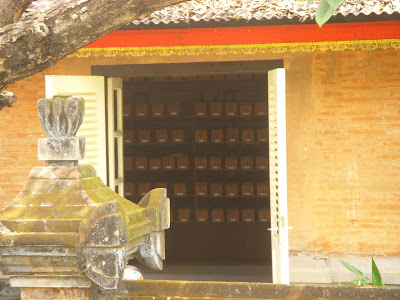
Museum is a misnomer, it is in fact a library or archive. We got a great introduction to the collection from the trained librarian guide who appears in these videos.


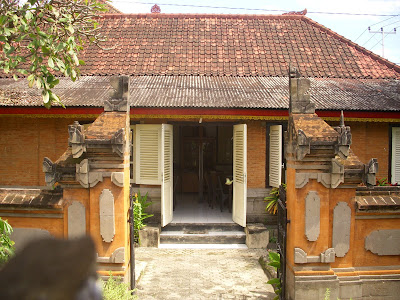
One amazing thing about both the art museums and the library we visited is how open they are to the elements in such a tropical climate. As you see in these pictures
From Bali Photos


From Bali Photos

the lontars, although protected in their boxes, were open to the humidity and temperature changes. This was also true of the Arma and and Neka Museums in Ubud.

The Impact of Balinese Religion upon the Rollins Group

Throughout the trip I have been asking members of the group about how they see our engagement with aspects of Balinese Hinduism based their own religious beliefs. Here are some of the clips.


Ilan on cockflighting

This is what it feels like ....


Monday, May 31, 2010

Balinese Cockfight (with apologies to Geertz.)

Yesterday we went to another trance possession ceremony, this one in Denpasar. But the thing that really took me out of my comfort zone at this one was the cockfighting. The Balinese have this marvelous way of mixing the sacred and profane. So while those in the inner temple are concerned with prayer and other sacred pursuits, in the outer temple there is a cockfight tournament and market and the place is absolute Bedlam.

Hundreds of men gather around the cockpit which is about 30 feet across and underneath the usual open pavilion. Some sit at the front, most stand and those that can afford it buy a plastic stool for Rp. 3,000 (30 cents) to stand on so they can see better. Around the back, women ply their trade selling drinks and snacks.

To one side sit the officials with a gong for calling the rounds. In the ring, about a dozen men, big fat, hard, betting men, and short, wiry, hungry men. Not your usual temple goers. These cock fighters, spur tiers, and referees all gather to sort out who will fight whom, everyone is looking for an even fight with well matched birds. The birds are about 8-12 months old and have been lovingly cared for by their owners. The handlers hold their cocks at shoulder height, gently under the belly of the bird, with the razor sharp spur on the left leg held away from the body. This protects the bird and handler and also displays it to the crowd. Other handlers retire to the edge of the ring to tie on the spurs.

The ring clears and the two handlers and referees strut around the ring gathering the money to support the main bet. This could be Rp. 7,000,000 at this temple (about $7,000. But this is chump change at another temple cockfight where the locals invite big gamblers from Java, the main bet can be Rp. 700, 000, 000.) Once each bird has accumulated enough money, the bets are opened to the floor and all hell breaks loose as the crowd wave their right hand to the left or to the right (indicate which bird they want to bet on.) The minimum bet is Rp. 10,000, a dollar, usually even odds. Sometimes it is easy to find a taker, other times the crowd has decided on a favorite and you can't place a bet. For the record I, with the guidance of our driver Nyoman, parleyed Rp. 50,000 into Rp. 200, 000. I gave Nyoman Rp. 100, 000. He will save it for his daughter. All this time the handlers are holding their cocks closely together, almost in pecking range, and are riling them up with pinches, feints, and ruffling of feathers.

The fight begins. The two men move with their cocks to opposite sides of the ring and let them go. the birds immediately rush at each other and jump, slash, and peck for their lives. Often the fight is over very quickly, in seconds, with a mortal wound from the spur. Sometimes the fight lasts a round or two. Occasionally, the two birds tire and refuse to fight. In these cases they are placed together in a bamboo cage and fight to the death, or until one cowers in defeat. During the whole thing the handlers bob and weave as though fighting themselves, the crowd roars, and the blood is up. The fight is the blood sacrifice at the temple.

Outside the ring the processions of Barong from local villages, accompanied by the syncopation of clashing cymbals and gongs of the traveling gamelan, continue to wind into the temple, the priest intones over the sound system. All this clashes with the roar of the cockfight and the sensory overload of a Balinese ceremony is achieved.

The defeated birds are plucked at ring side and taken home by the victor to be eaten. Imagine what it must be like, the cock you have lovingly raised for a year crows in the yard, you have millions of Rupiah in your pocket, and you are eating your defeated opponent -- smells like victory.

Here is Geertz's article.

The betting...


The flight ....


The ignominious end of the defeated.


Friday, May 28, 2010

Tourism in Bali

We are staying at the Puri Bagus Candidasa resort, so this is a perfect opportunity to write about tourism in Bali, with the caveat that I have been here all of twelve days. So take these thoughts as the first impressions of an ill-informed neophyte.

There seem to be three kinds of tourism here. The majority of visitors come for relatively cheap fun in the sun beach vacations. This place is pretty close to Australia and to the economic powerhouses of east Asia. The second is cultural tourism, centered around Ubud and Balinese art, music and religion. The third is high end resort vacations in tropical paradise. Finally, I suppose you can also add the ex-pat community. Foreigners who have moved here.

Tourists are coming from Japan, Australia, Malaysia, Taiwan, China, Europe, particularly the the UK, France,and Germany, the U.S., and from other Indonesian islands, particularly Java. Millions of people come here for vacations every year.

All of this is having a huge impact upon the island. Some positive, even if most tourist dollars stay in Bali for less than 24 hours before transfer to Jakarta or to Japan and destinations elsewhere, this industry is bringing a lot of jobs and money to the Balinese. Tourism is also bringing new ideas and opportunities to the Balinese and while that is not always positive it seems clear that some, perhaps many Balinese find that refreshing. Tourism is also building infrastructure, some of which can be used to meet the needs of ordinary Balinese. Finally, tourist interest in the environment and in Balinese culture seemed to have led to an increased sensitivity and interest in maintaining the environment and Balinese culture.

But it is also pretty clear, in fact it is blinding obvious as soon as you leave the airport that there are significant negative impacts as well. Western tourists bring western consumption expectations with them. This is having a huge impact on water use, electricity consumption, land use, and transportation (to and on the island.) Culturally, tourists come to Bali to see and experience this unique culture and form of Hinduism. But by our very presence and interest we impact on that culture. Ceremonies that were purely Balinese are now attended by foreigners with varying levels of knowledge of and sensitivity towards the ceremony and the people involved. Like European cathedrals, Balinese temples are overrun with people whose relationship to the space and the activities conducted there is very different than that of the local population. Aspects of Balinese ceremony and culture have now become performance or product for tourists and have been radically changed in the process. Hoyt contends that change is inevitable and the the Balinese may be strong enough to find a way to incorporate change brought by tourism on their culture and still maintain control of that culture. I would argue that while cultural change is inevitable, change brought about by post-modern global tourism is almost inevitably corrosive. Environmental change is perhaps the most destructive. Over-consumption by tourists (like me), pollution, the impact on global climate change of simply flying here, all negatively impact the island.

I am living in an object example now. I am sitting by the pool, using the wifi (and too much water and electricity) in a resort hotel that is constructed on a global model and has little connection to Bali. The beach has eroded away because someone mined the coral. The coral reef we went to yesterday evening was gorgeous, the best I have ever snorkeled in (above? over? Whatever!) but then I have only snorkeled in the Dry Tortugas. Seriously though, amazing. Acres of coral, feet from the beach, shoals of brightly colored fish, Mark followed a turtle. Just amazing. But as we swam we had to wave away the plastic garbage floating in the water. Exactly the same stuff Mark and I collected yesterday. Some of the coral was bleached and some had been damaged by boats that have come here to deliver tourists (like me) to the coral reef. Unusually, in my experience, one sees few offerings around the hotel grounds. There are few holy places, and few people employed by or connected to the hotel who feel the sense of connection to the place and culture that would lead to the leaving of daily offerings.

Ironically, it is now May 31st and since I began writing this post we have returned to Ubud, traveled to Denpasar (more on that in a later post) and now find my self at another beach resort hotel in Livona. This is first Internet connection I have had since Candidasa. The experience is much the same. Not much beach, buffet lunch, swimming pool with bar, 1970 - 80's resort experience, twenty middle-aged German tourists all drinking Coke, plonked down in Bali. These experiences have been the least satisfying of my time in Bali.

With one exception. Margaret and I walked out of the hotel in Candidasa through the banana groves and along the cost to the water temple perched on the promontory where the caretaker priest welcomed us and allowed us to take photos and patiently answered all out questions as we gazed over the sparkling Indian Ocean towards the island of Nusa Penida and watched Balinese cows graze on the hillside as the tropical breeze .lofted the cotton awning over the open-air temple.

Thursday, May 27, 2010

A Little Taste of Home


During the prayer service at Selat Pecan the woman I sat behind was wearing a Mickey and Minnie hair clip.

Chemical Baggies

Today we drive to Candidasa for a few temples and some snorkeling. So Mark and I collected plastic garbage on our regular running route this morning. There is a real problem with plastic garbage on the island. The Balinese used biodegradable containers and wrappings for centuries (banana leaves etc.) and they composted after use. Now they use a lot of plastic (though not as much as the average American) but have continued to toss their waste aside.
The waste we gathered (about 20 lbs in two miles) consisted of plastics bottles, individual candy wrappers, individual hygiene product wrappers, and a large number of small clear plastic bags that the farmers use for agricultural chemicals -- chemical baggies.

What we did not find were any condoms, needles, aluminum cans, or any broken high end plastics (cell phones, sunglasses, etc.) It was also interesting how little plastic garbage there was in light of that fact that they do not seem to ever collect it.

You can learn a lot from garbage.

The Future of College Libraries

Today I spoke to a group of librarians from Udayana University at the new campus at Bukit Jimbaran Badung, near Denpasar about the future of libraries. Here is my PowerPoint. No surprises here for anyone who has talked to me about the future of libraries recently.

The librarians' questions were good and perceptive. They were particularly interested in embedded library instruction, partnerships with faculty, library automation, the library as place, and working conditions for U.S. librarians.

Jaya took this picture of us all with his iPhone.

Tuesday, May 25, 2010

Procession in Mas

This afternoon we went to see a procession in Mas, a village in Ubud region. This is one of the iconic sights of Bali. Women processing to the temple with very tall offerings on their heads. Each neighbourhood gathers at the community center and then they all set off to the village center and then to the temple, accompanied by a marching band. We were told that the offerings are as tall as the family can afford. They are constructed around a banana stem and the fruit, chicken, and cakes are attached with bamboo spikes. Each offering is topped with three Chinese coins (the round ones with a square hole, these commemorate a marriage between a king and a Chinese princess (but don't quote me on that.) The offerings will be stored at the temple overnight and then taken by the family and eaten at about 5 a.m. tomorrow.