This was the second meeting of the advisory board and, as with the first, it was an meeting of a committed group of developers and of thoughtful librarians from all over the world. I think Summon is still ahead of the game in unified discovery but has some competition particularly from EBSCO's new discovery product.
New publishers and resources continue to be added, search and relevance continue to be refined, de-duplication is improving, next week we get better usage stats, and an autocomplete feature. As well as lots more stuff a bit further out.
I have lots to talk to Bill and the rest of Digital Services when I get back.
Thursday, June 24, 2010


Wednesday, June 23, 2010
Sustaining Copyright in Culture
I am in D.C. for the next week for a variety of meetings, the Center for Intellectual Property's 2010 Symposium, the Summon Advisory Board, then ALA, followed by a visit with Ms. Evangeline Moore about her father's papers, and then the ALA National Day of Advocacy on Capitol Hill.
Let's start with the symposium. This is the first one I have attended and I am not convinced it was money well spent. First that title. Hybrid C: Sustaining Copyright in Culture. I get the hybrid, we live in a hybrid world of analog and digital works and have for many decades, the phrase "sustaining copyright in culture" is as confusing, hazy, and empty as the Symposium turned out to be. I signed up because I thought I might learn something more about fair use, but the argument put forward by Jaszi and Jonathan Band, was pretty extreme. Here is the abstract to Band's 2007 paper for ARL.
“Three appellate decisions [Blanch v. Koons, Perfect 10 v. Amazon.com, and Bill Graham Archives v. Dorling Kindersley] concerning fair use should give educators and librarians greater confidence and guidance for asserting this important privilege. In all three decisions, the courts permitted extensive copying and display in the commercial context because the uses involved repurposing and recontextualization. The reasoning of these opinions could have far-reaching implication in the education context.”
Band thinks these decisions “should give educators and librarians greater confidence and guidance for asserting this important privilege.” Because, if I understand the argument, simply copying copyrighted works originally published for a non-educational market, in an educational context "re-contextualizes" the work and thus makes the use fair use. But he also notes, “many copyright owners will not agree.” (Band, December 2007.)
I did enjoy listening to Maria Pallante and David Balto on the Google Book Search settlement. They disagree on whether the judge will accept the settlement or not, but seem to agree it will be appealed. We could be in for a very long wait on this one.
I had hoped to get some good ideas on how to incorporate issues of copyright and information policy into information literacy, and some of the audience had some ideas (focus on carrots not sticks for undergraduates with contexts that interest them like textbook costs, fan fiction, and open access), but the panelists didn't.
I think that was the overall problem with the symposium. The format of theater style seating before talking heads on a raised panel, left little time for Q&A or interaction. I could have watched a webcast.
Let's start with the symposium. This is the first one I have attended and I am not convinced it was money well spent. First that title. Hybrid C: Sustaining Copyright in Culture. I get the hybrid, we live in a hybrid world of analog and digital works and have for many decades, the phrase "sustaining copyright in culture" is as confusing, hazy, and empty as the Symposium turned out to be. I signed up because I thought I might learn something more about fair use, but the argument put forward by Jaszi and Jonathan Band, was pretty extreme. Here is the abstract to Band's 2007 paper for ARL.
“Three appellate decisions [Blanch v. Koons, Perfect 10 v. Amazon.com, and Bill Graham Archives v. Dorling Kindersley] concerning fair use should give educators and librarians greater confidence and guidance for asserting this important privilege. In all three decisions, the courts permitted extensive copying and display in the commercial context because the uses involved repurposing and recontextualization. The reasoning of these opinions could have far-reaching implication in the education context.”
Band thinks these decisions “should give educators and librarians greater confidence and guidance for asserting this important privilege.” Because, if I understand the argument, simply copying copyrighted works originally published for a non-educational market, in an educational context "re-contextualizes" the work and thus makes the use fair use. But he also notes, “many copyright owners will not agree.” (Band, December 2007.)
I did enjoy listening to Maria Pallante and David Balto on the Google Book Search settlement. They disagree on whether the judge will accept the settlement or not, but seem to agree it will be appealed. We could be in for a very long wait on this one.
I had hoped to get some good ideas on how to incorporate issues of copyright and information policy into information literacy, and some of the audience had some ideas (focus on carrots not sticks for undergraduates with contexts that interest them like textbook costs, fan fiction, and open access), but the panelists didn't.
I think that was the overall problem with the symposium. The format of theater style seating before talking heads on a raised panel, left little time for Q&A or interaction. I could have watched a webcast.
Monday, June 14, 2010
Thinking About the Future of College Libraries
It is planning time at Olin (when isn't it planning time? Planning should be continuous!) I am gathering readings to be shared with the librarians. So on top of my hastily put together presentation to some Balinese librarians, I also have the following:
Horizons 2010
A collection of 21 pieces gathered by Alire and Evans.
C&RLN's 2010 top ten trends in academic libraries: A review of the current literature.
I haven't had a chance to look at the IMLS wiki yet, but it looks vaguely promising.
Do you have any others I should take a look at?
Horizons 2010
A collection of 21 pieces gathered by Alire and Evans.
C&RLN's 2010 top ten trends in academic libraries: A review of the current literature.
I haven't had a chance to look at the IMLS wiki yet, but it looks vaguely promising.
Do you have any others I should take a look at?
Saturday, June 12, 2010
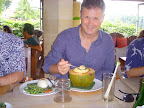
Indonesian Food
 |
| From Bali Photos |
Trust me. I did more food prep than these videos show. We made about five different dishes. All were delicious.
Thursday, June 10, 2010

Monday, June 07, 2010
Nature news article on open access and government mandates.
As I try to catch up with at least a semester's worth of e-mails, this article from Nature (April 7, 2010) caught my eye.
Blogging from Bali

Phil Deaver just sent me this. We would go to this local restaurant (Marni's? Mauni's?) and use their wifi while drinking Bintang's, the local beer. Many of my posts came from here. I am surpised I got any blogging doen at all!
Sunday, June 06, 2010
Wednesday, June 02, 2010
The Lontar Museum in Singaraja.
The Lontar palm leaf is a common traditional writing surface in southeast Asian and India. You can learn a bit more about them here and there is a fine digital archive of them here.
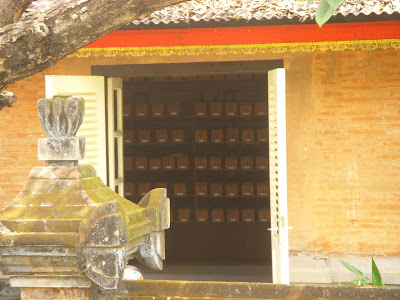
Museum is a misnomer, it is in fact a library or archive. We got a great introduction to the collection from the trained librarian guide who appears in these videos.
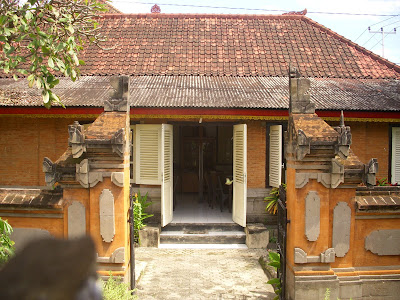
One amazing thing about both the art museums and the library we visited is how open they are to the elements in such a tropical climate. As you see in these pictures
the lontars, although protected in their boxes, were open to the humidity and temperature changes. This was also true of the Arma and and Neka Museums in Ubud.
Museum is a misnomer, it is in fact a library or archive. We got a great introduction to the collection from the trained librarian guide who appears in these videos.
One amazing thing about both the art museums and the library we visited is how open they are to the elements in such a tropical climate. As you see in these pictures
 |
| From Bali Photos |
 |
| From Bali Photos |
the lontars, although protected in their boxes, were open to the humidity and temperature changes. This was also true of the Arma and and Neka Museums in Ubud.
The Impact of Balinese Religion upon the Rollins Group
Throughout the trip I have been asking members of the group about how they see our engagement with aspects of Balinese Hinduism based their own religious beliefs. Here are some of the clips.
Monday, May 31, 2010
Balinese Cockfight (with apologies to Geertz.)
Yesterday we went to another trance possession ceremony, this one in Denpasar. But the thing that really took me out of my comfort zone at this one was the cockfighting. The Balinese have this marvelous way of mixing the sacred and profane. So while those in the inner temple are concerned with prayer and other sacred pursuits, in the outer temple there is a cockfight tournament and market and the place is absolute Bedlam.
Hundreds of men gather around the cockpit which is about 30 feet across and underneath the usual open pavilion. Some sit at the front, most stand and those that can afford it buy a plastic stool for Rp. 3,000 (30 cents) to stand on so they can see better. Around the back, women ply their trade selling drinks and snacks.
To one side sit the officials with a gong for calling the rounds. In the ring, about a dozen men, big fat, hard, betting men, and short, wiry, hungry men. Not your usual temple goers. These cock fighters, spur tiers, and referees all gather to sort out who will fight whom, everyone is looking for an even fight with well matched birds. The birds are about 8-12 months old and have been lovingly cared for by their owners. The handlers hold their cocks at shoulder height, gently under the belly of the bird, with the razor sharp spur on the left leg held away from the body. This protects the bird and handler and also displays it to the crowd. Other handlers retire to the edge of the ring to tie on the spurs.
The ring clears and the two handlers and referees strut around the ring gathering the money to support the main bet. This could be Rp. 7,000,000 at this temple (about $7,000. But this is chump change at another temple cockfight where the locals invite big gamblers from Java, the main bet can be Rp. 700, 000, 000.) Once each bird has accumulated enough money, the bets are opened to the floor and all hell breaks loose as the crowd wave their right hand to the left or to the right (indicate which bird they want to bet on.) The minimum bet is Rp. 10,000, a dollar, usually even odds. Sometimes it is easy to find a taker, other times the crowd has decided on a favorite and you can't place a bet. For the record I, with the guidance of our driver Nyoman, parleyed Rp. 50,000 into Rp. 200, 000. I gave Nyoman Rp. 100, 000. He will save it for his daughter. All this time the handlers are holding their cocks closely together, almost in pecking range, and are riling them up with pinches, feints, and ruffling of feathers.
The fight begins. The two men move with their cocks to opposite sides of the ring and let them go. the birds immediately rush at each other and jump, slash, and peck for their lives. Often the fight is over very quickly, in seconds, with a mortal wound from the spur. Sometimes the fight lasts a round or two. Occasionally, the two birds tire and refuse to fight. In these cases they are placed together in a bamboo cage and fight to the death, or until one cowers in defeat. During the whole thing the handlers bob and weave as though fighting themselves, the crowd roars, and the blood is up. The fight is the blood sacrifice at the temple.
Outside the ring the processions of Barong from local villages, accompanied by the syncopation of clashing cymbals and gongs of the traveling gamelan, continue to wind into the temple, the priest intones over the sound system. All this clashes with the roar of the cockfight and the sensory overload of a Balinese ceremony is achieved.
The defeated birds are plucked at ring side and taken home by the victor to be eaten. Imagine what it must be like, the cock you have lovingly raised for a year crows in the yard, you have millions of Rupiah in your pocket, and you are eating your defeated opponent -- smells like victory.
Here is Geertz's article.
The betting...
The flight ....
The ignominious end of the defeated.
Hundreds of men gather around the cockpit which is about 30 feet across and underneath the usual open pavilion. Some sit at the front, most stand and those that can afford it buy a plastic stool for Rp. 3,000 (30 cents) to stand on so they can see better. Around the back, women ply their trade selling drinks and snacks.
To one side sit the officials with a gong for calling the rounds. In the ring, about a dozen men, big fat, hard, betting men, and short, wiry, hungry men. Not your usual temple goers. These cock fighters, spur tiers, and referees all gather to sort out who will fight whom, everyone is looking for an even fight with well matched birds. The birds are about 8-12 months old and have been lovingly cared for by their owners. The handlers hold their cocks at shoulder height, gently under the belly of the bird, with the razor sharp spur on the left leg held away from the body. This protects the bird and handler and also displays it to the crowd. Other handlers retire to the edge of the ring to tie on the spurs.
The ring clears and the two handlers and referees strut around the ring gathering the money to support the main bet. This could be Rp. 7,000,000 at this temple (about $7,000. But this is chump change at another temple cockfight where the locals invite big gamblers from Java, the main bet can be Rp. 700, 000, 000.) Once each bird has accumulated enough money, the bets are opened to the floor and all hell breaks loose as the crowd wave their right hand to the left or to the right (indicate which bird they want to bet on.) The minimum bet is Rp. 10,000, a dollar, usually even odds. Sometimes it is easy to find a taker, other times the crowd has decided on a favorite and you can't place a bet. For the record I, with the guidance of our driver Nyoman, parleyed Rp. 50,000 into Rp. 200, 000. I gave Nyoman Rp. 100, 000. He will save it for his daughter. All this time the handlers are holding their cocks closely together, almost in pecking range, and are riling them up with pinches, feints, and ruffling of feathers.
The fight begins. The two men move with their cocks to opposite sides of the ring and let them go. the birds immediately rush at each other and jump, slash, and peck for their lives. Often the fight is over very quickly, in seconds, with a mortal wound from the spur. Sometimes the fight lasts a round or two. Occasionally, the two birds tire and refuse to fight. In these cases they are placed together in a bamboo cage and fight to the death, or until one cowers in defeat. During the whole thing the handlers bob and weave as though fighting themselves, the crowd roars, and the blood is up. The fight is the blood sacrifice at the temple.
Outside the ring the processions of Barong from local villages, accompanied by the syncopation of clashing cymbals and gongs of the traveling gamelan, continue to wind into the temple, the priest intones over the sound system. All this clashes with the roar of the cockfight and the sensory overload of a Balinese ceremony is achieved.
The defeated birds are plucked at ring side and taken home by the victor to be eaten. Imagine what it must be like, the cock you have lovingly raised for a year crows in the yard, you have millions of Rupiah in your pocket, and you are eating your defeated opponent -- smells like victory.
Here is Geertz's article.
The betting...
The flight ....
The ignominious end of the defeated.
Friday, May 28, 2010
Tourism in Bali
We are staying at the Puri Bagus Candidasa resort, so this is a perfect opportunity to write about tourism in Bali, with the caveat that I have been here all of twelve days. So take these thoughts as the first impressions of an ill-informed neophyte.
There seem to be three kinds of tourism here. The majority of visitors come for relatively cheap fun in the sun beach vacations. This place is pretty close to Australia and to the economic powerhouses of east Asia. The second is cultural tourism, centered around Ubud and Balinese art, music and religion. The third is high end resort vacations in tropical paradise. Finally, I suppose you can also add the ex-pat community. Foreigners who have moved here.
Tourists are coming from Japan, Australia, Malaysia, Taiwan, China, Europe, particularly the the UK, France,and Germany, the U.S., and from other Indonesian islands, particularly Java. Millions of people come here for vacations every year.
All of this is having a huge impact upon the island. Some positive, even if most tourist dollars stay in Bali for less than 24 hours before transfer to Jakarta or to Japan and destinations elsewhere, this industry is bringing a lot of jobs and money to the Balinese. Tourism is also bringing new ideas and opportunities to the Balinese and while that is not always positive it seems clear that some, perhaps many Balinese find that refreshing. Tourism is also building infrastructure, some of which can be used to meet the needs of ordinary Balinese. Finally, tourist interest in the environment and in Balinese culture seemed to have led to an increased sensitivity and interest in maintaining the environment and Balinese culture.
But it is also pretty clear, in fact it is blinding obvious as soon as you leave the airport that there are significant negative impacts as well. Western tourists bring western consumption expectations with them. This is having a huge impact on water use, electricity consumption, land use, and transportation (to and on the island.) Culturally, tourists come to Bali to see and experience this unique culture and form of Hinduism. But by our very presence and interest we impact on that culture. Ceremonies that were purely Balinese are now attended by foreigners with varying levels of knowledge of and sensitivity towards the ceremony and the people involved. Like European cathedrals, Balinese temples are overrun with people whose relationship to the space and the activities conducted there is very different than that of the local population. Aspects of Balinese ceremony and culture have now become performance or product for tourists and have been radically changed in the process. Hoyt contends that change is inevitable and the the Balinese may be strong enough to find a way to incorporate change brought by tourism on their culture and still maintain control of that culture. I would argue that while cultural change is inevitable, change brought about by post-modern global tourism is almost inevitably corrosive. Environmental change is perhaps the most destructive. Over-consumption by tourists (like me), pollution, the impact on global climate change of simply flying here, all negatively impact the island.
I am living in an object example now. I am sitting by the pool, using the wifi (and too much water and electricity) in a resort hotel that is constructed on a global model and has little connection to Bali. The beach has eroded away because someone mined the coral. The coral reef we went to yesterday evening was gorgeous, the best I have ever snorkeled in (above? over? Whatever!) but then I have only snorkeled in the Dry Tortugas. Seriously though, amazing. Acres of coral, feet from the beach, shoals of brightly colored fish, Mark followed a turtle. Just amazing. But as we swam we had to wave away the plastic garbage floating in the water. Exactly the same stuff Mark and I collected yesterday. Some of the coral was bleached and some had been damaged by boats that have come here to deliver tourists (like me) to the coral reef. Unusually, in my experience, one sees few offerings around the hotel grounds. There are few holy places, and few people employed by or connected to the hotel who feel the sense of connection to the place and culture that would lead to the leaving of daily offerings.
Ironically, it is now May 31st and since I began writing this post we have returned to Ubud, traveled to Denpasar (more on that in a later post) and now find my self at another beach resort hotel in Livona. This is first Internet connection I have had since Candidasa. The experience is much the same. Not much beach, buffet lunch, swimming pool with bar, 1970 - 80's resort experience, twenty middle-aged German tourists all drinking Coke, plonked down in Bali. These experiences have been the least satisfying of my time in Bali.
With one exception. Margaret and I walked out of the hotel in Candidasa through the banana groves and along the cost to the water temple perched on the promontory where the caretaker priest welcomed us and allowed us to take photos and patiently answered all out questions as we gazed over the sparkling Indian Ocean towards the island of Nusa Penida and watched Balinese cows graze on the hillside as the tropical breeze .lofted the cotton awning over the open-air temple.
There seem to be three kinds of tourism here. The majority of visitors come for relatively cheap fun in the sun beach vacations. This place is pretty close to Australia and to the economic powerhouses of east Asia. The second is cultural tourism, centered around Ubud and Balinese art, music and religion. The third is high end resort vacations in tropical paradise. Finally, I suppose you can also add the ex-pat community. Foreigners who have moved here.
Tourists are coming from Japan, Australia, Malaysia, Taiwan, China, Europe, particularly the the UK, France,and Germany, the U.S., and from other Indonesian islands, particularly Java. Millions of people come here for vacations every year.
All of this is having a huge impact upon the island. Some positive, even if most tourist dollars stay in Bali for less than 24 hours before transfer to Jakarta or to Japan and destinations elsewhere, this industry is bringing a lot of jobs and money to the Balinese. Tourism is also bringing new ideas and opportunities to the Balinese and while that is not always positive it seems clear that some, perhaps many Balinese find that refreshing. Tourism is also building infrastructure, some of which can be used to meet the needs of ordinary Balinese. Finally, tourist interest in the environment and in Balinese culture seemed to have led to an increased sensitivity and interest in maintaining the environment and Balinese culture.
But it is also pretty clear, in fact it is blinding obvious as soon as you leave the airport that there are significant negative impacts as well. Western tourists bring western consumption expectations with them. This is having a huge impact on water use, electricity consumption, land use, and transportation (to and on the island.) Culturally, tourists come to Bali to see and experience this unique culture and form of Hinduism. But by our very presence and interest we impact on that culture. Ceremonies that were purely Balinese are now attended by foreigners with varying levels of knowledge of and sensitivity towards the ceremony and the people involved. Like European cathedrals, Balinese temples are overrun with people whose relationship to the space and the activities conducted there is very different than that of the local population. Aspects of Balinese ceremony and culture have now become performance or product for tourists and have been radically changed in the process. Hoyt contends that change is inevitable and the the Balinese may be strong enough to find a way to incorporate change brought by tourism on their culture and still maintain control of that culture. I would argue that while cultural change is inevitable, change brought about by post-modern global tourism is almost inevitably corrosive. Environmental change is perhaps the most destructive. Over-consumption by tourists (like me), pollution, the impact on global climate change of simply flying here, all negatively impact the island.
I am living in an object example now. I am sitting by the pool, using the wifi (and too much water and electricity) in a resort hotel that is constructed on a global model and has little connection to Bali. The beach has eroded away because someone mined the coral. The coral reef we went to yesterday evening was gorgeous, the best I have ever snorkeled in (above? over? Whatever!) but then I have only snorkeled in the Dry Tortugas. Seriously though, amazing. Acres of coral, feet from the beach, shoals of brightly colored fish, Mark followed a turtle. Just amazing. But as we swam we had to wave away the plastic garbage floating in the water. Exactly the same stuff Mark and I collected yesterday. Some of the coral was bleached and some had been damaged by boats that have come here to deliver tourists (like me) to the coral reef. Unusually, in my experience, one sees few offerings around the hotel grounds. There are few holy places, and few people employed by or connected to the hotel who feel the sense of connection to the place and culture that would lead to the leaving of daily offerings.
Ironically, it is now May 31st and since I began writing this post we have returned to Ubud, traveled to Denpasar (more on that in a later post) and now find my self at another beach resort hotel in Livona. This is first Internet connection I have had since Candidasa. The experience is much the same. Not much beach, buffet lunch, swimming pool with bar, 1970 - 80's resort experience, twenty middle-aged German tourists all drinking Coke, plonked down in Bali. These experiences have been the least satisfying of my time in Bali.
With one exception. Margaret and I walked out of the hotel in Candidasa through the banana groves and along the cost to the water temple perched on the promontory where the caretaker priest welcomed us and allowed us to take photos and patiently answered all out questions as we gazed over the sparkling Indian Ocean towards the island of Nusa Penida and watched Balinese cows graze on the hillside as the tropical breeze .lofted the cotton awning over the open-air temple.
Thursday, May 27, 2010
A Little Taste of Home

During the prayer service at Selat Pecan the woman I sat behind was wearing a Mickey and Minnie hair clip.
Chemical Baggies
Today we drive to Candidasa for a few temples and some snorkeling. So Mark and I collected plastic garbage on our regular running route this morning. There is a real problem with plastic garbage on the island. The Balinese used biodegradable containers and wrappings for centuries (banana leaves etc.) and they composted after use. Now they use a lot of plastic (though not as much as the average American) but have continued to toss their waste aside.
The waste we gathered (about 20 lbs in two miles) consisted of plastics bottles, individual candy wrappers, individual hygiene product wrappers, and a large number of small clear plastic bags that the farmers use for agricultural chemicals -- chemical baggies.
What we did not find were any condoms, needles, aluminum cans, or any broken high end plastics (cell phones, sunglasses, etc.) It was also interesting how little plastic garbage there was in light of that fact that they do not seem to ever collect it.
You can learn a lot from garbage.
The waste we gathered (about 20 lbs in two miles) consisted of plastics bottles, individual candy wrappers, individual hygiene product wrappers, and a large number of small clear plastic bags that the farmers use for agricultural chemicals -- chemical baggies.
What we did not find were any condoms, needles, aluminum cans, or any broken high end plastics (cell phones, sunglasses, etc.) It was also interesting how little plastic garbage there was in light of that fact that they do not seem to ever collect it.
You can learn a lot from garbage.
The Future of College Libraries
Today I spoke to a group of librarians from Udayana University at the new campus at Bukit Jimbaran Badung, near Denpasar about the future of libraries. Here is my PowerPoint. No surprises here for anyone who has talked to me about the future of libraries recently.
The librarians' questions were good and perceptive. They were particularly interested in embedded library instruction, partnerships with faculty, library automation, the library as place, and working conditions for U.S. librarians.
Jaya took this picture of us all with his iPhone.
The librarians' questions were good and perceptive. They were particularly interested in embedded library instruction, partnerships with faculty, library automation, the library as place, and working conditions for U.S. librarians.
Jaya took this picture of us all with his iPhone.

Tuesday, May 25, 2010
Procession in Mas
This afternoon we went to see a procession in Mas, a village in Ubud region. This is one of the iconic sights of Bali. Women processing to the temple with very tall offerings on their heads. Each neighbourhood gathers at the community center and then they all set off to the village center and then to the temple, accompanied by a marching band. We were told that the offerings are as tall as the family can afford. They are constructed around a banana stem and the fruit, chicken, and cakes are attached with bamboo spikes. Each offering is topped with three Chinese coins (the round ones with a square hole, these commemorate a marriage between a king and a Chinese princess (but don't quote me on that.) The offerings will be stored at the temple overnight and then taken by the family and eaten at about 5 a.m. tomorrow.
Monday, May 24, 2010
The Water Temple Tirta Empul at Tampaksiring
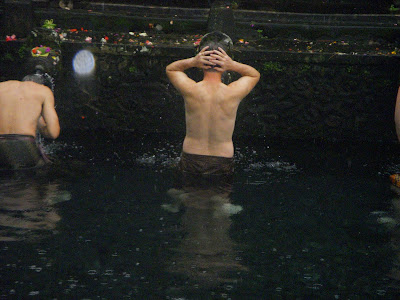
Today we went to the Water Temple, Tirta Empaul, and also visited the healing waters there. This was very special, again outside my comfort zone in the sense that it challenged my simplistic dismissal of all things spiritual. The temple is located at a spring. The water from this spring is channeled (the Balinese really know how to manage water) into a series of pools fed by multiple water spouts.
We entered the pool area in just our sarongs and sandals, and prayed in the Balinese manner. Men cross legged, women kneeling. Each with a small bowl containing flowers, a bouquet, and an incense stick. After wafting the incense over us we extinguished the stick and prayed with hands clasped in front of our foreheads, then we prayed again with a frangipani flower between our hands, then with the small bouquet, and with two petals, and finally with empty hands one more time.
Then we entered the left hand pool, walked to the first spigot, clasped our hands in prayer one more time and ritually washed our heads five times. Then proceeded to the next spigot and so on. Each spigot was labeled in Sanskrit and Balinese with the particular power, so some we avoided (cremation etc.) The repetition, the rain, the constant falling water, the communal nature of the act, the coolness of the water, the echo of the pool enclosure, all added up to a quite remarkable experience.
As Hoyt reminds us, Balinese Hinduism is a religion of orthopraxy (correct ritual practice and behavior), unlike Christianity's orthodoxy (correct belief or thought.) The ritual is important, not the thought, which is why a bunch of westerners like us can be so accepted, as long as we
do the right thing.
We entered the pool area in just our sarongs and sandals, and prayed in the Balinese manner. Men cross legged, women kneeling. Each with a small bowl containing flowers, a bouquet, and an incense stick. After wafting the incense over us we extinguished the stick and prayed with hands clasped in front of our foreheads, then we prayed again with a frangipani flower between our hands, then with the small bouquet, and with two petals, and finally with empty hands one more time.
Then we entered the left hand pool, walked to the first spigot, clasped our hands in prayer one more time and ritually washed our heads five times. Then proceeded to the next spigot and so on. Each spigot was labeled in Sanskrit and Balinese with the particular power, so some we avoided (cremation etc.) The repetition, the rain, the constant falling water, the communal nature of the act, the coolness of the water, the echo of the pool enclosure, all added up to a quite remarkable experience.
 |
| From Bali Photos |
As Hoyt reminds us, Balinese Hinduism is a religion of orthopraxy (correct ritual practice and behavior), unlike Christianity's orthodoxy (correct belief or thought.) The ritual is important, not the thought, which is why a bunch of westerners like us can be so accepted, as long as we
do the right thing.
Hunting the Durian
One of my goals for Bali has been to taste the fabled Durian. Today I succeeded. As we drove back from the Batur volcano, our driver Wayan Sarma, stopped at a roadside stand and helped us select the best fruit. Here is the video. Because of the smell no one wants to transport these fruits in the passenger compartment, so instead he secured it inside the engine compartment and off we drive. Once back at the hotel, Margaret cut the beast open and we all dug in, I have also posted the reviews here as soon as I can.
Sunday, May 23, 2010
Reading in Bali
This short video is a great example of one type of reading practice in Bali and I think it is a great example of the totemic power of reading. The sermon is being read in Sanskrit, and translated and interpreted by a second "reader'" in High Balinese.
I used to think that it was unlikely that anyone, other than perhaps a few priests and priests-in-training, hearing these performance understood what was being read or the translation. But today our driver, Nyoman, translated some of the interpretation for me and said that most people understood High Balinese, but did not use it. That doesn't change the point though, what was important was to hear the words in the original and in a revered older language. Another example would be jewel-encrusted codices paraded through medieval European towns but not read, the Latin Mass, or Tibetan prayer wheels.
For an illiterate population or a primary oral culture (which is what Bali would have been when Hindu texts were introduced to the island, perhaps around 800 -- 1100 C.E) the technology of reading and writing -- which enables people to move information through time and space outside of the human brain -- was magical, and those that controlled the technology, the priests and the rulers who employed them, were anxious to keep it that way.
Mass illiteracy is not the case today in Bali, but remnants of these practices remain in this kind of activity.
I used to think that it was unlikely that anyone, other than perhaps a few priests and priests-in-training, hearing these performance understood what was being read or the translation. But today our driver, Nyoman, translated some of the interpretation for me and said that most people understood High Balinese, but did not use it. That doesn't change the point though, what was important was to hear the words in the original and in a revered older language. Another example would be jewel-encrusted codices paraded through medieval European towns but not read, the Latin Mass, or Tibetan prayer wheels.
For an illiterate population or a primary oral culture (which is what Bali would have been when Hindu texts were introduced to the island, perhaps around 800 -- 1100 C.E) the technology of reading and writing -- which enables people to move information through time and space outside of the human brain -- was magical, and those that controlled the technology, the priests and the rulers who employed them, were anxious to keep it that way.
Mass illiteracy is not the case today in Bali, but remnants of these practices remain in this kind of activity.
Jaya at Selat Pecan.
Dr. Cokorda Bagus Jaya Lesmana is the son of Professor Surayni, a leading Balinese psychiatrist and a psychiatrist himself. He is a friend of Hoyt's and I met him at the ceremony at Selat Pecan.
Saturday, May 22, 2010
Biting the heads off chickens
This afternoon Hoyt took us to a temple ceremony in Selat Pekan up in the mountains. This was the first time we have had an opportunity to attend such an event that was not designed for tourists. There were hundreds of Balinese there and just a couple of dozen tourists.
The event began with Sanskrit chants and sermons, then prayers, then a long kind of mummers play with kings and demons, and lots of comic relief, and then the main event, a variant Barong dance, during and after which a number of men went into trances. This was quite well organized with a clear group of men officiating. They held the trancees (is that a word?) down -- not an easy task, or at least they made it look theatrically difficult -- and emptied their pockets, not sure if they did other things as well. Then let them go and gave them large knives (which a number of us thought was inadvisable since they then proceeded to charge the crowd, but it certainly added to the excitement of the evening, to most people's glee.) The officiants then dangled live chicks in front of the trancees and also bottles of arak -- Balinese moonshine -- because the possessing spirits love blood and alcohol (reminds me of this song.) The trancees, about five guys at this point, would grab the chicks and bite their heads off, then proceed to eat the birds heads and all. One guy must have eaten a dozen chicks. Finally, they are woken from their trance with holy water and weariness and proceeded through the temple gates and the evening is over. At which point we all stream out of the temple.
Generally a good time was had by all, exciting, communal, gossipy. It reminded me of a bullfight.
The most powerful point for me was when the temple guards forced everyone to crouch down below the spirits and Barong (no one could be higher than a spirit.) They were more successful with those people nearer the action. There was this wonderful transgressive amoeba-like quality to the crowd, everyone wanted to stand up and see but also were scared to exceed the gods or defy the guards. As we crouched down we needed more space and the crowd was pushed back. As we rose, we pressed forward. So under the hot lights in this enclosed space on a tropical night we wavered back and forth as the gods moved amongst us and the Barong paced around.
Next I will post a couple of videos from the event, so stay tuned.
The event began with Sanskrit chants and sermons, then prayers, then a long kind of mummers play with kings and demons, and lots of comic relief, and then the main event, a variant Barong dance, during and after which a number of men went into trances. This was quite well organized with a clear group of men officiating. They held the trancees (is that a word?) down -- not an easy task, or at least they made it look theatrically difficult -- and emptied their pockets, not sure if they did other things as well. Then let them go and gave them large knives (which a number of us thought was inadvisable since they then proceeded to charge the crowd, but it certainly added to the excitement of the evening, to most people's glee.) The officiants then dangled live chicks in front of the trancees and also bottles of arak -- Balinese moonshine -- because the possessing spirits love blood and alcohol (reminds me of this song.) The trancees, about five guys at this point, would grab the chicks and bite their heads off, then proceed to eat the birds heads and all. One guy must have eaten a dozen chicks. Finally, they are woken from their trance with holy water and weariness and proceeded through the temple gates and the evening is over. At which point we all stream out of the temple.
Generally a good time was had by all, exciting, communal, gossipy. It reminded me of a bullfight.
The most powerful point for me was when the temple guards forced everyone to crouch down below the spirits and Barong (no one could be higher than a spirit.) They were more successful with those people nearer the action. There was this wonderful transgressive amoeba-like quality to the crowd, everyone wanted to stand up and see but also were scared to exceed the gods or defy the guards. As we crouched down we needed more space and the crowd was pushed back. As we rose, we pressed forward. So under the hot lights in this enclosed space on a tropical night we wavered back and forth as the gods moved amongst us and the Barong paced around.
Next I will post a couple of videos from the event, so stay tuned.
Friday, May 21, 2010
Traditional Healer
In another trip outside of my comfort zone, Hoyt took us all to a traditional healer, Cok Rai. I will share Micki's video response when I can get blogger to accept such a big video. But in the meantime let me tell you about my experience. Cok Rai was a superb listener and observer and he very quickly understood quite a bit about each of us. i think this comes from natural empathy, careful observation, and long experience. Hoyt would say I am safely staying in my western rationalist comfort zone and that I should at least consider that he has some other power that is best understood from within a Balinese worldview. Perhaps so, but I think my rationalist explanation still leaves him as an amazing guy. He spent a lot of time poking me in an eclectic mixture of pressure points that seem to be based on Chinese and Indian Vedic medicine. Ultimately ending up poking me between my toes with a stylus, each point connected to a different internal organ. I have one problem, a memory lodged in my head (luckily it has not progressed to my chest) that I need to let go of.
After lunch we went to a mask maker, I Wayan Muka, in Mas. Masks are a common component in Balinese performances. I was amazed at how he was changed by simply putting on the mask and dancing, which is his specialty. But these tourist things, however, accomplished leave me cold. When I have some time I will have to blog about tourism in Bali, or at least my uninformed early impressions of same.
After lunch we went to a mask maker, I Wayan Muka, in Mas. Masks are a common component in Balinese performances. I was amazed at how he was changed by simply putting on the mask and dancing, which is his specialty. But these tourist things, however, accomplished leave me cold. When I have some time I will have to blog about tourism in Bali, or at least my uninformed early impressions of same.
Thursday, May 20, 2010
Running in Rice Fields
Mark and I found the most amazing run this morning. The hotel staff recommended a run through the rice fields in Ubud. About 3 miles. We ran through a neighbourhood of the usual B&B's and art galleries and then the road narrowed to a track and then to a muddy lane and we suddenly rose up into the rice paddies. we were running along the dikes that separate the rice fields, past coco palms and small compounds. Ducks were working eating bugs and weeds in the flooded fields and leaving their fertilizer behind them. Cocks crowing, We ran up one irrigatin system and then down another and could see the subak system at work. It reminded me of a similar system in Colorado created by the Spanish, but on a much more sophisticated level.
The run was a real mixture of pre-lapserian rural idyll and post-modern responses to globalization. About half way through we met a young man tending an art gallery, yes, an art gallery in the middle of a rice field! But he was also watching his water alarm a simple water balance that continuously filled and emptied and rose and fell, hitting a bamboo pole as it did so The regular "thock" notified the farmer that the water was still running (and thus that his neighbour had not cut off this water supply yet.) We also saw a man shinning up a coco palm after the ripe coconuts above and small fields of mustard greens and soy beans amid the rice.
It ws a run I will always treasure, but as Hoyt said, in ten years time those fields will probably all be art galleries. bali is a strange experience.
The run was a real mixture of pre-lapserian rural idyll and post-modern responses to globalization. About half way through we met a young man tending an art gallery, yes, an art gallery in the middle of a rice field! But he was also watching his water alarm a simple water balance that continuously filled and emptied and rose and fell, hitting a bamboo pole as it did so The regular "thock" notified the farmer that the water was still running (and thus that his neighbour had not cut off this water supply yet.) We also saw a man shinning up a coco palm after the ripe coconuts above and small fields of mustard greens and soy beans amid the rice.
It ws a run I will always treasure, but as Hoyt said, in ten years time those fields will probably all be art galleries. bali is a strange experience.
Wednesday, May 19, 2010
Outside my comfort zone
One of the points of these trips is to get you out of your comfort zone. So there we were this afternoon lounging in the pool of a truly superb hotel in Ubud (I will post photos later. I was dumb enough to forget to bring the doo-hicky that allows me to download photos from the camera -- so i will take some with the flip tomorrow. Stay tuned.) Trying to work out how this could possibly be outside of our comfort zone.
Then we went to get ceremonial temple clothing -- sarong, saput (over-sarong), and prayer sash, udeng (hat.) So there we all are choosing colors and styles, mixing and matching, and feeling foolish, but also somewhat peacocky in our finery, at least the men were. That was a little out of my comfort zone.
The reason we got this garb was to be able to attend and participate in an "opening prayer." A prayer tat the Balinese use to begin all kinds of activities, including a visit like ours. Again, photos to come, but this was way out of my comfort zone, old materialist that I am. The service consisted of interlocking prayers from the temple priest, offerings by the family, and various ritual actions by the audience/laity. So all our senses were engaged, hearing the prayers being snug to the sound of bells, the smell of incense, the incredibly rich visual environment, feeling my sorry butt on the hard floor and the feel of flowers between my hands as I pray. I can't wait to share some of these with you.
While we were waiting for the temple priest to arrive we watched a troupe of young girls practicing their dancing with the local gamelan orchestra in the district community center, an open pavilion on the street. These children were totally unconcerned with the audience, in fact pleased to have one. There level of skill was remarkable. Again, photos to come.
Then we went to get ceremonial temple clothing -- sarong, saput (over-sarong), and prayer sash, udeng (hat.) So there we all are choosing colors and styles, mixing and matching, and feeling foolish, but also somewhat peacocky in our finery, at least the men were. That was a little out of my comfort zone.
The reason we got this garb was to be able to attend and participate in an "opening prayer." A prayer tat the Balinese use to begin all kinds of activities, including a visit like ours. Again, photos to come, but this was way out of my comfort zone, old materialist that I am. The service consisted of interlocking prayers from the temple priest, offerings by the family, and various ritual actions by the audience/laity. So all our senses were engaged, hearing the prayers being snug to the sound of bells, the smell of incense, the incredibly rich visual environment, feeling my sorry butt on the hard floor and the feel of flowers between my hands as I pray. I can't wait to share some of these with you.
While we were waiting for the temple priest to arrive we watched a troupe of young girls practicing their dancing with the local gamelan orchestra in the district community center, an open pavilion on the street. These children were totally unconcerned with the audience, in fact pleased to have one. There level of skill was remarkable. Again, photos to come.
Running on the beach at Sanur

Mark Anderson and I went running on the beach at Sanur before dawn today. There were crowds of boisterous young Muslim people who came on big tourist buses and watched the sun come up. Lots of people were delighted to see two lumbering western tourists doing such a silly thing as running on the beach and greeted us with hellos and good mornings. Each beach restaurant, hotel, and house had numerous offerings and shrines clothed in distinctive clothes with lots of offerings placed about.
No pictures I am afraid, I could not run with the camera. So just my memories, but here isan accurate one from someone else.
Tuesday, May 18, 2010
Why are you going to Bali?
In Orlando airport I asked some of the group why they are going on this trip. Here is John Houston's answer.
Saturday, May 15, 2010
The road to Bali
On Monday I leave for Bali, Indonesia on the latest Rollins faculty trip. Each faculty member goes with a particular interest. I have two, the first is traditional Balinese writing and reading practices, Lontars, and reading groups, and the other is tropical vegetable gardening.
I am taking a laptop and flip camera with me and will try blogging from Bali as we go. I could have done this all from my phone, but Verizon would have charged me an arm and leg, and probably screwed it up anyway. One non-blog example: they put skype mobile on their phone and then only let you use it via their phone system, for which you need an international plan. Dumb.
Wish me luck. By the way, you know where the title of this post comes from.
I am taking a laptop and flip camera with me and will try blogging from Bali as we go. I could have done this all from my phone, but Verizon would have charged me an arm and leg, and probably screwed it up anyway. One non-blog example: they put skype mobile on their phone and then only let you use it via their phone system, for which you need an international plan. Dumb.
Wish me luck. By the way, you know where the title of this post comes from.
Tuesday, May 11, 2010
Olin Library on the iPhone
The Olin Library have now been added to the Rollins College iPhone App. You can search the library's online and physical collection with R-Search, search individual databases or the online catalog more selectively, check your account and renew books, access online reserves or your interlibrary loan materials, ask a librarian for information, and more. Download this free app here using iTunes, or search the iTunes Store for Rollins College.
Next steps: a website tuned for access form mobile devices, and apps for other phones, particularly the droid.
Tuesday, April 27, 2010
The New Yorker on the iPad
Allen Kupetz and I have been discussing Ken Auletta's article in the latest New Yorker. The iPad, the Kindle, and the future of books: newyorker.com
The thing I find most interesting about the article are the publisher plans to use the iPad to add multimedia to books. I have always thought this was bound to happen when we went digital and will ultimately lead to the overwhelming of text by multimedia, which in turn will lead to a counter trend in which some, smaller publishers, return to a "purer" form of the book dominated by text (probably in both print codex and digital forms.) That counter trend will be smaller, and thus we find ourselves ultimately (as much as there is any 'ultimate' when it come to information storage and distribution) in a situation in which, what we would recognize today as a book, occupies a far smaller place in our information economy and culture than it does at the moment, something akin to poetry today.
The thing I find most interesting about the article are the publisher plans to use the iPad to add multimedia to books. I have always thought this was bound to happen when we went digital and will ultimately lead to the overwhelming of text by multimedia, which in turn will lead to a counter trend in which some, smaller publishers, return to a "purer" form of the book dominated by text (probably in both print codex and digital forms.) That counter trend will be smaller, and thus we find ourselves ultimately (as much as there is any 'ultimate' when it come to information storage and distribution) in a situation in which, what we would recognize today as a book, occupies a far smaller place in our information economy and culture than it does at the moment, something akin to poetry today.
Thursday, April 08, 2010
Response to "OCLC's Uncommon Dilemma."
Today is Fox Day at Rollins, so I finally have a moment to respond to Barbara Fister’s LJ column “OCLC’s Uncommon Dilemma” of March 18th.
First, let’s deal with the metaphor of the “tragedy of the commons” that I used in response to her column “Something There is That Doesn’t Love a Wall” of March 11th. It seems clear from the tone of her piece that Barbara thinks that the end of OCLC, at least its current business model, would not be a tragedy and certainly not a tragedy of the commons. While I think it is good for the OCLC members and leadership to take the challenges we face in a new digital environment seriously and to consider alternative ways of continuing to serve libraries, I do think it would be a tragedy if we walked away from forty years of progress and experience to follow a relatively untested and rather utopian idea of a, to quote Barbara’s quotation from Yochai Benkler, “new modality of organizing production.” The important word in the quote Barbara takes from my response, which she does not seem to address, is “comprehensive.”
Although OCLC WorldCat is not completely comprehensive, it is the closest thing we have to a global bibliography of the contents of the world’s libraries. This very comprehensiveness makes it a valuable resource. If I need a cataloging record, it is likely to be in OCLC. If I want to borrow an item from a library, I am likely to find a willing lender in OCLC. Such one stop shopping is a huge efficiency for libraries, even if it is only as a resource of last resort after the resources of ones local consortia have been exhausted. So, the membership needs to plan a future that maintains and expands this comprehensiveness. I think it is worth investing some money in ensuring that.
Comprehensiveness is not very useful if it does not last. Long term sustainability is important. OCLC has been a remarkable success for libraries over the last forty years. Apart from the books and print journals my predecessors purchased four decades ago I can’t think of too many other significant resources from the last 1960’s that our staff and users make use of every day. Our library building was not built until 1985, our own OPAC is not that old, we disposed of the physical shelflist last year, and none of our staff were working here in the late sixties. NLM’s Medline might be the only example of a similarly long-lived and stable resource. As a director of an OCLC member library I feel a responsibility to ensure the sustainability of the OCLC bibliographic database for the long term if only for selfish long term planning purposes. We live in an age of enormous turmoil in the information economy, much of it very valuable creative destruction, but some of it just plain tumult. A reliable resource that we depend on to underpin many of the information resources and services we make available to our users, now and for many years to come, is extremely valuable and worth paying for to maintain. Barbara offers Wikipedia as an example of this new modality, but Joseph Janes in American Libraries (What Do You See? March 2010) cites recent work by the Augmented Social Cognition Group at Xerox’s PARC indicating that the rate of expansion in both articles and the number of contributors at Wikipedia has slowed. He wonders whether, “it is a lot harder to than it looks to make an encyclopedia using boldness and no firm rules.” And Wikipedia is just nine years old.
That sustainability has to be balanced with innovation. If the OCLC database had the same interface librarians began using all those decades ago, or even the same one I used when I became a librarian in the early 1990’s (anyone else remember the F11 key?) It wouldn’t be half as useful as it is today. This blog is littered with URLs to records of books in WorldCat and now WorldCat Local. I can now imagine, perhaps even begin planning for, a future without an integrated library system because the bibliographic record of the Rollins library collection is secure within the OCLC database and OCLC staff are making impressive progress on taking library systems to web scale. This innovation comes from a solid, long-lived, membership based not-for-profit organization, not from a hot startup, and not from a privately held, or publicly traded for profit corporation, and is not the result of, “loosely connected individuals who cooperate with each other without relying on either market signals or managerial commands.” (Benkler.) That again, is worth investing in.
I do not want to leave the impression that I am opposed to Open Access, I am not. In fact, OCLC already provides open access to the
So, how to balance these apparently conflicting goals? The answer might be to divide OCLC into two parts. OCLC1, the bibliographic utility, responsible for maintenance and development of the bibliographic database and records of library holdings, with a specific charge to attempt to be as comprehensive in terms of containing the record of the bibliographic production of humankind, and to provide unfettered access at the lowest price (the same price for everyone) that guarantees sustainability; and OCLC2, a systems and services vendor like any other (except that it is member owned and profits are ploughed back into development and to support the members) that seeks to compete with other vendors to create innovative services for any library. OCLC1 should be low priced enough to obviate the need for any other entity to find it necessary or profitable to attempt to duplicate a similar comprehensive bibliographic database, also other vendors will have a vested interest in maintaining the comprehensiveness of the database since their own systems will be layered on top of the bibliographic utility, and OCLC2 can sink or swim in the marketplace based on price and innovation.
I doubt if Barbara will like my solution. It is based on hard-nosed self interest (albeit organized collectively.) But then so was the enclosure of the English commons in the 17th and 18th centuries. Powerful landowners forced Parliament to provide a legal structure that enabled them to enclose common land and disempower villagers and landless peasants. This was a painful and violent process, but ultimately it contributed to a rise in English food production, the creation of an urban working class, and ushered in the Industrial Revolution leading to raised living standards for all; because landowners were prepared to invest in sustainability and innovation, while commoners were not. While I don’t want to down play the pain my ancestors endured as they left rural
Friday, March 26, 2010
NITLE Summit
Assessing the Impact of Information literacy and Technologies on Learning (David Baird, Colgate and Sondra Smith, St. Lawrence), the last session before Pat and I get on the plane. Some interesting sites:
Media Scholarship Website at Hamilton.
The "freshman" (hate that word!) survey of the Cooperative Institutional Research Program (CIRP) at the Higher Education Research Institute.
Media Scholarship Website at Hamilton.
The "freshman" (hate that word!) survey of the Cooperative Institutional Research Program (CIRP) at the Higher Education Research Institute.
NITLE Summit
The ERIAL Project is a really interesting anthropological study of research in academic libraries in Illinois. Akin to the Rochester Study. I am really interested in working with our Anthropology department on something similar -- maybe a student faculty collaborate research project?
NITLE Summit
Olin is conducting the LibQual survey of library service quality again this year. Here at the Summit, Pat and I are in a session about the MISO survey, which measures both IT and the library services. Since our IT and Library share the same building students and faculty often conflate their perceptions about the two. Using MISO might overcome this.
Thursday, March 25, 2010
NITLE Summit
Bryan Alexander gave his usual bravura performance about two particular emerging technologies on Thursday night. Here is an interesting alternative to PowerPoint. A report worth taking a look at as the Reed College report on e-books.
Tuesday, March 23, 2010
25th Anniversary


2010 is the Olin library building's 25th anniversary. This weekend we have Reunion on campus and so we sprucing ourselves up and celebrating the anniversary. As I wrote here a while ago, we have hung some posters and banners. I think Strategic Marketing did a great job.
Tuesday, March 16, 2010
Digital Preservation and Access
An interesting juxtaposition of articles in the Arts section of the Times this morning. Emory has made some of Salmen Rushdie's papers available, including the original Mac machines on which he wrote, and there is an interesting discussion of the difficulties of preserving "born digital" materials. Like most archives, our own Archives & Special Collections has not begun to tackle this yet, too expensive, not enough standards, etc.
The second article concerns C-Span placing their video archive on the web. You can find the archive here. This is not about preservation, but all about access, and what incredible access. This is going straight on my politics libguide. But C-Span is actually archived at the Research Park at Purdue.
The second article concerns C-Span placing their video archive on the web. You can find the archive here. This is not about preservation, but all about access, and what incredible access. This is going straight on my politics libguide. But C-Span is actually archived at the Research Park at Purdue.
Sunday, March 14, 2010
OCLC Records etc.
Barbara Fister, of Gustavus Adolphus, has written her usual thoughtful comments about the latest controversy concerning how we can use and sustain large shared bibliographic databases. My major concern here is how we can enable the maximum sharing and reuse of data while enabling such organizations as OCLC just enough control so that they have an incentive to continue to do the great work that we have seen over the last forty years.
Thursday, March 11, 2010
Google Bikes
I love this!
Unfortunately, when I look for my daily commute, it takes me through a gated reserve that would be lovely, but illegal. The real route slightly shorter and goes along Mizell, and east, not west of Lake Mizell. But Google Maps won't let me change it, because I take a pathway, not a road for a 20 feet of the route and I bike aacross campus, not around it.
C'est la vie!
Unfortunately, when I look for my daily commute, it takes me through a gated reserve that would be lovely, but illegal. The real route slightly shorter and goes along Mizell, and east, not west of Lake Mizell. But Google Maps won't let me change it, because I take a pathway, not a road for a 20 feet of the route and I bike aacross campus, not around it.
C'est la vie!
Tuesday, March 09, 2010
Urban Think to Close at the end of March.
Well this is sad news. The best local independent bookstore is closing. I suppose this is a sign of the times, but is a bad sign all the same. I enjoyed riding my bike down the Cady Way Trail, around the mall, and through Thorton Park to the bookstore. I guess I just didn't do it often enough. Last time I went, in February, I bought Fernando Baez's A Universal History of the Destruction of the Book: From Ancient Sumer to Modern Iraq. But since then I have bought at least two books (new and used) on Amazon. Pogo was right, "we have met the enemy and they is us."
Thursday, February 25, 2010
Rollins Adopts Open Access Policy
I am delighted to be able to tell you that I have just come from an Arts & Sciences Faculty Meeting at which the faculty unanimously voted to adopt an open access policy for faculty publications. I have attached the policy. We have signed up with Bepress to host the repository, the first iteration (certainly not ready for prime time, but you get the picture) is accessible at Rollins Scholarship Online.
We were advised to find a "faculty advocate" and in fact found two excellent ones -- Thom Moore, Physics professor, Chair of the A&S Professional Standards Committee and Director of the Rollins Student-Faculty Collaborative Research Program, and Claire Strom, History Professor and Editor of the journal Agricultural History.
They did a great job.
Thursday, February 11, 2010
Coyle's InFormation: DOJ: "A Bridge Too Far"
A thoughtful reaction to the Department of Justice's filing on the Google Book Search Settlement. Coyle's InFormation: DOJ: "A Bridge Too Far"
Wednesday, February 03, 2010
What do faculty at elite institutions think is the future of scholarly communication?
This report, Assessing the Future Landscape of Scholarly Communication: An Exploration of Faculty Values and Needs in Seven Disciplines, from the Center for Studies in Higher Education of the UC system is interesting, though it is important to note that the 160 interviewees mostly came from elite research universities. So they obviously have a dog in this fight.
This is akin to asking the abbots of the great medieval monasteries and the most literary aristocrats in the second half of the 15th century what the future of scholarly communication would be. Better to ask the inky scholar working in the back of the print shop down in the city.
This is akin to asking the abbots of the great medieval monasteries and the most literary aristocrats in the second half of the 15th century what the future of scholarly communication would be. Better to ask the inky scholar working in the back of the print shop down in the city.
Friday, January 29, 2010
Open Access Monographs
As Rollins develops an open access policy for faculty publications, questions arise form other scholars who tend to publish books rather than articles. Here is a notice of an interesting session called The Ebook Transition: Collaboration and Innovations Behind Open Access Monographs from SPARC/ACRL at ALA Midwinter.
The proposed policy will not include monographs, just scholarly articles, book chapters, and published conference proceedings.
The proposed policy will not include monographs, just scholarly articles, book chapters, and published conference proceedings.
Wednesday, January 27, 2010
Book a Year Reception
Every year the Olin Library holds a reception to thank the donors to our Book a Year program because, frankly, without them we would have no book budget! This year the reception will be on April 16th, just one day shy of the 25th anniversary of the opening of the Olin Library building in 1985, and obviously this year is the 125th anniversary of the College, so this will be a special one.
Every year we give our guests a small gift, usually a package of notecards with an illustration that reminds them of the library (perhaps an image from a beautiful book in Special Collections, a reproduction of an elegant book plate, or a historic image of the library.) This year we have a group of images we have to chose from. My vote goes for this one.
I think we should use the others as big posters, blown up and hung from the ceiling in the library, or as banners on the outside of the library entrance celebrating our 25th, because they are so dramatic. What do you think?


Every year we give our guests a small gift, usually a package of notecards with an illustration that reminds them of the library (perhaps an image from a beautiful book in Special Collections, a reproduction of an elegant book plate, or a historic image of the library.) This year we have a group of images we have to chose from. My vote goes for this one.

I think we should use the others as big posters, blown up and hung from the ceiling in the library, or as banners on the outside of the library entrance celebrating our 25th, because they are so dramatic. What do you think?


Sunday, January 17, 2010
ALA Midwinter 2010 Sunday
Over the stultifying proceedings of the ACRL Chapter Council we shall draw a veil. I did my duty.
With YBP's acquisition of Blackwell we have to transition from one to another. Edna, Darla, and Mary have recommended we go with YBP after investigating Amazon's more limited offerings. Amazon could really own this marketplace if they wanted to. They have the materials, the price, they have the technology, and they have the name recognition amongst our users. If they just step up to the plate and put a few things in place (basically physical processing and institutional customer service.) But for the moment, we are happy to go with YBP. I met with Mike Walmsley here and we agreed on a date to up with full processing etc. of April 1st, so that we can have a couple of months of experience before our fiscal year ends on 5/31. Next steps: complete a transition template with dates and responsibilities and a conference call with our staff and YBP.
Then the afternoon was all about ACRL and the Government Relations Committee. I am the outgoing chair and Marilyn Ochoa is the vice-chair and doing a great job. We have to find a way to grow the number of advocates from around 50 (in 26 states) to one in every congressional district. We are hoping we can get targeted lists of ACRL members and colleges and universities in strategic congressional districts that committee members can call (the ACRL members, and other colleagues and friends they know at institutions in those districts.)
We worked on the draft of the ACRL legislative agenda. No surprise that FRPAA and public access to federally funded research is at the top, but it is interesting to see orphan works rising (as we approach the Google Book Settlement) and possibly section 108 as well.
I was also delighted to see that all the committee members at the meeting are planning on attending the Advocacy Day on the Tuesday after ALA National in Washington. I hope you will be there too!
I had dinner with friends who wanted to pick my brains about Summon. I made a statement that I hoped would get challenged because I think it is worth thinking about, so let me know what your response would be. We now live in an age of information super-abundance. While there are still cases in which comprehensive search and retrieval are necessary, increasingly users do not need and cannot effectively use the overwhelming results of comprehensive searches. This super-abundance also means that many users are satisfied (and rightly so) with "good enough" results. The extra time and effort necessary to get the "best"results is wasted. Therefore some librarians' concerns that relevancy searching of unified discovery services like Summon will not result in comprehensive searches and not necessarily retrieve the best results are misplaced. User searching before such systems was not comprehensive or very well constructed. A large system with a good selection of resources, combined with a good search engine will result in better overall results for the user. Am I kidding myself?
With YBP's acquisition of Blackwell we have to transition from one to another. Edna, Darla, and Mary have recommended we go with YBP after investigating Amazon's more limited offerings. Amazon could really own this marketplace if they wanted to. They have the materials, the price, they have the technology, and they have the name recognition amongst our users. If they just step up to the plate and put a few things in place (basically physical processing and institutional customer service.) But for the moment, we are happy to go with YBP. I met with Mike Walmsley here and we agreed on a date to up with full processing etc. of April 1st, so that we can have a couple of months of experience before our fiscal year ends on 5/31. Next steps: complete a transition template with dates and responsibilities and a conference call with our staff and YBP.
Then the afternoon was all about ACRL and the Government Relations Committee. I am the outgoing chair and Marilyn Ochoa is the vice-chair and doing a great job. We have to find a way to grow the number of advocates from around 50 (in 26 states) to one in every congressional district. We are hoping we can get targeted lists of ACRL members and colleges and universities in strategic congressional districts that committee members can call (the ACRL members, and other colleagues and friends they know at institutions in those districts.)
We worked on the draft of the ACRL legislative agenda. No surprise that FRPAA and public access to federally funded research is at the top, but it is interesting to see orphan works rising (as we approach the Google Book Settlement) and possibly section 108 as well.
I was also delighted to see that all the committee members at the meeting are planning on attending the Advocacy Day on the Tuesday after ALA National in Washington. I hope you will be there too!
I had dinner with friends who wanted to pick my brains about Summon. I made a statement that I hoped would get challenged because I think it is worth thinking about, so let me know what your response would be. We now live in an age of information super-abundance. While there are still cases in which comprehensive search and retrieval are necessary, increasingly users do not need and cannot effectively use the overwhelming results of comprehensive searches. This super-abundance also means that many users are satisfied (and rightly so) with "good enough" results. The extra time and effort necessary to get the "best"results is wasted. Therefore some librarians' concerns that relevancy searching of unified discovery services like Summon will not result in comprehensive searches and not necessarily retrieve the best results are misplaced. User searching before such systems was not comprehensive or very well constructed. A large system with a good selection of resources, combined with a good search engine will result in better overall results for the user. Am I kidding myself?
Saturday, January 16, 2010
ALA Midwinter 2010 Saturday
Went to the Ebrary breakfast to be underwhelmed by their new DASH product. Basically you get to add pdf's to your Ebrary account. This means you get to take advantage of the great Ebrary search and info management features, but the documents you load aren't openly available on the web, just to your users. I suppose if a library had an Ebrary account but not an institutional repository then it might be helpful, but it feels like a solution in search of a problem. It is hardly difficult to find ways to load and make pdf's available to campus these days.
Then a session on getting librarians involved in legislative advocacy. Like most of these events, the panel told lots of war stories to the sparse audience about how much fun and how easy this is. I am not convinced these help others get involved. I am thinking about ways to organize Marilyn Ochoa's and my session at FLA in April (see page 7 of the preliminary program) to be more productive. Role playing? Actual calling and e-mailing from the session? Detailed, specific information for participants?
I spent some time at this conference looking at other players in the developing unified discovery service marketplace. Primo from Ex Libris clearly grows out of the company's ILS roots, just as Summon grows out of Serials Solutions' e-journal roots. Ex Libris are very proud of their known item searching, because they are listening to their customers (librarians) not the end user. EBSCO's contender is based on database, rather than article, searching (perhaps a distinction without a difference.) It has all the great features of EBSCO host searching, and is using federated searching to get to stuff they cannot get permission to pre-index. These resources are presented in the bottom right. It is a sensible, if unfortunate, solution. You can get WorldCat records this way (presumably they use the WorldCat API) quite cheaply, or they can be pre-indexed for beaucoup bucks. This could be a fall back position for Summon if they get serious about putting WorldCat in their service.
Then I went to listen to the big guys' take on the future role of academic libraries at the Elsevier 12th Digital Libraries Symposium: The New Role and Image of Academic Libraries (sorry it is not online yet, but will probably be here when it is.) Wendy Lougee (Minnesota) talked about their study of how their libraries fit into the research process and how that is changing (she talked about the "diffuse library", a somewhat old idea but a great phrase, and the libraries providing expertise, process, sensemaking and consultation), William Tabb (John Hopkins) gave a "how we done it good in my library" talk but made it sound important as only an ARL director can, and Carol Tenopir (Tennessee) talked about her study of the value research libraries provide in the grant money acquisition process (for research intensive institutions they provide great ROI, for teaching intensive ones they don't: big surprise. I am simplifying, but she based this on library materials cited in grant proposals and the value the grant writer/researcher placed on them. It would be more interesting to know how the grant reviewer to office valued them and if you could control for other variables and look at change in grants monies and library materials funding over time.)
Perhaps the most useful thing I picked up there was this issue of their Connect newsletter, all about libraries and mobile technology.
Then a session on getting librarians involved in legislative advocacy. Like most of these events, the panel told lots of war stories to the sparse audience about how much fun and how easy this is. I am not convinced these help others get involved. I am thinking about ways to organize Marilyn Ochoa's and my session at FLA in April (see page 7 of the preliminary program) to be more productive. Role playing? Actual calling and e-mailing from the session? Detailed, specific information for participants?
I spent some time at this conference looking at other players in the developing unified discovery service marketplace. Primo from Ex Libris clearly grows out of the company's ILS roots, just as Summon grows out of Serials Solutions' e-journal roots. Ex Libris are very proud of their known item searching, because they are listening to their customers (librarians) not the end user. EBSCO's contender is based on database, rather than article, searching (perhaps a distinction without a difference.) It has all the great features of EBSCO host searching, and is using federated searching to get to stuff they cannot get permission to pre-index. These resources are presented in the bottom right. It is a sensible, if unfortunate, solution. You can get WorldCat records this way (presumably they use the WorldCat API) quite cheaply, or they can be pre-indexed for beaucoup bucks. This could be a fall back position for Summon if they get serious about putting WorldCat in their service.
Then I went to listen to the big guys' take on the future role of academic libraries at the Elsevier 12th Digital Libraries Symposium: The New Role and Image of Academic Libraries (sorry it is not online yet, but will probably be here when it is.) Wendy Lougee (Minnesota) talked about their study of how their libraries fit into the research process and how that is changing (she talked about the "diffuse library", a somewhat old idea but a great phrase, and the libraries providing expertise, process, sensemaking and consultation), William Tabb (John Hopkins) gave a "how we done it good in my library" talk but made it sound important as only an ARL director can, and Carol Tenopir (Tennessee) talked about her study of the value research libraries provide in the grant money acquisition process (for research intensive institutions they provide great ROI, for teaching intensive ones they don't: big surprise. I am simplifying, but she based this on library materials cited in grant proposals and the value the grant writer/researcher placed on them. It would be more interesting to know how the grant reviewer to office valued them and if you could control for other variables and look at change in grants monies and library materials funding over time.)
Perhaps the most useful thing I picked up there was this issue of their Connect newsletter, all about libraries and mobile technology.
Friday, January 15, 2010
ALA Midwinter First day
I spent the morning in the Gardner Museum. Bethany loves this place, but I am less impressed. I think I would have enjoyed the Institute of Contemporary Arts more.
The afternoon was the ACRL Leadership Council, not much to say there. Now I am in my hotel room with a cold.
The afternoon was the ACRL Leadership Council, not much to say there. Now I am in my hotel room with a cold.
Wednesday, January 13, 2010
ALA MIdwinter 2010

Just as the temperature begins to rise in Florida, I am off to Boston for the Midwinter. Oh, the horror! The major things for this conference are the inaugural meeting of the Summon Advisory Board, lots of SPARC open access and ACRL Government Relations stuff, meetings with Bepress about our upcoming institutional repository "Rollins Scholarship Online", and with YBP as we transition from Blackwell to Gobi. What I really hope happens is I see and hear something new and meet up with some old friends.
Wednesday, January 06, 2010
Building Relationships with Adjunct Faculty

Adjunct faculty members can be tough to connect with, they can can feel like nomads on campus, no place to gather their thoughts, meet with a student, or check e-mail.
So I was delighted when the public services librarians suggested that we use the space that had been a reference workroom and ILL office as an Adjunct Faculty Lounge.
This is just an experiment at this stage, but we hope that creating this space right in the middle of the librarians offices will encourage more contact between these faculty and the librarians and thus lead to more instruction and a heightened awareness of how the library might help support their teaching. The room has a PC and printer as well as some comfortable seating, art on the walls, and soothing lights.

The printer is the networked printer that supports the librarians, so we hope they will be in and out all day as well; leading to all kinds of serendipidous opportunities for relationship building.
Sunday, January 03, 2010
Donna Cohen 1943-2010

This is a terribly sad way to start the new year, but I have to report that Donna Cohen, my predecessor as Director of the Olin Library at Rollins College, died on January 2nd, after suffering a stroke on December 30th, 2009 while on vacation with her family in New Mexico. Her husband, Dr. Ed Cohen also of Rollins College, was with her. A private funeral will be held in Washington, D.C. I understand a memorial service will be held at Rollins later in the spring.
Donna received her BA from the University of Maryland in 1964, her Masters in Education from Rollins in 1972, and her MSLS from the University of North Carolina, Chapel Hill in 1982. She became Acquisitions Librarian at Rollins College in 1986. She became Library Director in 1999 and served until her retirement in 2006. She was a valued member of the Rollins senior leadership team and was elevated to emeritus status on her retirement. Donna was active in numerous professional associations including the American Library Association, the Florida Library Association, the Association of Central Florida Librarians, and the Beta Phi Mu International Honor Society. She published in the areas of acquisitions and the history of Carnegie libraries. Her publications include:
"Andrew Carnegie and Academic Library Philanthropy: The Case of Rollins College, Winter Park, Florida," Libraries & Culture, Vol. 35, No. 3 (Summer 2000), pp. 389-413.
Amongst many other achievements in her career Donna was responsible for revitalizing the library's Book a Year program and for opening the Bookmark Cafe in the Olin Library, but I think the greatest professional impact she had was as a mentor to librarians and staff both within and beyond Rollins."Endowed Book Funds: The Book-A-Year Fund at Rollins College," Acquisitions Librarian, No. 22 (1999), pp. 171-177.
"Serials Review as a Collection Development and Acquisitions Tool," Issues in Collection Management: Librarians, Bookseller, Publishers, ed. by Murray S. Martin, Greenwich, CT: JAI Press, 1995, pp. 57-63.
"Serials Review as a Collection Development and Acquisitions Tool," Issues in Collection Management: Librarians, Bookseller, Publishers, ed. by Murray S. Martin, Greenwich, CT: JAI Press, 1995, pp. 57-63.
"The Role of the Acquisitions Librarian in the Accreditation of Academic Libraries," Acquisitions Librarian, 12 (1994): pp. 27-35.
"The Present State of Education for Acquisitions Librarianship," Library Acquisitions: Practice & Theory, Vol. 15 (1991), pp 359-364.
"A Recent History of the Library Criterion of the Southern Association of Colleges and Schools," Southeastern Librarian 39 (1989), pp. 9-12.
"A Recent History of the Library Criterion of the Southern Association of Colleges and Schools," Southeastern Librarian 39 (1989), pp. 9-12.
On a more personal note, I could not have wished for a better predecessor as a director. Donna was unfailingly supportive and discrete. It is never easy to watch someone else take the reins of an organization you have directed, but Donna found the right balance between withdrawing to let the library grow and develop and being supportive and available to answer questions and provide information. Even though I did not have the privilege of knowing Donna for long I will miss her and I know many others in the library, who enjoyed knowing Donna and working with her for decades, will miss her greatly.
Since the program was so important to Donna, it seems only fitting that we set up a Book a Year memorial in her name. Contributions to this fund should be marked "Book a Year, Donna Cohen" and sent to
Erin Hodge
Rollins College
1000 Holt Avenue - 2750
Winter Park, FL 32789
(407) 647-1196
Contributions can also be made to the Susan G. Komen Foundation for Breast Cancer Research.
Friday, January 01, 2010
BBC and BL together to build a digital archive.
This memorandum of understanding sounds like it could be pretty cool. There are lots of interesting digitization efforts underway in Europe.
Wednesday, December 23, 2009
New website
 Since the very beginning of this blog I have written about the Olin library website. I am delighted to be able to say that we are very close to having a new website. The image here is the home page, notice there is no great verbiage to wade through. We think most people come tot he library online to search for and find information. So the first thing you get is access to our iteration of Summon, and subject and title access to databases. Clustered around that is the ability to navigate to more specific kinds of searches, and information about, or services of, the library.
Some of the links still don't work, some of the images are stock images, but you get the idea. I have to give a big thank you to Paul Gindlesperger for all his work in coding this site. At the beginning of the fall term we got access to the college CMS and began writing our new site. Over the fall we have had numerous meetings about what we want it to look like and how we want it function. We have tried to design it based on these principles.
- Our top priority is enabling our users to find the information they seek.
- We seek to help relative novice student users, while enabling more sophisticated users to get what they need in a familiar "native mode" or via quick shortcuts.
- The website should include a significant education component, and not assume that users are in the building or can seek in person help.
- It should be aesthetically gorgeous.
- Information about us, our services, facilities, or resources, that are key to our users use of the (online and physical) library are of primary importance (e.g. hours, phone #, etc.). Other information about us is secondary (e.g. history, statistics, etc.)
- Metadata should be consistent and not hide us from search engines (on and off campus)
- If we disagree on architecture, nomenclature, etc. usability testing will be used to decide the outcome.
- Pages should be coded so that we continuously collect data about usage etc.
- We use that data and usability testing to make decisions about revisions of the site.
- The site should be efficiently maintained, hopefully by a variety of people in the library.
I would love to hear your reactions to it. What do you think we have got right? Wrong?
Tuesday, December 22, 2009
For all my northern friends

My brother just sent me a photo of snow on the hills outside Lancaster, so I sent him this to show him what he is missing.
Friday, December 18, 2009
More on the Google Book Search Settlement
The library associations are right on this one. As I wrote in an earlier post, the usefulness of Google Book Search will come down to the price of the institutional licenses for libraries. The original libraries that opened their collections to Google for scanning did so because they thought that the resulting digitized texts would be available to their users and everyone else. Librarians did not participate in this to create a huge new revenue stream for the heirs of death authors and for brain dead publishers. If that was the deal, those authors and publishers could have rummaged through their own libraries to find the copies to digitize.
Reading Books on Smartphones.
Flurry is a mobile computing research company based in San Fransisco. Their research supports my (and many others) claim that smartphone will be the ultimate book reader. "The sharp rise in eBook activity on the iPhone indicates that Apple is positioned take market share from the Amazon Kindle as it did from the Nintendo DS. Despite the smaller form factor of the display, we predict that the iPhone will be a significant player in the book category of the Media & Entertainment space."
Read the full post here.
Read the full post here.
Wednesday, December 16, 2009
Matching teaching to learning styles
Interesting article in the Chronicle today, Matching Teaching Style to Learning Style May Not Help Students.
"... teachers should worry about matching their instruction to the content they are teaching. Some concepts are best taught through hands-on work, some are best taught through lectures, and some are best taught through group discussions."
So what is the best "teaching style" for library instruction content? I suppose a further question is, does all library instruction all into one style of content? In general I would argue that most classic library instruction is about skills acquisition and development, which would suggest kinesthetic learning (learning through practical hands on experience.) Very often we reduce that to hands on computer work with library services and resources, sometimes supplemented with hands on work with printed materials.
But what is the "practice" is the verbalization of thought and decision making in the content of information retrieval and analysis? Can thinking be hands on?
"... teachers should worry about matching their instruction to the content they are teaching. Some concepts are best taught through hands-on work, some are best taught through lectures, and some are best taught through group discussions."
So what is the best "teaching style" for library instruction content? I suppose a further question is, does all library instruction all into one style of content? In general I would argue that most classic library instruction is about skills acquisition and development, which would suggest kinesthetic learning (learning through practical hands on experience.) Very often we reduce that to hands on computer work with library services and resources, sometimes supplemented with hands on work with printed materials.
But what is the "practice" is the verbalization of thought and decision making in the content of information retrieval and analysis? Can thinking be hands on?
Saturday, December 12, 2009
Is the Great Recession the Tipping Point for the Book Industries?
Will we look back twenty years from now and see our current Great Recession as a tipping point for the book industries (writing books and about books, publishing, distribution (bookstores, libraries, online, etc.)?
This week we just learnt that Baker & Taylor, and their academic library book vendor subsidiary YBP, has bought Blackwell. This is a very significant move towards monopoly in the academic library book sales market. While there are still other players in the marketplace -- Ambassador, Midwest Library Services, Coutts -- YBP will dominate. But they will dominate a market that, in terms of the portion of library collection budgets spent on books, continues to shrink. Basically, it seems in this recession Blackwell could not compete in the US market.
Now today I read this story in the New York Times that Kirkus Review is closing down as well. It was always one of the major reviewing venues for librarians. As the ways in which professionals and readers alike find out about recently published books continue to change, Kirkus could survive and this recession struck the coup de grace.
There are many other examples (the rise of the Kindle and Nook, and Google Book Search come to mind) but those two will do for this week.
This week we just learnt that Baker & Taylor, and their academic library book vendor subsidiary YBP, has bought Blackwell. This is a very significant move towards monopoly in the academic library book sales market. While there are still other players in the marketplace -- Ambassador, Midwest Library Services, Coutts -- YBP will dominate. But they will dominate a market that, in terms of the portion of library collection budgets spent on books, continues to shrink. Basically, it seems in this recession Blackwell could not compete in the US market.
Now today I read this story in the New York Times that Kirkus Review is closing down as well. It was always one of the major reviewing venues for librarians. As the ways in which professionals and readers alike find out about recently published books continue to change, Kirkus could survive and this recession struck the coup de grace.
There are many other examples (the rise of the Kindle and Nook, and Google Book Search come to mind) but those two will do for this week.
Sunday, December 06, 2009
Noise and Space in Club Olin
I couldn't have put it better myself, than TJ Fisher in the latest issue of the Sandspur
"As the time comes for spending hours upon hours in the library, the most important thing to remember is to be considerate and respectful of those around you. Do not make noise or hold group discussions where there are quiet study signs, and try not to take up all the high demand real estate in the library for catching a couple Zs between study sessions."
"As the time comes for spending hours upon hours in the library, the most important thing to remember is to be considerate and respectful of those around you. Do not make noise or hold group discussions where there are quiet study signs, and try not to take up all the high demand real estate in the library for catching a couple Zs between study sessions."
Tuesday, December 01, 2009
How good is Summon?
So I am in my Faculty Evaluation Committee meeting today, at which the committee decides on my tenure, serious business. Half way through the meeting a professor says, "By the way, that R-Search is great. My students love it. I love it!"
This doesn't often happen with other library services ....
This doesn't often happen with other library services ....
Monday, November 30, 2009
More on the Revised Google Book Deal
Couple of more comments on the Amended Settlement Agreement (ASA for the cognoscenti.)
http://americanlibrariesmagazine.org/news/11252009/library-groups-release-guide-revised-google-books-settlement
Revised Google Book deal disappoints many
http://americanlibrariesmagazine.org/news/11252009/library-groups-release-guide-revised-google-books-settlement
Revised Google Book deal disappoints many
Tuesday, November 10, 2009
Wayne Wiegand at Rollins
Wayne is the F. William Summers Professor of Library and Information Studies and Professor of American Studies at Florida State University and currently a resident scholar in the Winter Park Institute.
 More importantly he is the dean of American library history and we are really lucky to have him with us here at Rollins. This semester he has been teaching a class on censorship and part of a book discussion group that has been discussing the issues raised by Sven Birkerts' Gutenberg Elegies: the fate of reading in an electronic age. At the moment a couple of our librarians are working with him to organize a seminar/workshop/discussion group next semester for librarians and others on a topic of interest -- more on that later. What I want to let everyone know now is that he will be giving a public lecture on Wednesday November 18th on “Main Street Public Library; Community Places and Reading Spaces in the Heartland, 1865-1965” at 7pm in the Suntrust Auditorium in the Crummer School on Rollins campus.
If you are at all interested in libraries, community spaces, reading and are anywhere near central Florida on the 18th I hope you will consider coming. It is free and open to the public.
 More importantly he is the dean of American library history and we are really lucky to have him with us here at Rollins. This semester he has been teaching a class on censorship and part of a book discussion group that has been discussing the issues raised by Sven Birkerts' Gutenberg Elegies: the fate of reading in an electronic age. At the moment a couple of our librarians are working with him to organize a seminar/workshop/discussion group next semester for librarians and others on a topic of interest -- more on that later. What I want to let everyone know now is that he will be giving a public lecture on Wednesday November 18th on “Main Street Public Library; Community Places and Reading Spaces in the Heartland, 1865-1965” at 7pm in the Suntrust Auditorium in the Crummer School on Rollins campus.
If you are at all interested in libraries, community spaces, reading and are anywhere near central Florida on the 18th I hope you will consider coming. It is free and open to the public.
Thursday, October 22, 2009
Open Access Week
Did you know this week is Open Access Week? We are not making a particularly big deal about it here at Rollins because it comes just a bit too early in an effort on campus to pass an Open Access Policy concerning A&S faculty publications.
If you are not even sure what open access is, take a look at this great little video.
If you are not even sure what open access is, take a look at this great little video.
Open Access 101, from SPARC from Karen Rustad on Vimeo.
Sunday, October 18, 2009
Why does college tuition continue to rise?
This is a big question and lots of people have weighed in on it. Many agree that one contributing factor is that the costs of higher education rise more quickly than the CPI. One small part of those costs are library collection costs -- particularly continued journal price inflation. Recently we saw a particularly egregious example of this when the Nature Publishing Group (NPG) raised institutional subscription prices on their new acquisition, Scientific American from $39.95 per year, to an amazing $299 per year. Three hundred bucks is not such a big figure in comparison with the hundreds of thousands of dollars we spend each year on library materials but a single order of magnitude increase does get my attention.
So this time we did not just roll over and take it.
I organized my Oberlin Group colleagues to sign a joint letter to NPG and publicized the letter with the media. Our ultimate hope is that NPG will reconsider this decision and revoke this price increase. If the letter doesn't achieve this, then I expect the marketplace will. Rollins, along with a number of other college libraries, have already cancelled their subscriptions.
So this time we did not just roll over and take it.
I organized my Oberlin Group colleagues to sign a joint letter to NPG and publicized the letter with the media. Our ultimate hope is that NPG will reconsider this decision and revoke this price increase. If the letter doesn't achieve this, then I expect the marketplace will. Rollins, along with a number of other college libraries, have already cancelled their subscriptions.
Subscribe to:
Posts (Atom)

