On Monday Rollins is hosting a new workshop from Ithaka on "Transitioning to Electronic Only Journals Collections." Six institutions are sending teams to the workshop: Birmingham Southern, Furman, Hobart & William Smith, Macalester, St Olaf, and of course Rollins.
This is the first of three such workshops that we are hosting here at Rollins this year. The other two are a pair of NITLE workshops on social networking softwares: "Social Software for Education: Collaborative Learning and Research Practices" and "Emerging Technologies and the Liberal Arts Campus." But more about those two later.
It will be interesting to see what comes out of Monday's workshop. We are not planning to go "electronic only" in terms of journals any time soon. We see the future as a hybrid of print and digital, albeit increasingly weighted towards digital particularly in terms of mainline peer-reviewed scholarly journals. But this will not be a clean process. In some cases the move from print to digital will so change the journal that the word journal (see sense B I 6) will no longer be relevant. In the others the move may never take place. I am not sure, for instance, that small literary magazines will ever stop being published in print even though they may also have quite well developed web-based versions.
In any event this will be a tough transition for most libraries and the communities they serve. One recent example of how tough this could be comes from Sandia National Laboratories. I am not sure of the whole story of what they are doing with their library, but the library profession is abuzz with opposition to what is described as closing the physical library and moving to online only library services and collections. Sandia announces this move here. Here are the Special Library Association and the American Library Association responses. Obviously, this concerns more than just journals, but my guess is that online journal access is a big part of this.
Friday, November 09, 2007


Tuesday, November 06, 2007
We have a winner!

Professor Rosana Diaz-Zambrana of Modern Languages has won the first Annual Olin Library Interlibrary Borrowing Prize. She is the member of the Rollins community who borrowed the most items via our interlibrary loan service during 2006-07, borrowing fifty items in all. Apart of the honor of this prize she also won a cup of coffee (thanks Barbara) from the Bookmark Cafe.
Rosana had lots of lovely things to say about the ILL service and Shawne Keevan who dealt with most of these requests. I can only agree, Shawne does a great job managing to get all kinds of materials from libraries large and small from around the world. Rosana's requests can be really challenging since she requests materials in Spanish, often published in Latin America and the Caribbean, and often out of print.
She was happy to hear about some of the improvements we are working to put in place in our service including software packages that:
- Automatically authenticate so that users do not have to repeatedly type in their personal information and can also track their outstanding requests.
- Automatically populate ILL request forms with the bibliographic data from our databases.
- Significantly speed turnaround time.
- Automatically deliver digital versions of articles to the user.
Shawne and the Digital Library Group are currently investigating what our options are and, if things work out well, we will implement many of these changes in the summer of 2008.
The Sandspur, November 5th edition
There are a couple of interesting items in the Sandspur this week. The first concerns the importance of local libraries. Unfortunately, it isn't about any local libraries around here. It looks as though the paper just took it off the wire. I suggested to a Rollins student who is interested in literary culture that he may want to respond. I hope he does. The second is more interesting and actually has more to say about the continuing relevance of this local library. The print version is more visually appealing since it includes pictures, but of the nine students asked for their favorite place on campus to study or just relax, four mentioned places in the library, often more than one. Interestingly, most chose quiet, contemplative spaces, rather than more social spaces. The spaces were the Tower Room, the 1st floor cubicles, a 1st floor table, the 24 Hour Lab, and the Pillow Room, and one was pictured in a rocking chair on the loggia.
Monday, November 05, 2007
We are not in Kansas anymore

I was off on Hallowe'en for my birthday. But it seems everyone had a great time in my absence. What a world, what a world ....
Monday, September 24, 2007
A Strategy for Academic Libraries in the First Quarter of the 21st Century
It is rare that I enthuse about the professional literature of librarianship, except for Ranganathan. However, there is an article in the September issue of C&RL that articulates pretty much exactly what I have been thinking about, writing in this blog, and discussing with the librarians and faculty at Rollins. David W. Lewis is the Dean of the University Library at IUPUI and he has outlined an ambitious "strategy for academic libraries in the digital age or at least in its early stages." (p419)
The core of the article are five elements that Lewis contends will maintain "the library as a vibrant enterprise worthy of support from our campuses." (p.420) I will summarize them here, but I hope you go and find the article (the link above will only work for ACRL members, and our online version has not caught up with September yet -- so much for Open Access! However, it is downstairs in the paper periodicals.) It is worth reading.
"Library staff will need to recognize that they are unlikely to be doing, ten or even five years hence, the same things they are doing now." (p.430)
By "staff" I think Lewis means all library personnel. If we do truly recognize this, then we have to begin now planning for what we will, and will not, be doing five years hence and preparing ourselves for that future.
Late addition: I sent a copy of this to David Lewis. Here is part of his response, "thanks for the good words. By the way open access does work. There is a final draft version of the paper at: http://hdl.handle.net/1805/953." My rather flip comments above was more a criticism of ACRL than of OA in general. ACRL supports open access in principle, but then doesn't practice it with its own journal. IDeA, the IUPUI Digital Archive, is a good example of the content curating that Lewis advocates.
The core of the article are five elements that Lewis contends will maintain "the library as a vibrant enterprise worthy of support from our campuses." (p.420) I will summarize them here, but I hope you go and find the article (the link above will only work for ACRL members, and our online version has not caught up with September yet -- so much for Open Access! However, it is downstairs in the paper periodicals.) It is worth reading.
- "Complete the migration from print to electronic collections."
- "Retire legacy print collections."
- In partnership with other campus units, "redevelop the library as the primary informal learning space on the campus."
- Embed library and information tools in teaching, learning, and research.
- Refocus collections from "purchasing materials to curating content."
"Library staff will need to recognize that they are unlikely to be doing, ten or even five years hence, the same things they are doing now." (p.430)
By "staff" I think Lewis means all library personnel. If we do truly recognize this, then we have to begin now planning for what we will, and will not, be doing five years hence and preparing ourselves for that future.
Late addition: I sent a copy of this to David Lewis. Here is part of his response, "thanks for the good words. By the way open access does work. There is a final draft version of the paper at: http://hdl.handle.net/1805/953." My rather flip comments above was more a criticism of ACRL than of OA in general. ACRL supports open access in principle, but then doesn't practice it with its own journal. IDeA, the IUPUI Digital Archive, is a good example of the content curating that Lewis advocates.
Friday, September 21, 2007
Ranganathan's Five laws
I wrote this piece for the library newsletter, OlinInfo. Since we don't print too many copies of OlinInfo I thought it might get a few more readers if I published it here. As far as I am concerned, the more people who know about Ranganathan the better.
Books that made a difference: S. R. Ranganathan’s “The Five Laws of Library Science.”
How can a book with such a boring title have changed my life?
To answer this question we have to go back to a small Christian hostel called Hephzibah House in New York City in the summer of 1989. (Why Hephzibah? Well, that is another book, specifically Isaiah 62:4.) Now, I am no Christian but if you are looking for a cheap bed in NYC this place can’t be beat. It is still there. Anyway, there I was in NYC thinking about my future. I was managing bookstores and going nowhere in Rochester, NY while my wife Bethany had found her bliss (Oops! Another book, see Joseph Campbell’s The Power of Myth) as a graduate student of modernist poetry. I had a copy of What Color is Your Parachute a book that had changed many peoples’ lives but it didn’t much help me. But it was there that I decided to become a librarian.
One of the assignments in my first course in Library School required that I read one of the classics of librarianship. Being an ornery foreigner, I didn’t want to read one of the predictable Anglo librarians – Melvil Dewey, Charles Ammi Cutter, Verner Clapp, Michael Buckland, etc. Instead I decided to hunt down an Indian mathematician and father of Indian librarianship who was just mentioned briefly in my textbook -- Shiyali Ramamrita Ranganathan and his book The Five laws of Library Science.
My professor encouraged me, relieved not to have to read another summary of Dewey’s Decimal Classification and Relativ Index. So I hunted down a 1931 edition published in India in English owned by the Buffalo and Erie County Public Library. A small book printed on cheap paper and bound in blue cloth, it felt like a visitor from the past in my hands. Opening it I found the seal of the publisher, the Madras Library Association, with their wonderful motto, “To Be Literate is to Possess the Cow of Plenty.”
The book is a strange mixture of a philosophy of librarianship and a manual of library operations, liberally sprinkled with anecdotes about libraries. The core of the book consists of Ranganathan’s five laws:
1. Books are for use.
2. Every reader his or her book.
3. Every book its reader.
4. Save the time of the reader.
5. The library is a growing organism.
I knew as I read them that I had found my bliss. Each one is so simple and yet perfectly encapsulates an aspect of my chosen career, my vocation. Nowadays we may talk of information resources instead of books, just one information format amongst many that librarians deal with, but the laws still ring true. The first law boldly states that books are for use. Not to be adored as objects, not to be preserved, untouched, but for use now and into the future. The second and third laws stress that use is not amorphous but particular. Every reader is in pursuit of a particular book and each book satisfies a particular need. The fourth is one librarians break constantly by placing barriers between the reader and the information they seek and we must constantly work to remove those barriers and save the time of the reader. Finally, we must remember that a library is not, as Nicholson Baker in Double Fold might have thought, a museum or a closed archive. It is a growing organism with information added and taken away constantly and with new services designed to meet the new needs of new users. Libraries are a product of the societies that nourish or neglect them and as those societies change so does the library.
Books that made a difference: S. R. Ranganathan’s “The Five Laws of Library Science.”
How can a book with such a boring title have changed my life?
To answer this question we have to go back to a small Christian hostel called Hephzibah House in New York City in the summer of 1989. (Why Hephzibah? Well, that is another book, specifically Isaiah 62:4.) Now, I am no Christian but if you are looking for a cheap bed in NYC this place can’t be beat. It is still there. Anyway, there I was in NYC thinking about my future. I was managing bookstores and going nowhere in Rochester, NY while my wife Bethany had found her bliss (Oops! Another book, see Joseph Campbell’s The Power of Myth) as a graduate student of modernist poetry. I had a copy of What Color is Your Parachute a book that had changed many peoples’ lives but it didn’t much help me. But it was there that I decided to become a librarian.
One of the assignments in my first course in Library School required that I read one of the classics of librarianship. Being an ornery foreigner, I didn’t want to read one of the predictable Anglo librarians – Melvil Dewey, Charles Ammi Cutter, Verner Clapp, Michael Buckland, etc. Instead I decided to hunt down an Indian mathematician and father of Indian librarianship who was just mentioned briefly in my textbook -- Shiyali Ramamrita Ranganathan and his book The Five laws of Library Science.
My professor encouraged me, relieved not to have to read another summary of Dewey’s Decimal Classification and Relativ Index. So I hunted down a 1931 edition published in India in English owned by the Buffalo and Erie County Public Library. A small book printed on cheap paper and bound in blue cloth, it felt like a visitor from the past in my hands. Opening it I found the seal of the publisher, the Madras Library Association, with their wonderful motto, “To Be Literate is to Possess the Cow of Plenty.”
The book is a strange mixture of a philosophy of librarianship and a manual of library operations, liberally sprinkled with anecdotes about libraries. The core of the book consists of Ranganathan’s five laws:
1. Books are for use.
2. Every reader his or her book.
3. Every book its reader.
4. Save the time of the reader.
5. The library is a growing organism.
I knew as I read them that I had found my bliss. Each one is so simple and yet perfectly encapsulates an aspect of my chosen career, my vocation. Nowadays we may talk of information resources instead of books, just one information format amongst many that librarians deal with, but the laws still ring true. The first law boldly states that books are for use. Not to be adored as objects, not to be preserved, untouched, but for use now and into the future. The second and third laws stress that use is not amorphous but particular. Every reader is in pursuit of a particular book and each book satisfies a particular need. The fourth is one librarians break constantly by placing barriers between the reader and the information they seek and we must constantly work to remove those barriers and save the time of the reader. Finally, we must remember that a library is not, as Nicholson Baker in Double Fold might have thought, a museum or a closed archive. It is a growing organism with information added and taken away constantly and with new services designed to meet the new needs of new users. Libraries are a product of the societies that nourish or neglect them and as those societies change so does the library.
We make progress everyday ...
This just came over the transom. I can't take any credit, Dining Services decided to do this on their own, based on increased sales and an investigation of library traffic. Next step 8 a.m. ....
Effective Monday, September 24
THE BOOKMARK CAFE WILL BE OPEN
Monday - Thursday 10 AM - 10 PM
Friday - Saturday CLOSED
Sunday - 5 PM - 10 PM
THE BOOKMARK CAFE WILL BE OPEN
Monday - Thursday 10 AM - 10 PM
Friday - Saturday CLOSED
Sunday - 5 PM - 10 PM
Friday, September 14, 2007
Access to Federally Funded Research
For the last few years the National Institutes of Health (NIH) has been following a policy of asking researchers to voluntarily add research articles that are published based on NIH funded research to the PubMed database. The voluntary part has resulted in just 5% of such articles being added, so they are now trying to make it mandatory. This is part of the open access movement and just one of many government actions worldwide seeking to provide public access to research. See the Wellcome Trust for one example
Some of you may know I am an ACRL Legislative Advocate and so I recently faxed the following to our Florida Senators, Nelson and Martinez.
"As you know, access to health information and health care in general is an issue of great concern to central Floridians. The opening of the medical school at UCF will help enormously in this regard. However, there is something else that you can also do to help Floridians access the latest health and scientific information.
Please support the inclusion of language put forth in the Labor/HHS Appropriations bill directing the National Institutes of health (NIH) to implement a mandatory policy ensuring free, timely access to all research articles stemming from NIH-funded research.
Floridians, and all American citizens, are entitled to open access on the Internet to the peer-reviewed scientific articles resulting from research funded by the U.S. government. Widespread access to the information contained in these articles is an essential, inseparable component of our nation's investment in science. It helps small colleges like Rollins educate the next generation of leaders. It helps research institutions like UCF develop new scientific and medical breakthroughs, and it helps all Floridians have access to the latest research to help them understand and manage their own health.
Over the more than two years since its implementation, the NIH's current voluntary policy has failed to achieve any of the agency's stated goals, attaining a deposit rate of less than 5% by individual researchers. A mandate is required to ensure deposit in NIH¹s online archive of articles describing findings of all research funded by the agency.
The Fiscal Year 2008 Labor/HHS Appropriations Bill reported out of committee contains language directing the National Institutes of Health (NIH) to change its Public Access Policy so that it requires NIH-funded researchers to deposit copies of agency-funded research articles into the National Library of Medicine¹s online archive. Please support that language.
I would appreciate knowing what action you take on this issue. Thank you for your consideration."
For more information you can go to the ALA or the the Alliance for Taxpayer Access. For the other side of the story, take a look at the Partnership for Research Integrity in Research and Medicine (PRISM.)
On a side note, you gotta love these names, "taxpayer access" "research integrity." Marketing the message is as important in influencing the governmental process as the quality of the public policy. Welcome to Washington.
Some of you may know I am an ACRL Legislative Advocate and so I recently faxed the following to our Florida Senators, Nelson and Martinez.
"As you know, access to health information and health care in general is an issue of great concern to central Floridians. The opening of the medical school at UCF will help enormously in this regard. However, there is something else that you can also do to help Floridians access the latest health and scientific information.
Please support the inclusion of language put forth in the Labor/HHS Appropriations bill directing the National Institutes of health (NIH) to implement a mandatory policy ensuring free, timely access to all research articles stemming from NIH-funded research.
Floridians, and all American citizens, are entitled to open access on the Internet to the peer-reviewed scientific articles resulting from research funded by the U.S. government. Widespread access to the information contained in these articles is an essential, inseparable component of our nation's investment in science. It helps small colleges like Rollins educate the next generation of leaders. It helps research institutions like UCF develop new scientific and medical breakthroughs, and it helps all Floridians have access to the latest research to help them understand and manage their own health.
Over the more than two years since its implementation, the NIH's current voluntary policy has failed to achieve any of the agency's stated goals, attaining a deposit rate of less than 5% by individual researchers. A mandate is required to ensure deposit in NIH¹s online archive of articles describing findings of all research funded by the agency.
The Fiscal Year 2008 Labor/HHS Appropriations Bill reported out of committee contains language directing the National Institutes of Health (NIH) to change its Public Access Policy so that it requires NIH-funded researchers to deposit copies of agency-funded research articles into the National Library of Medicine¹s online archive. Please support that language.
I would appreciate knowing what action you take on this issue. Thank you for your consideration."
For more information you can go to the ALA or the the Alliance for Taxpayer Access. For the other side of the story, take a look at the Partnership for Research Integrity in Research and Medicine (PRISM.)
On a side note, you gotta love these names, "taxpayer access" "research integrity." Marketing the message is as important in influencing the governmental process as the quality of the public policy. Welcome to Washington.
Monday, September 10, 2007
Our new furniture is here!

Over the last few months the new furniture we ordered has come to the Olin library. The rocking chairs are a real hit on the loggia (more are coming and should be here for the perfect porch weather of October.) The new furniture seems to be as big a hit on the inside. I have already seen people pausing by the table of new books located on a gorgeous rug that really warms up the lobby and I have heard good things from people lounging in the comfortable leather chairs that you can see in the background of this pic.
As I have noted before, this is just a test. We want to see what spaces people use and how they use them and then use that information to help make decisions about furniture and space elesewhere in the library. I hope this is just the beginning.
As I have noted before, this is just a test. We want to see what spaces people use and how they use them and then use that information to help make decisions about furniture and space elesewhere in the library. I hope this is just the beginning.
Wednesday, September 05, 2007
Librarianship as a vocation
I think of librarianship (please note: not library science, librarianship implies more craft than science) as more than just a way to make money and occupy my time. It is a vocation, as in calling.
I saw an interesting example of this a while ago. Someone mentioned that love bugs were the product of a failed genetic experiment at the University of Florida. In a room full of intelligent, engaged people I and the only other librarian in the room immediately glanced at each other. We recognize a possible urban legend when we hear one. Later a quick Google search showed that this was indeed an urban legend, or perhaps "tongue in cheek lore," and I shared that with those involved. I know, very geeky of me, but I hate to spread urban legends.
This element of the vocation of librarianship -- critically appraising information, having the skills to act upon such a critical appraisal, and then communicating more accurate information to others -- should be part of a good liberal education. I think every Rollins' student should be able to critically engage with information in this way, hopefully in far more serious situations (work, politics, scholarship, consumption, etc.) than a coffee break discussion of love bugs.
I saw an interesting example of this a while ago. Someone mentioned that love bugs were the product of a failed genetic experiment at the University of Florida. In a room full of intelligent, engaged people I and the only other librarian in the room immediately glanced at each other. We recognize a possible urban legend when we hear one. Later a quick Google search showed that this was indeed an urban legend, or perhaps "tongue in cheek lore," and I shared that with those involved. I know, very geeky of me, but I hate to spread urban legends.
This element of the vocation of librarianship -- critically appraising information, having the skills to act upon such a critical appraisal, and then communicating more accurate information to others -- should be part of a good liberal education. I think every Rollins' student should be able to critically engage with information in this way, hopefully in far more serious situations (work, politics, scholarship, consumption, etc.) than a coffee break discussion of love bugs.
Monday, August 27, 2007
We have a wiki
But I can't share it with you ....
Carolyn Carpan has returned from her sabbatical all fired up about wikis, social networking, smart phones etc. This is great, a perfect result of a sabbatical and a good example of how productive faculty status and its attendant benefits can be for both the individual and the library.
She has started a wiki for the reference librarians as place where they can share news and solutions to frequent questions. This is a great use of wiki technology that enables web content to be created and updated in a collaborative way. Since this wiki will include information about assignments and possibly information that identifies individual instructors or users, the reference librarians have decided to keep it private. This makes sense, but i just wonder how much more powerful it could be if it took advantage of the true power of social networking software and the wisdom of the crowd and was open to everyone. Students could add their own suggestions for completing assignments and could learn from each other as well as expert searchers like the librarians.
The next wiki I am thinking about is a strategic planning wiki. Stay tuned ....
Carolyn Carpan has returned from her sabbatical all fired up about wikis, social networking, smart phones etc. This is great, a perfect result of a sabbatical and a good example of how productive faculty status and its attendant benefits can be for both the individual and the library.
She has started a wiki for the reference librarians as place where they can share news and solutions to frequent questions. This is a great use of wiki technology that enables web content to be created and updated in a collaborative way. Since this wiki will include information about assignments and possibly information that identifies individual instructors or users, the reference librarians have decided to keep it private. This makes sense, but i just wonder how much more powerful it could be if it took advantage of the true power of social networking software and the wisdom of the crowd and was open to everyone. Students could add their own suggestions for completing assignments and could learn from each other as well as expert searchers like the librarians.
The next wiki I am thinking about is a strategic planning wiki. Stay tuned ....
Tuesday, August 07, 2007
This is my first anniversary
It is August 7th. I started this day last year. You can tell I have been here a whole year because in a recent meeting two people told me, "the honeymoon is over." Great! Not just one, but two people. Clearly they wanted to emphasize the fact....
The year has flown by. Today I am holding an ice cream social and all-staff meeting (I get the impression everyone is happy about the former, but not so happy about the latter.) I want to thank everyone for what they have accomplished in the last year and show everyone the latest draft of the strategic plan. It still needs work, but I want everyone to see what has evolved since our retreat in May and give them an opportunity to express interest in specific projects in which they may want to participate.
We will also take a look at a series of leading indicators of activity in the library that I want to keep track of in the years to come. You will notice that use of the digital library is continuing to rise, use of the print library is rising but not as fast and is a smaller proportion of library use. I think this is another indication that the digital library is the core and the print is no longer the core library collection for our users. Our services (see the decline in traditional reference and Special Collections & Archives queries for examples) need to catch up. Instruction is rising, which is good and ILL borrowing is rising. This is good as well because it shows our users are stretching us. Fill rate has dropped, which concerns me, but training and developing some relationships should help with that. ILL lending is not a leading indicator. We lend so that we can borrow and should concentrate our efforts on the former not the latter.
You will also notice that acquisitions, cataloging, budgets, etc. don't appear here. I want us to look at outputs -- and if possible outcomes -- not inputs.
Here is a list of all the library personnel has accomplished over the last year above and beyond their normal activities. This in a year when I said I would be listening and not changing stuff! I can't thank them enough, they are an impressive bunch of people.
The year has flown by. Today I am holding an ice cream social and all-staff meeting (I get the impression everyone is happy about the former, but not so happy about the latter.) I want to thank everyone for what they have accomplished in the last year and show everyone the latest draft of the strategic plan. It still needs work, but I want everyone to see what has evolved since our retreat in May and give them an opportunity to express interest in specific projects in which they may want to participate.
We will also take a look at a series of leading indicators of activity in the library that I want to keep track of in the years to come. You will notice that use of the digital library is continuing to rise, use of the print library is rising but not as fast and is a smaller proportion of library use. I think this is another indication that the digital library is the core and the print is no longer the core library collection for our users. Our services (see the decline in traditional reference and Special Collections & Archives queries for examples) need to catch up. Instruction is rising, which is good and ILL borrowing is rising. This is good as well because it shows our users are stretching us. Fill rate has dropped, which concerns me, but training and developing some relationships should help with that. ILL lending is not a leading indicator. We lend so that we can borrow and should concentrate our efforts on the former not the latter.
You will also notice that acquisitions, cataloging, budgets, etc. don't appear here. I want us to look at outputs -- and if possible outcomes -- not inputs.
Here is a list of all the library personnel has accomplished over the last year above and beyond their normal activities. This in a year when I said I would be listening and not changing stuff! I can't thank them enough, they are an impressive bunch of people.
- Investigation of feasibility of licensing of Web of Science/Scopus, ArtSTOR, Science, Nature, Religion Index, Fall 2006. [Subscribed to Religion Index with Fulltext, Scopus, and ArtSTOR. Science and Nature will be delayed for consideration until later.]
- Replacement of off-campus access software with better solution, Winter/Spring 2006-07. [EZProxy replaced OneLog March 2007]
- Extension of Bookmark Café hours of service and offerings, January 2007. [On target. Extended hours and offerings started 1/17/07. Spring term was a test of the new hours and offerings.]
- Renovation of Bib Lab. [Touch up complete. Furniture installed March 2007]
- Proof of Concept development for Genius Reserve website and institutional repository, Spring 2007. [Grant proposal accepted December 2006, Wenxian and students completed work on website May 2007.]
- Annual reviews for Mary, Jonathan, Mid-course review for Yvonne, annual reviews for all staff [Spring 2007]
- Investigation and selection of open URL compliant link resolver, [Digital Library Group is incorporating this into their planning. Tentative date Spring/Summer 2007]
- Cataloging and Acquisitions Departments merged into one Technical Services Department. Effective April 2007.
- Tested 24 hour access during Spring Exam period. [Need to evaluate to decide whether to continue.]
- Consolidate budget from four to one budget. [Jonathan has met with Bill Short, will present budget outline to Librarians Spring 2007, implement with FY’08]
- Upgrade to SIRSI ILS, summer 2007. [All staff expected to complete review of enhancements, Spring 2007. Upgraded early July 2007. Incorporate changes into work procedures. Late summer 2007.]
- IT Help Desk Moved to 2nd floor. Videos/DVDs moved to north end of 2nd, Micro moved to 1st floor.
- Incorporate Reference PC’s into Novell network and consolidate printing. [Summer 2007]
Thursday, August 02, 2007
Information Seeking Behavior
Mary pointed me towards a good article in the Washington Post on July 25th about changing College libraries. The reporter particularly focused on Rhodes College. Quite rightly, because they have done a really good job of their new library and have become a model for others. The article really doesn't break new ground for readers of this blog, but it ends in an interesting way.
"Working under a giant window in the new library late last spring, Rhodes student Marjorie Schwahn of Atlanta said she spends three to four hours per day at Barret.
"Everyone's around," she says. "If you have a question, you can probably find someone in your class.""
If you have a question, you can probably find someone in your class. Heaven forbid you should ask a librarian, consult the information resources surrounding you, or seek out your instructor. No, you can find someone in your class. There is twenty million well spent.
Of course, I am being too cynical. In fact studies of information seeking behavior have pretty consistently found that people -- not just students -- prefer to consult the most convenient source of information rather than the most authoritative for example. The trick for libraries is to try and make the best source the most convenient as well.
"Working under a giant window in the new library late last spring, Rhodes student Marjorie Schwahn of Atlanta said she spends three to four hours per day at Barret.
"Everyone's around," she says. "If you have a question, you can probably find someone in your class.""
If you have a question, you can probably find someone in your class. Heaven forbid you should ask a librarian, consult the information resources surrounding you, or seek out your instructor. No, you can find someone in your class. There is twenty million well spent.
Of course, I am being too cynical. In fact studies of information seeking behavior have pretty consistently found that people -- not just students -- prefer to consult the most convenient source of information rather than the most authoritative for example. The trick for libraries is to try and make the best source the most convenient as well.
Friday, July 27, 2007
Science leaving JSTOR
Just when you think it is safe to go back in the water ...
I just wrote about the migration of journals from print to digital and that one of the major problems with this move is the issue of really long term archiving and preservation of the content. JSTOR has been a real bright spot in the midst of this whole issue, digitizing complete runs of leading journals and licensing access to libraries. But doing that in such a way that libraries felt that we could rely on those back issues being around for a long time.
Now the AAAS's Science -- the grand old man of American scientific scholarly publishing -- has decided to withdraw from JSTOR because it fits its business model to drive traffic to its own site, and only its site. Read about it here.
In the history of journal publishing (in fact publishing in general) publishers have not taken the role of archiving their content seriously. Old issues or copies are pulped and print runs are short (but copyright terms aren't) when it makes business sense. They have left preservation of back issues to libraries. Now we are supposed to believe that in the digital world they will take it seriously, when digital preservation is a far more active and therefore expensive process that print preservation.
AAAS will probably do a fine job of preserving their content. But they are setting a lousy example and it is completely unnecessary. I understand their agreement with JSTOR was non-exclusive.
I just wrote about the migration of journals from print to digital and that one of the major problems with this move is the issue of really long term archiving and preservation of the content. JSTOR has been a real bright spot in the midst of this whole issue, digitizing complete runs of leading journals and licensing access to libraries. But doing that in such a way that libraries felt that we could rely on those back issues being around for a long time.
Now the AAAS's Science -- the grand old man of American scientific scholarly publishing -- has decided to withdraw from JSTOR because it fits its business model to drive traffic to its own site, and only its site. Read about it here.
In the history of journal publishing (in fact publishing in general) publishers have not taken the role of archiving their content seriously. Old issues or copies are pulped and print runs are short (but copyright terms aren't) when it makes business sense. They have left preservation of back issues to libraries. Now we are supposed to believe that in the digital world they will take it seriously, when digital preservation is a far more active and therefore expensive process that print preservation.
AAAS will probably do a fine job of preserving their content. But they are setting a lousy example and it is completely unnecessary. I understand their agreement with JSTOR was non-exclusive.
Wednesday, July 25, 2007
Changing Faculty Needs Report from Ithaka
Sorry it has been so long since I posted. I have had a really busy month. Crazy really because it is the summer and I am on my own in Florida, so what keeps me so busy? Selling and buying a house, the diss. of course, strategic planning, prep. for Fall, all kinds of personnel issues. I should have learnt by now, summer is never summer ...
Anyway, that is not what I want to post about. Have you seen the new report from Ithaka, "2006 Librarian and and faculty Study"? There is a good overview of it in the July/August issue of EDUCAUSE Review.
I am not going to summarize the report, you can read it yourself. But here are some things that strike me.
According to the report, faculty see themselves as decreasingly dependent on the library to meet their teaching and research needs (figure 1) and they ask the question, "how can libraries ... strategically realign the services that support [this] function?" I think part of the answer is that we cannot. This is simply a function of the disintermediation of information retrieval that we will have to live with. But part of it is a product of digital access to licensed databases that faculty don't realise is organized and paid for by the library. We can do something about that and about how integrated we are into the scholarly and educational process. We have to build relationships at a retail level, through our liaison librarians for instance, and make it clear to faculty how we add value -- assuming that we do.
E-Books -- (figure 2) Librarians seem to be responding to student rather than faculty needs here and are leading rather than following. I expect us to reach a "tipping point" in faculty attitudes at some point in the next 5-10 years when Google Book Search and services that add value to those digital objects really take hold, and our students become the next generation of faculty.
Institutional Repositories -- (figure 3) the report's findings reflect the current groupthink that institutions are going to get a huge bang for their buck from digitalizing special collections. Like some others, I worry that libraries do not make good publishers and I also think that we often over rate our special collections -- they may be rare or unique, but that does not necessarily make them interesting and worthy of wide distribution.
From print to digital journals -- I agree with the authors of the report, "the elimination of print current issues is a fast-arriving reality" for all but the most iconic or marginal periodicals. Here, I do think we have reached a tipping point. The question we face is how to manage the transition. I am pleased to be able to say that Rollins will be hosting a workshop organized by Ithaka on Transitioning to Electronic Only Journals in November 2007 (more on that in a later post.) This workshop is designed to help librarians, faculty, and administrators think through the issues associated with this transition. Not least of which is ...
Preservation (figures 5 and 6.) According to the report, "faculty members expect librarians to find a solution to the preservation needs that they view as critically important." The authors make the very important point that, "some sort of collective action may be needed here to avoid any losses." I would put it even more strongly, collective action is absolutely necessary. Colleges like Rollins have to be able to rely on international, national, or consortial archives of electronic journals if we are to move to, and to persuade our faculty to support, all electronic access. There is already evidence that we cannot rely on research universities who are already abdicating this role as ultimate repositories as they face these same user demand and budgetary pressures. Services like LOCKSS and Portico are part of the answer here.
One final thing, in a liberal arts context, the library supports the faculty members' teaching role but not always their research. We simply do not have the resources. So faculty rely on interlibrary loan and on other relationships with libraries (their graduate school library, etc.) We can help them with services and infrastructure. Still others are working on the cutting edge in such rarefied areas that no library supports their needs. A computational biologist once told me that there were only five people whose work he needed to keep track of, they did that via e-mail. Once the work was in the library it was too old.
Anyway, that is not what I want to post about. Have you seen the new report from Ithaka, "2006 Librarian and and faculty Study"? There is a good overview of it in the July/August issue of EDUCAUSE Review.
I am not going to summarize the report, you can read it yourself. But here are some things that strike me.
According to the report, faculty see themselves as decreasingly dependent on the library to meet their teaching and research needs (figure 1) and they ask the question, "how can libraries ... strategically realign the services that support [this] function?" I think part of the answer is that we cannot. This is simply a function of the disintermediation of information retrieval that we will have to live with. But part of it is a product of digital access to licensed databases that faculty don't realise is organized and paid for by the library. We can do something about that and about how integrated we are into the scholarly and educational process. We have to build relationships at a retail level, through our liaison librarians for instance, and make it clear to faculty how we add value -- assuming that we do.
E-Books -- (figure 2) Librarians seem to be responding to student rather than faculty needs here and are leading rather than following. I expect us to reach a "tipping point" in faculty attitudes at some point in the next 5-10 years when Google Book Search and services that add value to those digital objects really take hold, and our students become the next generation of faculty.
Institutional Repositories -- (figure 3) the report's findings reflect the current groupthink that institutions are going to get a huge bang for their buck from digitalizing special collections. Like some others, I worry that libraries do not make good publishers and I also think that we often over rate our special collections -- they may be rare or unique, but that does not necessarily make them interesting and worthy of wide distribution.
From print to digital journals -- I agree with the authors of the report, "the elimination of print current issues is a fast-arriving reality" for all but the most iconic or marginal periodicals. Here, I do think we have reached a tipping point. The question we face is how to manage the transition. I am pleased to be able to say that Rollins will be hosting a workshop organized by Ithaka on Transitioning to Electronic Only Journals in November 2007 (more on that in a later post.) This workshop is designed to help librarians, faculty, and administrators think through the issues associated with this transition. Not least of which is ...
Preservation (figures 5 and 6.) According to the report, "faculty members expect librarians to find a solution to the preservation needs that they view as critically important." The authors make the very important point that, "some sort of collective action may be needed here to avoid any losses." I would put it even more strongly, collective action is absolutely necessary. Colleges like Rollins have to be able to rely on international, national, or consortial archives of electronic journals if we are to move to, and to persuade our faculty to support, all electronic access. There is already evidence that we cannot rely on research universities who are already abdicating this role as ultimate repositories as they face these same user demand and budgetary pressures. Services like LOCKSS and Portico are part of the answer here.
One final thing, in a liberal arts context, the library supports the faculty members' teaching role but not always their research. We simply do not have the resources. So faculty rely on interlibrary loan and on other relationships with libraries (their graduate school library, etc.) We can help them with services and infrastructure. Still others are working on the cutting edge in such rarefied areas that no library supports their needs. A computational biologist once told me that there were only five people whose work he needed to keep track of, they did that via e-mail. Once the work was in the library it was too old.
Monday, June 25, 2007
ALA 5 -- Lincoln, Reference, Learning Commons, and Ambassadors
Monday, and we are in the home stretch. this seems to have been a long conference and I am ready to be home. I enjoy Washington as a city, but four days of ALA is quite enough!
About Washington. I try to run every day when I am at a conference. It helps make up for the inevitable high-fat, low-fibre eating out or being fed conference diet. This morning I ran with Sue and we visited the Lincoln Memorial and reading the Gettysburg address gave me goose bumps all over again. The short declarative statements, the memorable phrases ("Four score and seven years ago,""last full measure of devotion," and "a new birth of freedom") the patterns of three ("dedicate ... consecrate ... hallow." "Little note... long remember ... never forget." And of course, "of the people, for the people, by the people." It is the greatest piece of American rhetoric ever written.
The two sessions today were the best I have participated in at this conference. The first considered the question, "Is Print Reference Dead?" As in the print reference collection. The general conclusion was that if it is not dead, it is dying and we need to move on to electronic reference. Not just librarians but also publishers. Librarians continue to buy reference works, publishers continue to publish them, it is just library users (particularly students) who are not using them. Segregating them in the Reference Collection and in the OPAC (where they tend to not even come with the same summaries, and table of contents info that many of our other books come with) makes them almost invisible to users. Publishers need to develop open standards of cross platform searching for their online reference tools (like journal publishers have done with OpenURL for instance.) Librarians need to bite the bullet, shift most print reference books to the circulating collection, spend the money on online reference, and find ways to link reference works together and with the rest of their offerings (see products like Reference Universe) and find solutions to archival, permanent access, and preservation issues (like Portico.) Finally, we need to consider the future of the reference collection as just one part of the wider discussion of the future of reference service.
The second one concerned Learning Commons. I had to leave early, but I am really interested in this idea of moving beyond the library as "box of books" into a shared space emphasizing learning, where all the various services and functions that support the educational mission of the college -- information technology, the library, tutoring services, the writing center, etc. -- all come together in one space to provide coordinated services and also collaborative and contemplative spaces, facilities, and technologies for student learning.
Now I am staffing the ALA Ambassadors' Desk here to help new ALA attendees with questions and a friendly face. Luckily the desk also has a chair and power outlet so I can get this blog written over the wireless connection the Conference provides.
About Washington. I try to run every day when I am at a conference. It helps make up for the inevitable high-fat, low-fibre eating out or being fed conference diet. This morning I ran with Sue and we visited the Lincoln Memorial and reading the Gettysburg address gave me goose bumps all over again. The short declarative statements, the memorable phrases ("Four score and seven years ago,""last full measure of devotion," and "a new birth of freedom") the patterns of three ("dedicate ... consecrate ... hallow." "Little note... long remember ... never forget." And of course, "of the people, for the people, by the people." It is the greatest piece of American rhetoric ever written.
The two sessions today were the best I have participated in at this conference. The first considered the question, "Is Print Reference Dead?" As in the print reference collection. The general conclusion was that if it is not dead, it is dying and we need to move on to electronic reference. Not just librarians but also publishers. Librarians continue to buy reference works, publishers continue to publish them, it is just library users (particularly students) who are not using them. Segregating them in the Reference Collection and in the OPAC (where they tend to not even come with the same summaries, and table of contents info that many of our other books come with) makes them almost invisible to users. Publishers need to develop open standards of cross platform searching for their online reference tools (like journal publishers have done with OpenURL for instance.) Librarians need to bite the bullet, shift most print reference books to the circulating collection, spend the money on online reference, and find ways to link reference works together and with the rest of their offerings (see products like Reference Universe) and find solutions to archival, permanent access, and preservation issues (like Portico.) Finally, we need to consider the future of the reference collection as just one part of the wider discussion of the future of reference service.
The second one concerned Learning Commons. I had to leave early, but I am really interested in this idea of moving beyond the library as "box of books" into a shared space emphasizing learning, where all the various services and functions that support the educational mission of the college -- information technology, the library, tutoring services, the writing center, etc. -- all come together in one space to provide coordinated services and also collaborative and contemplative spaces, facilities, and technologies for student learning.
Now I am staffing the ALA Ambassadors' Desk here to help new ALA attendees with questions and a friendly face. Luckily the desk also has a chair and power outlet so I can get this blog written over the wireless connection the Conference provides.
Sunday, June 24, 2007
ALA 4 -- Directors, and Govt. Relations,
Today was the ACRL College Library Directors' Discussion Group, one of my favorite sessions at ALA. It is great to talk with other directors who are struggling with many of the same issues we are. Topics that came up included: Technical Services for the 21st Century, staffing (inspiring, hiring, retaining, new skills needed), the future of Reference, learning commons, and space. Unfortunately, I had to leave early because the ACRL Government Relations Committee met that same afternoon.
The Legislative Advocates program seems to have got off to a good start, with 40 + Advocates, but we agreed we needed more -- preferably one in each Congressional district. The Judiciary Committees in the House and Senate (that oversee and develop legislation in the area of intellectual property) have been otherwise occupied so there have not been too many developments in that area,but take a look at the latest ACRL legislative Agenda for details.
The Legislative Advocates program seems to have got off to a good start, with 40 + Advocates, but we agreed we needed more -- preferably one in each Congressional district. The Judiciary Committees in the House and Senate (that oversee and develop legislation in the area of intellectual property) have been otherwise occupied so there have not been too many developments in that area,but take a look at the latest ACRL legislative Agenda for details.
Saturday, June 23, 2007
ALA 3 -- federated searching, RFID, and supervision
I took in the new developments at Webfeat over breakfast. They are building on their core of federated searching to add remote access and ERMS. As you know we have gone with Serial Solutions for our initial foray into federated searching, but Webfeat remains the market leader in this area and it is interesting to see what they are doing. I am getting a real sense of convergence at this ALA. In the exhibits I visited the OCLC booth because I am interested in Worldcat Local and the beta test at the University of Washington. OCLC is thinking about this as a single interface that sits on top of your Integrated Library System (ILS, in our case think Sirsi) and it can do the same for multiple databases. I also took a look at AquaBrowser because so many people are talking about it. It is a web based search interface that sits on top of your ILS and can also do the same for multiple databases. See a pattern here.?
Bibliographic and inventory control is being decoupled from discovery and access. The former will remain with traditional ILS vendors (for now, though look for more generic database vendors to step up in this area and also for open source solutions to appear) and the latter will be dealt with by these new single interface solutions. So our job in the library becomes both simpler and more complex. Simpler because we no longer have to compromise between control and discovery in selecting just one integrated library system, and more complicated, because -- well -- we can no longer rely on just one integrated library system.
Then I caught a session on recent developments (standards, security, minturization, etc.) in RFID for libraries. This session was packed which surprised me, but this is one of those issues that libraries are very concerned about and, according to some people, are very actively implementing. RFID helps with logistics -- check in, check out, stack maintenance, and inventory control. A library really gains from economies of scale so it makes lots of sense for large consortia or systems with high circulation and many locations. It doesn't make much sense for low volume, high-touch operations like Rollins College. The start up costs are too high. I would contend that we have to move in an almost diametrically opposite direction. We need to find ways to squeeze costs out of our print operations so that we can use those resources on digital resources.
After that it was a session designed for new Technical Services supervisors. Not that I am one, but we now have one, Darla Moore, and I wanted to see if I could pick up any tips that might help her. I didn't, but I did have an idea I want to pursue when I get home. Or at least float it by the managers in the Olin Library and see what they think of it. I am wondering if a monthly supervisors' discussion group might be helpful. Over coffee we could discuss a particular issue a manager is facing in our library and solutions we might have. It would have to be very open, non-evaluative, and strictly confidential, but it might help us overcome what I am coming to think of as our "management deficit" and enable people to concentrate on the skills of management and learn from each other.
Finally it was dinner at Kanlaya Thai Cuisine with friends. John Pollitz has become Director of Libraries at UW Eau Claire and shamelessly copied my idea for a blog. Steve Ostrem has cut off his pony tail (the sixties are over!) Sue O'Dell continues to prosper at Bowdoin. It was good to see them all.
Bibliographic and inventory control is being decoupled from discovery and access. The former will remain with traditional ILS vendors (for now, though look for more generic database vendors to step up in this area and also for open source solutions to appear) and the latter will be dealt with by these new single interface solutions. So our job in the library becomes both simpler and more complex. Simpler because we no longer have to compromise between control and discovery in selecting just one integrated library system, and more complicated, because -- well -- we can no longer rely on just one integrated library system.
Then I caught a session on recent developments (standards, security, minturization, etc.) in RFID for libraries. This session was packed which surprised me, but this is one of those issues that libraries are very concerned about and, according to some people, are very actively implementing. RFID helps with logistics -- check in, check out, stack maintenance, and inventory control. A library really gains from economies of scale so it makes lots of sense for large consortia or systems with high circulation and many locations. It doesn't make much sense for low volume, high-touch operations like Rollins College. The start up costs are too high. I would contend that we have to move in an almost diametrically opposite direction. We need to find ways to squeeze costs out of our print operations so that we can use those resources on digital resources.
After that it was a session designed for new Technical Services supervisors. Not that I am one, but we now have one, Darla Moore, and I wanted to see if I could pick up any tips that might help her. I didn't, but I did have an idea I want to pursue when I get home. Or at least float it by the managers in the Olin Library and see what they think of it. I am wondering if a monthly supervisors' discussion group might be helpful. Over coffee we could discuss a particular issue a manager is facing in our library and solutions we might have. It would have to be very open, non-evaluative, and strictly confidential, but it might help us overcome what I am coming to think of as our "management deficit" and enable people to concentrate on the skills of management and learn from each other.
Finally it was dinner at Kanlaya Thai Cuisine with friends. John Pollitz has become Director of Libraries at UW Eau Claire and shamelessly copied my idea for a blog. Steve Ostrem has cut off his pony tail (the sixties are over!) Sue O'Dell continues to prosper at Bowdoin. It was good to see them all.
Friday, June 22, 2007
ALA 2 -- Advocacy
I spent all to day in the Advocacy Institute. The morning was a bit of a bust, but in the afternoon Stephanie Vance of Advocacy Associates, a lawyer and an ex Hill staffer led a lively and very practical workshop on lobbying Congress. I have always wondered whether I should visit, call, write or e-mail a Representative or Senator. Calling is for urgent issues, visits can really show you care, but what about e-mail versus a letter? I always thought that a letter showed more effort and therefore concern. But it turns out that since the anthrax scare of 2001 all mail to the Capitol is first sent to New Jersey where it is irradiated. This not only delays the mail, it also turns each sheet of paper brown, brittle, and leaves it with a strange smell. Vance therefore suggests e-mail or fax.
However, the particular mode of correspondence matters less than the content of your message: be specific, keep it short, and personalize it.
However, the particular mode of correspondence matters less than the content of your message: be specific, keep it short, and personalize it.
Thursday, June 21, 2007
ALA -- Corcoran
As with ACRL I am going to blog the 2007 ALA Annual Conference in Washington DC. I arrived today and just registered. So, with nothing substantive to write, you will have to excuse the following dyspeptic outburst!
Why is it that conference organizers always give you so much stuff? This conference is a little better than ACRL. At that one they tried to give me a great big, elaborate messenger bag with a vendor's name plastered all over it. Here they just attempted to foist a cheap nylon tote bag with the Conference logo on it on me. Honestly, why would I want either? Do they think I didn't bring a bag with me? Do they imagine I like to be instantly recognizable as a tote bag wearing, overloaded tourist/librarian? Why are they wasting my money on such things? Needless to say, I gave the bag back to the nice, but mystified, lady behind the registration counter.
Inside the bag was the obligatory badge holder. These have become more elaborate over the years. We can no longer have a simple plastic sleeve that fits the badge and no more with a choice of a simple clip or thin cord to either attach it to our clothes or hang it round our neck. Oh no, we have to have a great big sleeve, twice as big as the badge, connected to a thick blue ribbon so that I am forced to hang it round my neck. "Hang" being the operative verb. This thing is literally substantial enough to hang oneself with! Why so robust? Because lord knows we cannot miss another advertising opportunity; a vendor's name is emblazoned multiple times on the cord. Now I know where all our library subscription money goes.
The Corcoran Gallery is open late on Thursdays, so I took the opportunity to go and see their exhibition, "Modernism: Designing a New World 1914-1939" Brilliant.
Why is it that conference organizers always give you so much stuff? This conference is a little better than ACRL. At that one they tried to give me a great big, elaborate messenger bag with a vendor's name plastered all over it. Here they just attempted to foist a cheap nylon tote bag with the Conference logo on it on me. Honestly, why would I want either? Do they think I didn't bring a bag with me? Do they imagine I like to be instantly recognizable as a tote bag wearing, overloaded tourist/librarian? Why are they wasting my money on such things? Needless to say, I gave the bag back to the nice, but mystified, lady behind the registration counter.
Inside the bag was the obligatory badge holder. These have become more elaborate over the years. We can no longer have a simple plastic sleeve that fits the badge and no more with a choice of a simple clip or thin cord to either attach it to our clothes or hang it round our neck. Oh no, we have to have a great big sleeve, twice as big as the badge, connected to a thick blue ribbon so that I am forced to hang it round my neck. "Hang" being the operative verb. This thing is literally substantial enough to hang oneself with! Why so robust? Because lord knows we cannot miss another advertising opportunity; a vendor's name is emblazoned multiple times on the cord. Now I know where all our library subscription money goes.
The Corcoran Gallery is open late on Thursdays, so I took the opportunity to go and see their exhibition, "Modernism: Designing a New World 1914-1939" Brilliant.
Keep it simple.
The librarians got their first group look at the link resolver on Wednesday. Bill Svitavsky took us through a basic run through of how it works (take a look at any of our databases if you want to test drive it yourself. Look for the "find fulltext?" button.) We then discussed the format of various pages and wording choices etc.
Dorothy Mays did a great job of keeping us on track with keeping it simple and focused on what the technology is supposed to do: enable a user find fulltext of an article they are interested in. All library software packages come with lots of bells and whistles and the temptation is to make use of all of these options. As librarians we can all think of situations in which a particular feature may be useful for our own work with users or for one sophisticated user. The trouble is that as you add those features the screen fills up, obscures the main purpose of the page for most users, and confuses more people than it helps.
I was reminded of this when I read James Surowiecki's piece called "Feature Presentation" on the Financial Page of the May 28, 2007 issue of the New Yorker. Surowiecki makes the point that, "although consumers find overloaded gadgets unmanageable, they also find them attractive. It turns out that when we look at a new product in a store we tend to think that the more features there are, the better. It's only when we get the product home and try to use it that we realize the virtues of simplicity." (p.28)
This is another view of Christiansen's "disruptive technologies" argument. Successful corporations design products and product enhancements to meet the needs -- or requests -- of leading established consumers with whom they have a relationship. Those consumers ask for bells and whistles to enhance their sophisticated use of the product. This adds complexity and cost and thus leads to a disruptive market entrant creating a simpler, cheaper, paradigm shifting product that attracts users frustrated by the cost or complexity of the market leader. Peter Murray maintains a good blog about this
In our implementation of the link resolver we are determined to resist this and stay focussed on the needs of the majority of our users to just find the article. Our deadline is July 25th, when the Crummer School "begins" its ceaseless round of programs again. So you can judge whether we have succeeded then.
Dorothy Mays did a great job of keeping us on track with keeping it simple and focused on what the technology is supposed to do: enable a user find fulltext of an article they are interested in. All library software packages come with lots of bells and whistles and the temptation is to make use of all of these options. As librarians we can all think of situations in which a particular feature may be useful for our own work with users or for one sophisticated user. The trouble is that as you add those features the screen fills up, obscures the main purpose of the page for most users, and confuses more people than it helps.
I was reminded of this when I read James Surowiecki's piece called "Feature Presentation" on the Financial Page of the May 28, 2007 issue of the New Yorker. Surowiecki makes the point that, "although consumers find overloaded gadgets unmanageable, they also find them attractive. It turns out that when we look at a new product in a store we tend to think that the more features there are, the better. It's only when we get the product home and try to use it that we realize the virtues of simplicity." (p.28)
This is another view of Christiansen's "disruptive technologies" argument. Successful corporations design products and product enhancements to meet the needs -- or requests -- of leading established consumers with whom they have a relationship. Those consumers ask for bells and whistles to enhance their sophisticated use of the product. This adds complexity and cost and thus leads to a disruptive market entrant creating a simpler, cheaper, paradigm shifting product that attracts users frustrated by the cost or complexity of the market leader. Peter Murray maintains a good blog about this
In our implementation of the link resolver we are determined to resist this and stay focussed on the needs of the majority of our users to just find the article. Our deadline is July 25th, when the Crummer School "begins" its ceaseless round of programs again. So you can judge whether we have succeeded then.
Friday, June 15, 2007
Our Strategic Plan
Earlier in the spring I told you that the library had written its mission statement. At a series of meetings in the Spring semester we developed a series of "Strategic Directions." The Library Advisory Council and the Provost had an opportunity to comment. Here they are:
- In partnership with the faculty and through the curriculum, educate all Rollins students – in groups and individually -- in the skills of critical thinking, research, and evaluation of information.
- Improve our users’ experience of the library; with exceptionally good, consistent, friendly, and professionally competent customer service to users, both online and in person.
- Develop, organize, and provide easy access to the best possible information resources in the most appropriate formats for the Rollins community.
- Find new and more effective ways to provide services and information resources beyond the library building so that the user need not come to the library, but the library services and resources are where the user needs us to be.
- Develop the Olin Library as a welcoming and well organized space, in the building and online, that fosters the love of learning through services, programming, and exhibits.
- Effectively communicate with and learn from the Rollins community and consistently use quantitative and qualitative evidence in decision making and development.
- Support professional development and engagement aimed at continually improving all library personnel ability to implement this plan and improve library operations.
These are all priorities for us, but they are also in priority order. Maybe in years past collections(3) would have been number one, but that now comes below our educational (1) and user (2) services. The others, particularly six and seven are aimed at helping us achieve those top priorities.
All of these are situation and time specific. We decided on these for the Olin Library, at Rollins College, in 2007 (and hopefully for a few years hence.) We fully expect to have review them and change them as conditions change.
We are now actively engaged in the next level down of our strategic plan: determining the projects, action plans, and responsibilities that actually take us over the next year (or two) in the direction we think we need to go. After that we will incorporate those items into individual people's annual goals and begin measuring progress.
In the meantime, I would love to hear your comments on these strategic directions. Are we on the right track? Wat have we missed? What is not clear?
Thursday, June 14, 2007
More from the Cornell Fine Arts Museum
Luanne McKinnon, Director of the Cornell Fine Arts Museum, has created another really interesting series of exhibits that if you are near Winter Park are worth taking a look at this summer.
"Diverse Africa" continues from the Spring with some striking examples of African sculpture. "Winslow Homer: Joys of the Day" is a wonderful exhibit of engravings of Homer's work that were originally published in various magazines (library trivia: libraries lucky enough to have collections of original printed 19th century magazines like Harper's Weekly or Appleton's Magazine have to be very careful to make sure that these engraving are not razored out by nefarious visitors.) The sense of movement Homer was able to achieve in prints like (don't quote me on the title) "The Dance at the Music Academy" is astonishing. "15th - 20th Century European and American Painting" is perhaps my favorite because I was struck by the number of early British modernists represented. These are not the greatest art from the period (the British visual arts, like composers, are rarely the very best or most avant garde in any period, why is that?) but I enjoy them as examples of the familiar.
The Cornell really is an incredible resource for us to have on campus and we are luck to have Luanne to show it at its best.
"Diverse Africa" continues from the Spring with some striking examples of African sculpture. "Winslow Homer: Joys of the Day" is a wonderful exhibit of engravings of Homer's work that were originally published in various magazines (library trivia: libraries lucky enough to have collections of original printed 19th century magazines like Harper's Weekly or Appleton's Magazine have to be very careful to make sure that these engraving are not razored out by nefarious visitors.) The sense of movement Homer was able to achieve in prints like (don't quote me on the title) "The Dance at the Music Academy" is astonishing. "15th - 20th Century European and American Painting" is perhaps my favorite because I was struck by the number of early British modernists represented. These are not the greatest art from the period (the British visual arts, like composers, are rarely the very best or most avant garde in any period, why is that?) but I enjoy them as examples of the familiar.
The Cornell really is an incredible resource for us to have on campus and we are luck to have Luanne to show it at its best.
Monday, June 11, 2007
Blogs at Rollins College
In an idle moment I was wondering what other blogs exist at Rollins. Here is a list, feel free to add any blog to this list that is created or maintained by anyone at Rollins, or is about Rollins.
These seem to reveal some interesting aspects of blogging. First, there are not all that many. A school of 3,200 FTE students and only fifteen blogs (including yours truly.) Some are more current and more active than others, some are clearly moribund, but they stick around for a long time. Only two seem to be course-related, it is clear that a number of teachers are discussing and using blogs in teaching, but not necessarily creating them (unless they are keeping them below the radar of the search engines, which is perfectly possible.) Some are corporate and institutional in nature, others are very personal. Some are well designed, visually interesting, carefully written, others are a mess. Finally, some are concerned with communication about specific time limited events others have no obvious limit.
These are in the order I found them. So thank Google.
http://www.rollins.edu/4C/blog.shtml (a short lived experiment in communication by the 4C's Committee?)
FoxBlogs (Ken Posner's test, only a test ...)
Welcome to the Wonders Blog (certainly the most visually stunning blog at Rollins.)
Rollins College Alumni Association (is this official?)
IMFourPlay (David Charles being wacky again, as only a Kiwi can.)
Economics Broadly Writ (Ben Balak and Charlie Rock are contributor to this course related blog.)
R-Journals (do these count?)
I.T. Lab Assistant Report (This is so cool! IT keeps a blog of problems in the lab, but how do I add to it?)
Morocco for the Professors (Sounds like a great trip.)
Annie Russell Theatre (As they say, Blog with Annie.)
No Hassles (the Olin Library's internal blog aimed at improving service.)
Moody Meow (a recently graduated student?)
Activism 101 (another course related blog.)
Kenneth J. Posner (Ken's personal blog.)
Rollins China Journey (Another great trip. Wenxian told me about this blog)
So that's it for now, do you know any others I can add to the list?
These seem to reveal some interesting aspects of blogging. First, there are not all that many. A school of 3,200 FTE students and only fifteen blogs (including yours truly.) Some are more current and more active than others, some are clearly moribund, but they stick around for a long time. Only two seem to be course-related, it is clear that a number of teachers are discussing and using blogs in teaching, but not necessarily creating them (unless they are keeping them below the radar of the search engines, which is perfectly possible.) Some are corporate and institutional in nature, others are very personal. Some are well designed, visually interesting, carefully written, others are a mess. Finally, some are concerned with communication about specific time limited events others have no obvious limit.
These are in the order I found them. So thank Google.
http://www.rollins.edu/4C/blog.shtml (a short lived experiment in communication by the 4C's Committee?)
FoxBlogs (Ken Posner's test, only a test ...)
Welcome to the Wonders Blog (certainly the most visually stunning blog at Rollins.)
Rollins College Alumni Association (is this official?)
IMFourPlay (David Charles being wacky again, as only a Kiwi can.)
Economics Broadly Writ (Ben Balak and Charlie Rock are contributor to this course related blog.)
R-Journals (do these count?)
I.T. Lab Assistant Report (This is so cool! IT keeps a blog of problems in the lab, but how do I add to it?)
Morocco for the Professors (Sounds like a great trip.)
Annie Russell Theatre (As they say, Blog with Annie.)
No Hassles (the Olin Library's internal blog aimed at improving service.)
Moody Meow (a recently graduated student?)
Activism 101 (another course related blog.)
Kenneth J. Posner (Ken's personal blog.)
Rollins China Journey (Another great trip. Wenxian told me about this blog)
So that's it for now, do you know any others I can add to the list?
Friday, June 08, 2007
Rollins Undergraduate Research Journal
You may have seen the link to the RURJ on the library's home page or elsewhere on campus. Here is a bit of background.
Fay Pappas, a remarkably energetic student at Rollins, didn't think that there was enough scholarly research going on at Rollins, at least amongst the students, and what there was didn'tget enough airtime. She thought about starting a research journal for students. She kept on talking about this idea with friends. Some said it would never take off, but others encouraged her. She got involved in Brushing, the long-standing student literary journal at Rollins, met Clay Ferrara, got him interested in the research journal idea, and became the Brushing Editor. Even this was not enough work for her and she still kept on thinking about the research journal. She met with President Duncan who found a little cash to help her get it going. She gathered a group of interested students and looked around for faculty sponsors. Ben Balak from Economics was interested and I offered to help with the journal side of things. Fay and Clay got excited about the idea of an online journal, tussled with the issues of copyright and with peer review, website design, and the submission process. They now have it up and running. It is really quite impressive.
I am proud that the library was able to help with the journal management issues, with copyright, and by archiving the articles. This is one of the things academic libraries should be doing these days. We should be a locus of expertise on systems of scholarly communication, intellectual property, and institutional repositories for digital objects.
The RURJ is a great example of student entrepreneurship, scholarship, and engagement at Rollins and one of the reasons I thoroughly enjoy working here.
Fay Pappas, a remarkably energetic student at Rollins, didn't think that there was enough scholarly research going on at Rollins, at least amongst the students, and what there was didn'tget enough airtime. She thought about starting a research journal for students. She kept on talking about this idea with friends. Some said it would never take off, but others encouraged her. She got involved in Brushing, the long-standing student literary journal at Rollins, met Clay Ferrara, got him interested in the research journal idea, and became the Brushing Editor. Even this was not enough work for her and she still kept on thinking about the research journal. She met with President Duncan who found a little cash to help her get it going. She gathered a group of interested students and looked around for faculty sponsors. Ben Balak from Economics was interested and I offered to help with the journal side of things. Fay and Clay got excited about the idea of an online journal, tussled with the issues of copyright and with peer review, website design, and the submission process. They now have it up and running. It is really quite impressive.
I am proud that the library was able to help with the journal management issues, with copyright, and by archiving the articles. This is one of the things academic libraries should be doing these days. We should be a locus of expertise on systems of scholarly communication, intellectual property, and institutional repositories for digital objects.
The RURJ is a great example of student entrepreneurship, scholarship, and engagement at Rollins and one of the reasons I thoroughly enjoy working here.
Libraries make you fat.
I have written about link resolvers before. In case you are not au courant with the latest library jargon a link resolver is software that makes a link between an article citation in one database and the fulltext of the article in another. It helps libraries maximize our investment in online information. How many times have you found a reference to an article and been frustrated to find that the database you are searching does not have the fulltext available? Perhaps you have given up, perhaps you have asked a librarian for help, perhaps you have placed an interlibrary loan request and been chagrined to find that the article was available all along -- just not where you were looking. Well no more, if we have it in fulltext, you will find it. Even better, if we don't have it in fulltext the software will guide you to search our holdings of printed journals to find a copy and if we do not own a copy will guide you to interlibrary loan (more on that in a later post I hope.) Link resolvers do more than that, but that is enough for now.
Olin Library just signed a licence with a company called Serials Solutions to use their link resolver and Bill Svitavsky is feverishly working on customizing the software as I write. In another example of the synergies possible when information, and particularly "metadata" (information about information) becomes digital we licensed their link resolver as part of a suite including monthly updates of MARC records of the online periodicals we have access to, which will be loaded to our catalog thus making that database a much more attractive option when you are trying to find out what we have access to or own. The suite also includes a federated searching software that will enable you to search more that one database at one time; helping to overcome the eternal question of all library users, "where do I start?" Finally the suite includes an Electronic Resource Asset Management System or ERAMS. This is a piece of backroom software that will enable us to better manage all this digital information we have licenced. All of this is based on the fact that Serials Solution has a knowledge base of the databases and the fulltext journals the Olin Library has licensed. This knowledge base underpins each one of these softwares.
I have been trying to come up with a metaphor to describe what is going on here. Time was, if you wanted to use a library, you entered the building, searched the card catalog, consulted printed periodical indexes, and than walked from floor to floor collecting the books and journal articles you needed. Along came networked computers, the Internet and the web. You entered the library website, consulted the online catalog and the periodical databases and moved from database to database collecting and printing the items you needed. With a link resolver, federated searching, and an enhanced online catalog you still enter the library website, but you no longer need to move from database to database. The next step is to put library resources where you are -- in Blackboard, Google, departmental websites, Second Life, etc. so that you do not even need to take that first step.
And people wonder why there is an obesity crisis in America. It is the librarians!
Olin Library just signed a licence with a company called Serials Solutions to use their link resolver and Bill Svitavsky is feverishly working on customizing the software as I write. In another example of the synergies possible when information, and particularly "metadata" (information about information) becomes digital we licensed their link resolver as part of a suite including monthly updates of MARC records of the online periodicals we have access to, which will be loaded to our catalog thus making that database a much more attractive option when you are trying to find out what we have access to or own. The suite also includes a federated searching software that will enable you to search more that one database at one time; helping to overcome the eternal question of all library users, "where do I start?" Finally the suite includes an Electronic Resource Asset Management System or ERAMS. This is a piece of backroom software that will enable us to better manage all this digital information we have licenced. All of this is based on the fact that Serials Solution has a knowledge base of the databases and the fulltext journals the Olin Library has licensed. This knowledge base underpins each one of these softwares.
I have been trying to come up with a metaphor to describe what is going on here. Time was, if you wanted to use a library, you entered the building, searched the card catalog, consulted printed periodical indexes, and than walked from floor to floor collecting the books and journal articles you needed. Along came networked computers, the Internet and the web. You entered the library website, consulted the online catalog and the periodical databases and moved from database to database collecting and printing the items you needed. With a link resolver, federated searching, and an enhanced online catalog you still enter the library website, but you no longer need to move from database to database. The next step is to put library resources where you are -- in Blackboard, Google, departmental websites, Second Life, etc. so that you do not even need to take that first step.
And people wonder why there is an obesity crisis in America. It is the librarians!
Wednesday, May 30, 2007
I was reading Harper's Magazine (June 2007) in the airport on my way back from Pittsburgh. As I write, it is only available online to their subscribers and our subscription at Rollins only makes the May 2007 issue available. If you have read the magazine then I am sure you know about Harper's Index, a mind bending list of weird stats, ratios, and numbers about life that generally amaze and appal. (e.g. "Number of the sixteen states of the South where more than 25 percent of adults are clinically obese: 12. Number of all other states where this is true: 5." Yikes!)
The ones that caught my librarian's eye this month were the following:
I am not sure you can define 99, as published,as in "make generally known" and over 100,000 is a definite bestseller; that leaves 322,517 in the middle. Olin library buys about 1.25% of those. It is a tough task the librarians and faculty have to do: which one book out of eighty belongs in the collection now and for decades to come?
More importantly, about 1,000,000 books get written, but hardly read. Yet another factoid that lead me to the conclusion that we are writing more books, but reading fewer, which is another way of saying we are more interested in talking than listening. (Kinda like the bloggers amongst us.) A liberal education should attempt to rectify this situation.
The ones that caught my librarian's eye this month were the following:
- Minimum number of different books sold in the U.S. last year, as tracked by Nielsen BookScan: 1,446,000
- Number of these that sold fewer than 99 copies: 1,123,000
- Number that sold more than 100,000: 483.
I am not sure you can define 99, as published,as in "make generally known" and over 100,000 is a definite bestseller; that leaves 322,517 in the middle. Olin library buys about 1.25% of those. It is a tough task the librarians and faculty have to do: which one book out of eighty belongs in the collection now and for decades to come?
More importantly, about 1,000,000 books get written, but hardly read. Yet another factoid that lead me to the conclusion that we are writing more books, but reading fewer, which is another way of saying we are more interested in talking than listening. (Kinda like the bloggers amongst us.) A liberal education should attempt to rectify this situation.
Tuesday, May 15, 2007
Academic Library Success
This is a really interesting post from Steven Bell on ACRLog. So interesting that I intend sending it to everyone in our library to help inform our strategic planning process.
Steven's formula is "Greater Awareness + Usable Websites + Flawless Authentication = Better Results."
Here at Olin, we have made great strides with authentication, and some progress in terms of greater awareness, but need to do better on both of those and we still have a long way to go with a usable website.
Steven's formula is "Greater Awareness + Usable Websites + Flawless Authentication = Better Results."
Here at Olin, we have made great strides with authentication, and some progress in terms of greater awareness, but need to do better on both of those and we still have a long way to go with a usable website.
Thursday, May 10, 2007
What is Mapstats?
If you look at the bottom on the right hand column you will see a link to Mapstats. This is a free way of keeping stats on the (depressingly low) readership of this, or any, blog. The cool think about this (apart from it being free) is that it also maps the usage so I can see where usage is coming from and which specific post is being read. As a visual person anyway, I am increasingly interested in the various spatial ways we can display data, interactively and in real time.
You can see my readers are all in the US, not even my mother reads it!
You can see my readers are all in the US, not even my mother reads it!
Tuesday, May 08, 2007
NITLE Liaisons' Summit
I am just finishing the NITLE (National Institute of Technology in Liberal Education, pronounced "nightly") Summit. My first since becoming NITLE Liaison at Rollins. Rollins is the first NITLE school I have worked at so this is also my introduction to this group of liberal arts colleges. NITLE is a child of the Mellon Foundation and is run out of Ithaka. You can learn more than you ever wanted to know at those three websites.
I have a few take homes from this summit:
I have a few take homes from this summit:
- We still need to be involved in NITLE as it transitions from "2.o" (a fixed fee with effectively unlimited opportunities for participation) to "3.0" (a low membership fee and a pay as you go model of participation.)
- We need to make greater use of NITLE professional development opportunities particularly in relationship to curricula renewal/reform at Rollins and our in involvement in general needs to be more more planned and strategic. As liaison I need to plan who I will invite to participate and try and pair interested faculty members with IT staff and librarians so that participation is more productive when participants get back to campus.
- We have a lot more to do at the interface between IT and the Library in supporting the use of technology in teaching and learning if we are to match the activities at our peer and aspirational institutions.
Information Literacy
In a recent post on the AHA Blog Peter Townsend reviews Google Book Search and finds it wanting. His entry has been discussed elsewhere so I will not enter the fray. But I do want to say that his original post and the associated comments are a perfect example of an information literate discussion. Of course, this is to be expected from the Assistant Director of the American Historical Association and readers of the AHA Blog.
Townsend's original post was not perfect, he misunderstood a particular aspect of US copyright law concerning US govt. publications and the public domain and did not know all there was to know about serial cataloging rules (I can only sympathize with him!) But both of those issues were quickly dealt with in the comments and did not affect his basic argument.
I want students to graduate from Rollins with the kind of information literacy competencies exhibited by everyone involved in this discussion -- the ability to be able evaluate information resources and compare and relate them to similar resources, to be able to understand information in context, to appreciate the long term implications of aspects and context of information resources, and to be able to discuss these in a civilized manner. They are going to need them if they are to thrive in the information, and misinformation, rich world that we live in and become more than just consumers of ill digested corporate pap.
Townsend's original post was not perfect, he misunderstood a particular aspect of US copyright law concerning US govt. publications and the public domain and did not know all there was to know about serial cataloging rules (I can only sympathize with him!) But both of those issues were quickly dealt with in the comments and did not affect his basic argument.
I want students to graduate from Rollins with the kind of information literacy competencies exhibited by everyone involved in this discussion -- the ability to be able evaluate information resources and compare and relate them to similar resources, to be able to understand information in context, to appreciate the long term implications of aspects and context of information resources, and to be able to discuss these in a civilized manner. They are going to need them if they are to thrive in the information, and misinformation, rich world that we live in and become more than just consumers of ill digested corporate pap.
Saturday, May 05, 2007
An age of irrationality
I rarely read the Financial Times, but one of the peculiar things about living in Winter Park is that one finds papers like the FT abandoned on tables in my favorite coffee shop -- Palmano's. This says something I am not prepared to explore here about the particular mixture of acquisitive luxury that seems to be a feature of life in Winter Park.
Still I had left the Times at home, so I read the FT while enjoying my delicious cappuccino. This quote from an interview with Francois-Henri Pinault (owner of YSL, Gucci, et al.) caught my eye. "We are entering what I think is an age of irrationality." OK, I thought, this is going to be about fundamentalists, creationism, Al Qaeda, a retreat from science and the Enlightenment, or perhaps a comment upon a Presidential Debate in which someone can ask whether or not the candidates "believe" in evolution and be taken seriously! I expected Pinault to be against irrationality.
But I was wrong. Pinault continued, "and a return to luxury. We are at the beginning of a social trend, change in values that could go on for years -- the age of rationalisation, after all, lasted for more than a century. The question we all have to resolve is how big can these brands grow?"
So the previous century was the age of rationalization and is now over. We can now all return to the Gilded Age, or perhaps the Ancien Regime. How awful.
As someone who works in higher education, and libraries in particular, I am a big fan of reason.
Still I had left the Times at home, so I read the FT while enjoying my delicious cappuccino. This quote from an interview with Francois-Henri Pinault (owner of YSL, Gucci, et al.) caught my eye. "We are entering what I think is an age of irrationality." OK, I thought, this is going to be about fundamentalists, creationism, Al Qaeda, a retreat from science and the Enlightenment, or perhaps a comment upon a Presidential Debate in which someone can ask whether or not the candidates "believe" in evolution and be taken seriously! I expected Pinault to be against irrationality.
But I was wrong. Pinault continued, "and a return to luxury. We are at the beginning of a social trend, change in values that could go on for years -- the age of rationalisation, after all, lasted for more than a century. The question we all have to resolve is how big can these brands grow?"
So the previous century was the age of rationalization and is now over. We can now all return to the Gilded Age, or perhaps the Ancien Regime. How awful.
As someone who works in higher education, and libraries in particular, I am a big fan of reason.
Friday, April 27, 2007
OK, so what next?
So, the furniture is popular. It is getting used and changing the way the space outside the library is used. Jane Wright told us it would slow people down and make the space more social. She was right. The new hours and offerings of the Bookmark Cafe have had the same effect inside. Our experiment with 24 hour access during exams and the lead up to exams is also changing how students think about the library. This is all good, but it is not enough.
These are all good things and they change students' perception of Olin Library -- they are ready to give us another look. But now we have to make some more fundamental changes to the library and, of course, when I say library I don't just mean the building that houses the personnel, the print based collection, and lots of study space. I mean the library as a physical space, an online presence, a collection of information resources, services, and relationships -- both online and the physical world. OK. So what might those changes be?
These are all good things and they change students' perception of Olin Library -- they are ready to give us another look. But now we have to make some more fundamental changes to the library and, of course, when I say library I don't just mean the building that houses the personnel, the print based collection, and lots of study space. I mean the library as a physical space, an online presence, a collection of information resources, services, and relationships -- both online and the physical world. OK. So what might those changes be?
- Integrating the library's educational role more effectively into the curriculum so that we work in partnership with the faculty to help students become more information literate by the time they graduate, and doing that online (synchronously and asynchronously) and in the physical world.
- Continuing the hard work of making sure our customer services are consistently excellent and that our personnel are not undermined by poor planning, space, or procedures.
- Linking all our digital resources so a document in one database is accessible from any other.
- Linking our digital resources and services out from the library to digital places where the users are: Blackboard, the College website, Google, Facebook, their cell phone, campus plasma screens, etc.
- Building alliances with other academic support organizations (IT, the Writing Center, TJ's, etc.) so that the truly integrated nature of research, writing, and dissemination is supported by our services, not hindered by them, and making sure such alliances are happening both online and in the physical world.
- Creating extra-curricula reasons for students and faculty to spend time in the library, or online at the library: poetry slams, reading groups, exhibits, workshops, seminars, events of all kinds. At the same time, when it is useful, integrating the library's resources into other events happening around campus.
All of these are more difficult to do, are more expensive to implement, and in some cases mean a change in our mindsets. It is like a row boat. With the furniture, cafe, and hours we kicked off from the shore. Now we have to set the oars in place and bend our backs to rowing. It is hard work, but you get further.
Thursday, April 19, 2007
The new furniture has arrived

At least the outside rocking chairs and cafe style tables and chairs are here and were set out today. This picture really doesn't do them justice. They are an elegant green and the space is much sunnier. The inside furniture will be installed before the start of Fall term.
It all looks great and is getting used already. At least three students have complimented us on the furniture. One told me it was great to have when she brought her dog to campus, another said he had thought about this idea years ago, but never told anyone. I told him to let me know of any other great ideas he has. That goes for everyone, don't keep them to yourself.
We have put no smoking signs on the tables to try and set that as an expectation for the space. We shall see if it works. When I took this photo, it was.
The Cult of Barbara
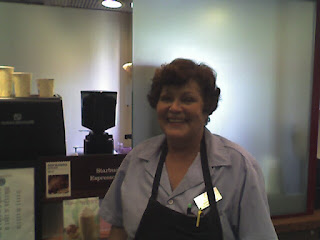
Some time ago I wrote about the Bookmark Cafe, amongst other things. We have been trying out some changes over the last semester with food offerings, extended hours, and new personnel. According to Dining Services these have so far been very successful. A big part of that success is due to Barbara a tireless source of energy, ideas, and good cheer who just makes the students want to come back, spend some time in the cafe, and buy another coffee. As Jim Collins says -- its all about the people. As Gerard Short of Dining Services said, "Barbara seems to have a cult following."
Monday, April 09, 2007
Library of Congress

The Madison Building has this magnificent relief of tumbling (or are they flying?) books above the main doors. I am happy to say that I managed to get all the way through all 64 boxes of unprocessed materials in the ARL collection. Now I just have to digest everything I learnt.
Tuesday, April 03, 2007
Research in the Library of Congress
I am lucky enough to have another week in the Manuscript Reading room of the Library of Congress buried in the ARL archive once again. I am still working my way through the 64 boxes of unprocessed materials, but it is going reasonably quickly this time, since most boxes don’t have anything about copyright in them or cover the period after the passage of the 1976 Act. It is only Tuesday and I have already passed the half way mark on the final collection:
- The Joint Committee’s acceptance of Fisher’s strategy.
- Rutherford Roger’s testimony before the House Subcommittee in 1965.
- The joint ALA/ARL proposed amendment to S597 in 1969
- Joint ALA/ARL proposed amendment to §108 (d) in S1361 and Philip Brown and Stephen McCarthy’s testimony on 7/31/73.
- The ARL response to §108 (g) (2) in 1974.
Sunday, April 01, 2007
Rollins Colloquy
I live in the vain hope that someone may be paying enough attention to this blog to notice the large gap between my March 7th and March 31st posts. My aim is to post two or three times a week (ha!) So what happened?
Well a number of things. Spring break was crazy busy with the librarians' workshop on March 12th when we worked on the Olin Library's strategic directions, then the 13th was spent at St. Leo University with Brent Short , Director of the Library, who I am working with as part of the ACRL College Library Directors Mentor Program, and then I also participated in an online SOLINET workshop on Web 2.0: Social Software Applications for Libraries. More on that later.
Then a couple of weeks after Spring break, Les Lloyd, George Herbst and I went to Tacoma, WA for a NITLE workshop on Learning Spaces and Technology. More on that later as well.
But what really had my attention was the Rollins College Colloquy. I was asked to facilitate a panel with Duane Ackerman, Sally Ride and Anna Deavere Smith and the follow up Q&A. You can imagine this was a little nerve wracking. But it seemed to go off quite well because these three people are consummate professionals with some fascinating experiences and plenty of well articulated thoughts about the future of liberal education in the 21st century. Some of the things that came from them and from other panelists and speakers that most struck me include:
Well a number of things. Spring break was crazy busy with the librarians' workshop on March 12th when we worked on the Olin Library's strategic directions, then the 13th was spent at St. Leo University with Brent Short , Director of the Library, who I am working with as part of the ACRL College Library Directors Mentor Program, and then I also participated in an online SOLINET workshop on Web 2.0: Social Software Applications for Libraries. More on that later.
Then a couple of weeks after Spring break, Les Lloyd, George Herbst and I went to Tacoma, WA for a NITLE workshop on Learning Spaces and Technology. More on that later as well.
But what really had my attention was the Rollins College Colloquy. I was asked to facilitate a panel with Duane Ackerman, Sally Ride and Anna Deavere Smith and the follow up Q&A. You can imagine this was a little nerve wracking. But it seemed to go off quite well because these three people are consummate professionals with some fascinating experiences and plenty of well articulated thoughts about the future of liberal education in the 21st century. Some of the things that came from them and from other panelists and speakers that most struck me include:
- American parochialism in terms of language, geography, and cultural literacy is unacceptable.
- In an age of fluid cultural production and ubiquitous access to (mis)information, some body of shared knowledge, a core curriculum, is necessary.
- The ability of people to critically engage with information, data, and the media, to find, evaluate, and use information in their own work is only going to become more important in an age of disintermediation, and information overload, and technology is not going to solve this problem. Our students need to learn the skills of critical thinking and information literacy.
- At least two speakers mentioned the importance of memorization. Particularly in an age that actively works to enable us to stop using our memories.
- Predictably, C.P. Snow's Two Cultures got a good workout.
- Many of the faculty were very concerned with how to create the conditions in which our students can take risks and learn from failure.
ACRL 3 Usability testing
Perhaps the most interesting session was on usability testing with Nora Dimmock from the University of Rochester. They have a usability program that works with programmers and designers on digital projects. The usability group deals with 5-6 projects each year; new homegrown digital products, evaluating and suggesting changes to vendor products, and revising existing systems. The workshop went through a number of usability techniques including card sorting in which you give 21 users cards with one element from your website in each card (for instance a library website might have journals, books, articles, hours, staff, news, events, ask-a-librarian, departments, and policies) and ask the user to group them in a way that makes sense to them. Also the reverse, when you put flip charts on the wall with headings and ask users to put postit notes with when they would expect to find under each heading on your website for instance. Both these tests reveal the users’ mental model of the service. Heuristics, when you ask expert users, like librarians, to critique a digital product based on specific criteria. This latter one has the added advantage of enabling librarians to have input into web design etc. something that is politically useful since librarians have very strong, but usually conflicting, ideas about website design and like to be consulted. Finally, she took us through assessment, when you have a user complete 5-6 tasks on a website (e.g. "Find a book on fish farming.”) and see where they click and how long it takes them. This can be combined with the Talking Out Loud Protocol in which the subject articulates their thinking while they are working on the task.
Rochester used to then write copious reports on the results of the tests. Now they just record them using Morae and send the file to the designers and programmers.
Oh, one final point. They often save expensive programming and designer time by creating paper mock-ups of the website and having users work through those. This means that big problems can be fixed before it ever gets to the programming stage.
OK, I lied: one more point. In a few years Rochester may not even have a stand alone website. They are considering moving to widgets to be inserted in appropriate places, often at the users discretion, through the users’ personal “infosphere.”
Rochester used to then write copious reports on the results of the tests. Now they just record them using Morae and send the file to the designers and programmers.
Oh, one final point. They often save expensive programming and designer time by creating paper mock-ups of the website and having users work through those. This means that big problems can be fixed before it ever gets to the programming stage.
OK, I lied: one more point. In a few years Rochester may not even have a stand alone website. They are considering moving to widgets to be inserted in appropriate places, often at the users discretion, through the users’ personal “infosphere.”
Saturday, March 31, 2007
ACRL 2 -- librarians and technology
A recent theme in librarianship (recent as in 3 maybe 4 years) is this idea that everything is now different. A combination of digital technology and the so called Net Generation has changed our tradition role. At this point one is usually subjected to a hectoring tirade about how we have to keep up or die. It gets a bit exhausting after a while.
I was subjected to it today at a session called "Keeping Libraries in the Flow: Being Relevant in the World of Amazoogle." The trouble with this is that, like every other generation, this on is not monolithic. Rather than being all digital all the time I find that they are very selective about what technology they use and when. The other problem is the idea that librarians are not adapting to change and seeking new ways of doing things. Obviously this is not true. There are certainly Luddites and curmudgeons in the field but there are also quite forward thinking people and most -- of course -- are like the Net Generation: selective about what technology they use and when.
There were some interesting things that also seemed to be consensus positions:
I was subjected to it today at a session called "Keeping Libraries in the Flow: Being Relevant in the World of Amazoogle." The trouble with this is that, like every other generation, this on is not monolithic. Rather than being all digital all the time I find that they are very selective about what technology they use and when. The other problem is the idea that librarians are not adapting to change and seeking new ways of doing things. Obviously this is not true. There are certainly Luddites and curmudgeons in the field but there are also quite forward thinking people and most -- of course -- are like the Net Generation: selective about what technology they use and when.
There were some interesting things that also seemed to be consensus positions:
- The current model of the "just in case" reference desk is doomed.
- As is the locally maintained catalog
- Librarians must integrate themselves and their services and resources into the educational process.
- Planning needs to speed up and improve.
ACRL
I am at the ACRL Conference. Strange to say this is the first time I have attended so I thought I would record some things. I am going to do this in bits, so expect more of these.
First, at 3000 people it is 10 times smaller than ALA and all academic librarians so I have met lots of friends, far more than I would meet at ALA. I like that.
Sessions, as usual, are a mixed bag but there have been some useful things.
Luz Mangurian, had some helpful things to say from a brain biology perspective about improving learning: emotions matter, show your students you care, sleep is important to memory retention, group learning, interactivity, discussion, and getting them to do the work all really work. We know this, I just wish we practiced it more! The other thing she said that I think is very important is "exclude the irrelevant." I always tell librarian teachers to show a model of success (in using a database etc.) before you get into the possible problems etc. Since she emphasizes the importance of emotion in learning it is no surprise that she describes online education as "the McDonalds of education."
First, at 3000 people it is 10 times smaller than ALA and all academic librarians so I have met lots of friends, far more than I would meet at ALA. I like that.
Sessions, as usual, are a mixed bag but there have been some useful things.
Luz Mangurian, had some helpful things to say from a brain biology perspective about improving learning: emotions matter, show your students you care, sleep is important to memory retention, group learning, interactivity, discussion, and getting them to do the work all really work. We know this, I just wish we practiced it more! The other thing she said that I think is very important is "exclude the irrelevant." I always tell librarian teachers to show a model of success (in using a database etc.) before you get into the possible problems etc. Since she emphasizes the importance of emotion in learning it is no surprise that she describes online education as "the McDonalds of education."
Wednesday, March 07, 2007
Off-campus access

We just made the jump from OneLog to EZproxy to provide off-campus access to our restricted databases for the Rollins community. Back in the fall Steve Kahana, a student and Mac user who was unhappy with OneLog's PC-only solution, promised to donate two books to the Library if we found a way for him to access the databases etc. form off-campus. Here he is making good on his promise.
Incidentally this was a good early experience for us of people from the Library and IT working in a cross-departmental team. It also feels like the first substantial change in library operations that I have been able to help happen since I arrived.
Other comments include, "This is excellent, thanks!" "A big thank you to you from all of us Mac users!!! Thanks so much!!" and "As far as I can tell, this is GREAT, because now I can actually GET ON THESE VARIOUS D-BASES from off campus, which I could not do before!"
Thursday, March 01, 2007
Power in the 21st Century Library

No, this is not some arcane discussion of Foucault, knowledge, and information services in the post-modern world. I really mean power. Regular readers (in the vain hope that there might be such people) will remember that I wrote some time ago about transforming the experience of entering the library. I am delighted to say that many of these ideas have been taken up by the administration. Facilities installed power outlets on the loggia in anticipation of the imminent arrival of furniture. The idea is that if you put rocking chairs and power in such a delightful location then students will begin to linger there, meet their friends, and use the wireless network. Well it seems two at least can't wait until the furniture arrives, simply adding power is enough.
Thus the issue of power. We used to think that what we needed to do when building a new library was put as many network jacks in as many places as we possibly could. We were wrong. Wireless has become ubiquitous, but battery power is still a precious resource. Have you noticed the cluster of salespeople around power outlets in airport waiting rooms, like zebra mussels around an warm water outlet? Well students exhibit the same behavior in libraries and other academic buildings. So my mantra (at least until someone develops a reasonable wireless power solution) is put power everywhere.
Subscribe to:
Posts (Atom)


